
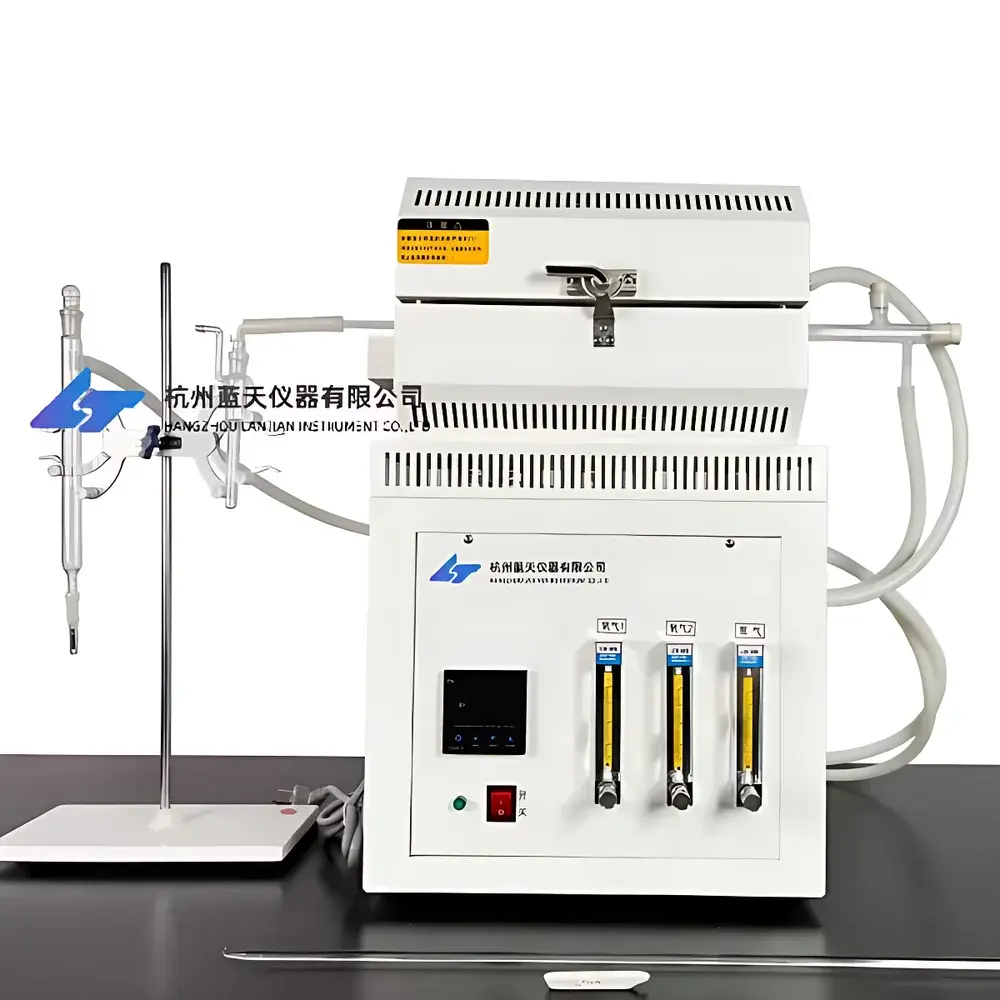
LANTIAN AOX-C Integrated Combustion Furnace System for Adsorbable Organic Halogens (AOX) Analysis per HJ/T 83–2001
| Brand | LANTIAN |
|---|---|
| Origin | Zhejiang, China |
| Manufacturer Type | Direct Manufacturer |
| Product Category | Domestic Instrument |
| Model | AOX-C |
| Compliance | HJ/T 83–2001, ISO 9562:1989, GB/T 15959–1995 |
| Detection Method | Ion Chromatography (IC) of Inorganic Halides (Cl⁻, F⁻, Br⁻) after High-Temperature Combustion |
| Sample Matrix | Water (drinking, surface, groundwater, wastewater, seawater, treated effluent), sludge, sediment, soil, and waste oils |
| Key Components | Integrated furnace with built-in scrubbing system, quartz combustion tube, dual-zone oxygen supply, nitrogen-pressurized adsorption module, IC-compatible absorption train |
Overview
The LANTIAN AOX-C Integrated Combustion Furnace System is an engineered solution for the quantitative determination of Adsorbable Organic Halogens (AOX) in environmental matrices, fully aligned with the Chinese national standard HJ/T 83–2001 *Water Quality — Determination of Adsorbable Organic Halogens (AOX)*. It implements a validated two-stage analytical protocol: first, selective adsorption of organic halogenated compounds onto activated carbon under controlled nitrogen pressure; second, high-temperature pyrolytic conversion (≥950 °C) of adsorbed organohalogens into inorganic hydrogen halides (HCl, HF, HBr), followed by alkaline absorption and quantification via ion chromatography (IC). Unlike microcoulometric methods (e.g., GB/T 15959–1995), this system enables speciated analysis—simultaneous quantification of adsorbable organic chlorine (AOCl), organic fluorine (AOF), and organic bromine (AOBr)—all reported as halide equivalents (µg Cl⁻/L or µg X⁻/L). The furnace architecture features precise dual-oxygen gas zoning (inner tube for sample combustion, outer tube for soot oxidation), integrated acid-gas scrubbing, and thermally stable quartz components to ensure complete mineralization and minimal interferences from sulfur or nitrogen species.
Key Features
- Integrated combustion furnace with built-in multi-stage scrubbing system to remove SO₂, NOₓ, and CO₂ prior to absorption, minimizing IC column contamination and baseline drift.
- Dual-zone oxygen delivery system: independent flow control for inner combustion zone (≥950 °C) and outer oxidation zone (≥750 °C), ensuring complete conversion of refractory organohalogens and carbonaceous residue.
- Nitrogen-pressurized adsorption module with calibrated pressure regulation (0.1–0.3 MPa), enabling reproducible, matrix-independent adsorption kinetics across diverse water types—including saline, turbid, and high-DOC samples.
- Quartz combustion tube and sample boat assembly rated for continuous operation up to 1000 °C; includes quartz push rod and heat-resistant rubber end caps for safe, repeatable sample loading.
- Modular absorption train comprising two series-connected absorption tubes (10 mL each) filled with 0.1 mol/L NaOH, mounted on dedicated fixed brackets to prevent leakage and ensure consistent gas residence time.
- Pre-configured gas tubing kit (15 mm OD silicone tubing, total length 1.27 m) with segment-specific lengths optimized for pressure drop minimization and leak-tight connections between N₂ source, adsorption column, furnace, and absorbers.
Sample Compatibility & Compliance
The AOX-C system supports solid and liquid environmental samples per HJ/T 83–2001, including raw and treated wastewater, surface and groundwater, drinking water, seawater, industrial effluents, pulp mill discharges, soil slurries, sediments, sludges, and waste oils. All operational parameters—including adsorption volume (25–500 mL), carbon mass (100–500 mg), combustion temperature profile, and absorption efficiency—are traceable to documented validation protocols compliant with ISO/IEC 17025 requirements. The method satisfies data quality objectives outlined in ISO 9562:1989 and is compatible with GLP-aligned laboratory workflows. While not intrinsically 21 CFR Part 11–compliant (as it interfaces externally with IC systems), full audit trails, calibration logs, and raw absorption solution handling records can be maintained manually or integrated into LIMS platforms supporting electronic signatures.
Software & Data Management
The AOX-C is a hardware-only platform designed for seamless integration with commercially available ion chromatography systems (e.g., Thermo Fisher Dionex, Metrohm 940 Professional IC). No proprietary software is embedded; instead, instrument operation follows standardized SOPs for adsorption, combustion, and absorption. All critical process parameters—N₂ pressure, furnace temperature ramp rates, oxygen flow rates, and absorption timing—are manually logged or recorded via external digital loggers. Absorption solutions are analyzed using validated IC methods with certified reference standards (e.g., NIST SRM 3183 for Cl⁻/F⁻/Br⁻ mixtures). Quantitative results are calculated using external calibration curves with R² ≥ 0.999, detection limits typically < 1.5 µg/L as Cl⁻ (based on 100 mL sample volume and 10 µL IC injection).
Applications
This system is routinely deployed in municipal and industrial wastewater treatment plants for regulatory AOX monitoring under discharge permits; in drinking water utilities assessing disinfection by-product formation potential; in pulp and paper laboratories evaluating bleaching process efficiency; and in environmental testing labs conducting contaminated site assessments (soil/sediment leachates). Its ability to speciate AOCl, AOF, and AOBr supports forensic analysis of halogenated pollutant sources—e.g., distinguishing chlorinated pesticide residues from brominated flame retardants in landfill leachate. The robust adsorption-combustion-IC workflow also serves as a reference method for method validation studies supporting ISO/IEC 17025 accreditation.
FAQ
What standards does the AOX-C system comply with?
It is fully configured to meet HJ/T 83–2001, and its operational principles align with ISO 9562:1989 and GB/T 15959–1995.
Can the system quantify individual halogen species (Cl, F, Br)?
Yes—when coupled with a multi-anion IC system, it enables simultaneous quantification of Cl⁻, F⁻, and Br⁻ in the absorption solution, allowing calculation of AOCl, AOF, and AOBr separately.
Is operator training included with purchase?
Yes—on-site installation support and hands-on method training for sample preparation, adsorption setup, combustion cycle execution, absorption handling, and QC checks are provided by LANTIAN-certified field application specialists.
What maintenance is required for long-term reliability?
Routine inspection of quartz components for thermal stress cracks, replacement of silicone tubing every 6 months, annual calibration of pressure regulators and oxygen flow meters, and periodic verification of scrubber reagent efficacy (e.g., H₂O₂ + NaOH for SO₂ removal).
Does the system support automated sample throughput?
No—it is a manual batch-processing system optimized for precision over speed; however, up to 6 samples can be prepared in parallel using the supplied dual adsorption kits and standardized glassware.
Related Products







