
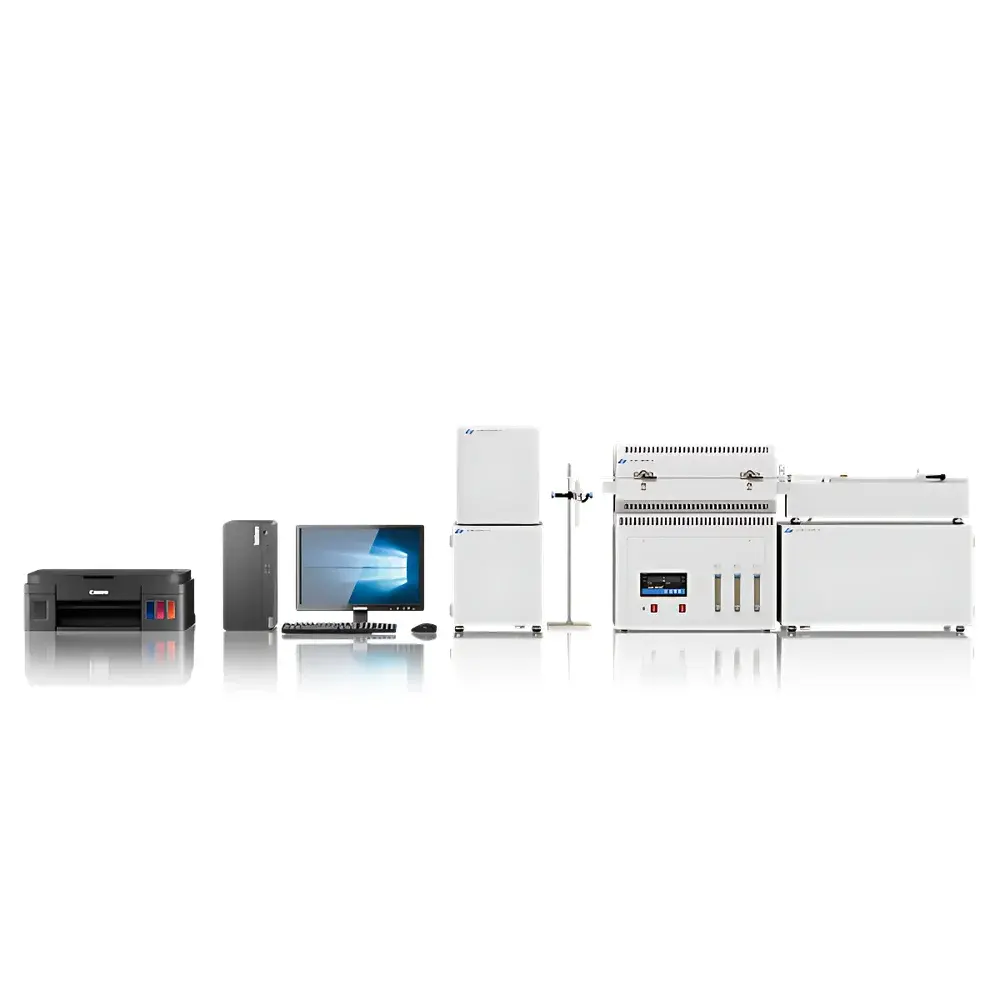
LANTIAN AOX-WK-S Microcoulometric Analyzer for Adsorbable Organic Halogens (AOX) per HJ 1214–2021
| Brand | LANTIAN |
|---|---|
| Origin | Zhejiang, China |
| Manufacturer Type | Direct Manufacturer |
| Model | AOX-WK-S |
| Compliance Standard | HJ 1214–2021 |
| Detection Principle | Microcoulometric Titration |
| Max Generator Current | ±2 mA |
| Amplifier Output Voltage | ±30 V |
| Bias Voltage Range | 0–500 mV (continuously adjustable) |
| Detection Limit | 0.007 mg/L (at 100 mL sample volume) |
| Optimal Measurement Range (as Cl) | 0.02–2 mg/kg |
| Accuracy | ≤10% relative deviation (at 1 µg Cl) |
| Repeatability | ≤10% RSD (for samples ≤2 mg/L) |
| Activated Carbon Dosage | 50 mg ±5 mg |
| Combustion Temperature Range | 500–1100 °C (±1 °C control accuracy) |
| Power Supply | AC 220 V ±10%, 50 Hz ±0.5 Hz |
| Rated Power | 3000 W |
Overview
The LANTIAN AOX-WK-S Microcoulometric Analyzer is a dedicated instrumental system engineered for the quantitative determination of Adsorbable Organic Halogens (AOX) in aqueous environmental matrices, fully compliant with the People’s Republic of China National Ecological and Environmental Standard HJ 1214–2021: “Determination of Adsorbable Organic Halogens (AOX) in Water—Microcoulometric Method.” The instrument operates on the principle of high-temperature catalytic combustion followed by microcoulometric titration. In this process, halogenated organic compounds are adsorbed onto activated carbon, thermally decomposed at precisely controlled temperatures (500–1100 °C) in an oxygen-rich quartz combustion tube, and converted to hydrogen halides (e.g., HCl). These gaseous halides are swept into a silver coulometric titration cell, where electrochemical quantification occurs via controlled-current electrolysis of Ag⁺ ions. The charge consumed during titration is directly proportional to the halogen mass, enabling trace-level quantification with high reproducibility and minimal matrix interference.
Key Features
- Integrated dual-module architecture comprising a high-precision microcoulometric titration unit and a programmable high-temperature combustion furnace (500–1100 °C, ±1 °C stability), ensuring complete mineralization of refractory AOX species.
- Automated bias voltage adjustment (0–500 mV, continuously variable) and real-time current feedback control (±2 mA generator range) optimize signal-to-noise ratio across low- and mid-concentration ranges.
- Dedicated hardware design for HJ 1214–2021 compliance: includes calibrated 50 mg ±5 mg activated carbon dosing, standardized quartz sample cups, and nitrogen-purged, moisture-scavenging gas pathways with integrated desiccant and adsorption traps.
- Robust electromechanical interface: DB9 RS-232 communication port enables direct data logging and remote parameter configuration from Windows-based host software; no third-party drivers required.
- Self-contained thermal management with overtemperature cut-off and redundant safety interlocks, meeting IEC 61010-1 requirements for laboratory electrical equipment.
Sample Compatibility & Compliance
The AOX-WK-S is validated for use with surface water, groundwater, domestic wastewater, and industrial effluents—samples requiring pre-filtration through chlorine-free filter paper and adsorption onto activated carbon under standardized pH and contact time conditions as specified in HJ 1214–2021. Sample volumes range from 10 to 100 mL, with corresponding detection limits down to 0.007 mg/L (Cl-equivalent) at full-volume loading. All wetted components—including quartz combustion tubes, silver/silver chloride electrodes, and PTFE-sealed titration cells—are chemically inert and resistant to halogen-induced corrosion. While HJ 1214–2021 is the primary regulatory reference, method principles align with ISO 9562 and ASTM D5808 for comparative validation studies. The system supports GLP-compliant audit trails when paired with timestamped data export and manual logbook documentation.
Software & Data Management
Controlled via native Windows application, the AOX-WK-S software provides a deterministic workflow interface with real-time visualization of generator current, bias voltage, titration endpoint, and cumulative charge (in Coulombs). All analytical parameters—including combustion temperature ramp profiles, carrier gas flow verification logs, and calibration curve coefficients—are stored with metadata (date/time, operator ID, sample ID). Data output conforms to CSV and PDF formats for long-term archival; printed reports include instrument ID, calibration status, and raw titration curves. The software does not implement FDA 21 CFR Part 11 electronic signature functionality but supports manual validation protocols for regulated laboratories conducting internal quality assurance or environmental monitoring under local accreditation schemes (e.g., CNAS).
Applications
- Regulatory monitoring of AOX discharge limits in municipal and industrial wastewater treatment plants per Chinese environmental discharge standards.
- Process validation of chlorine-based disinfection systems and chlorination/dechlorination efficiency studies in drinking water facilities.
- Environmental impact assessment of pulp and paper mills, pesticide manufacturing sites, and pharmaceutical production units where organohalogen byproducts are potential contaminants.
- Research applications in environmental chemistry, including speciation studies of adsorbed vs. dissolved AOX fractions and kinetic modeling of halogen release during thermal decomposition.
FAQ
What is the minimum detectable AOX concentration using the AOX-WK-S?
At a 100 mL sample volume and optimal combustion/titration conditions, the practical detection limit is 0.007 mg/L expressed as chlorine.
Is the system compatible with international standards such as ISO 9562 or ASTM D5808?
While designed and verified for HJ 1214–2021, the underlying microcoulometric combustion methodology is fundamentally consistent with ISO 9562 and ASTM D5808; cross-validation studies may be performed using certified reference materials.
Does the instrument require external gas supply?
Yes: high-purity oxygen (≥99.995%) is required for combustion, and nitrogen (≥99.99%) serves as carrier and purge gas; both must be supplied via regulated gas cylinders with appropriate pressure-reducing valves.
Can the AOX-WK-S be operated without the included PC and printer?
No—the Windows-based control software is mandatory for instrument initialization, parameter setting, real-time monitoring, and data acquisition; standalone operation is not supported.
What maintenance routines are recommended for sustained accuracy?
Daily: electrode cleaning with deionized water and ethanol; weekly: replacement of desiccant in drying tubes and inspection of quartz combustion tube integrity; quarterly: recalibration using potassium hydrogen phthalate (KHP) or certified AOX standards.






