
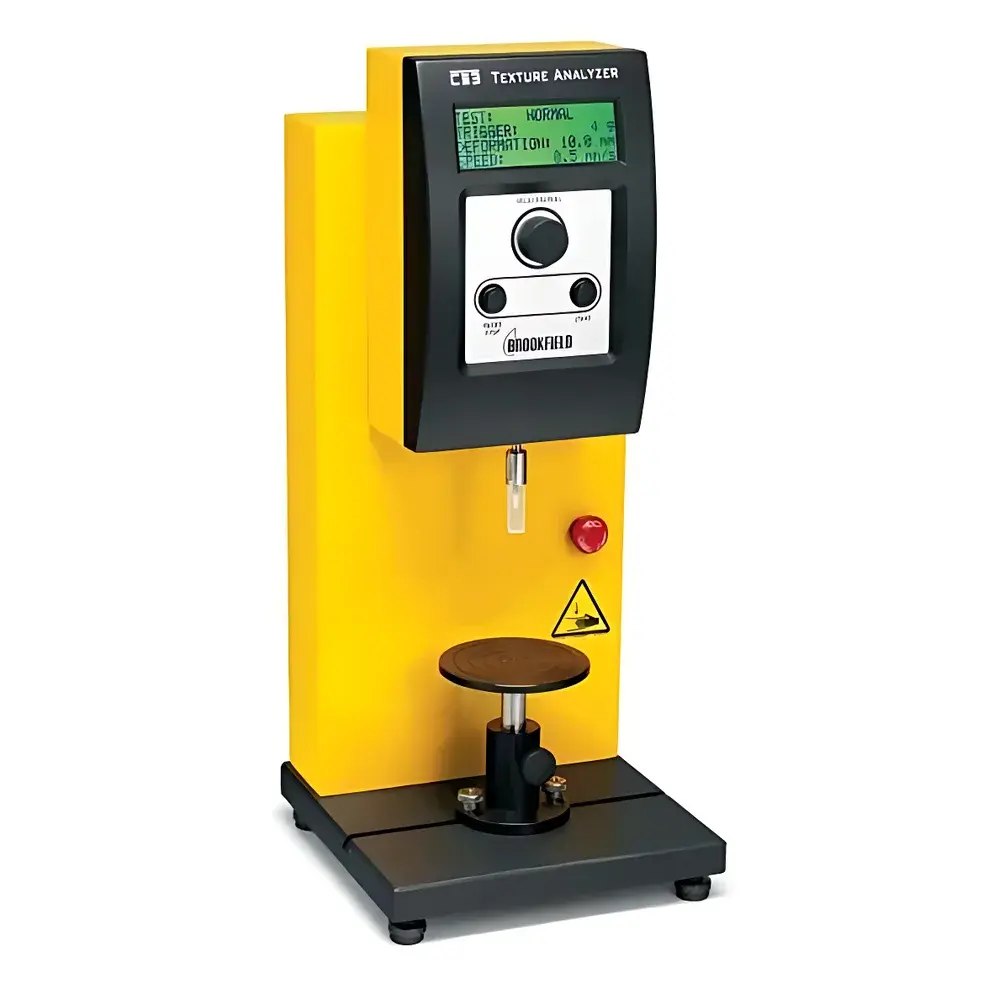
Brookfield CT3 Texture Analyzer
| Brand | Brookfield |
|---|---|
| Origin | USA |
| Model | CT3 |
| Load Capacity Options | 100 g, 1000 g, 1500 g, 4500 g, 10 kg, 25 kg, 50 kg |
| Force Resolution | 0.01–5.0 g (model-dependent) |
| Speed Range | 0.01–10 mm/s (two precision ranges) |
| Position Range | 0–101.6 mm |
| Position Resolution | 0.1 mm (0.01 mm with TexturePro CT software) |
| Accuracy | ±0.5% FSR (load), ±0.1% (speed), ±0.1 mm (position) |
| Compliance | ASTM, ISO, AOAC, AACC, BS 757:1975, GB 6783–1994, USP <1160> |
| Test Modes | Compression, Tension, Bloom, TPA, Hold Time, Cycle Count, Static Load, Surimi |
| Connectivity | USB |
| Software | TexturePro CT (for advanced analysis), Texture Loader (for offline program deployment) |
Overview
The Brookfield CT3 Texture Analyzer is a dedicated mechanical testing instrument engineered for precise, objective quantification of textural properties across food, pharmaceutical, personal care, and industrial material applications. It operates on the principle of controlled uniaxial compression or tension, applying a calibrated force via motor-driven probe movement while simultaneously recording load vs. displacement data in real time. Unlike sensory evaluation, the CT3 eliminates subjective bias by delivering repeatable, traceable, and standardized measurements—making it an essential tool for quality control, product development, and regulatory compliance. Designed as the direct successor to the QTS-25 and LFRA systems, the CT3 maintains full mechanical and accessory compatibility while introducing enhanced modularity, expanded load capacity (up to 50 kg), and improved positional resolution (0.01 mm when paired with TexturePro CT software). Its architecture conforms to GLP/GMP-aligned workflows, supporting audit-ready data capture and instrument calibration verification per ISO/IEC 17025 and FDA 21 CFR Part 11 requirements when used with validated software configurations.
Key Features
- Seven interchangeable load cell options (100 g to 50 kg), each optimized for resolution and linearity within its range (e.g., CT3-1000: 0.01 g resolution; CT3-50kg2: 5.0 g resolution)
- Dual-mode operation: programmable compression and tension testing with independent speed profiles (0.01–10 mm/s in two precision bands)
- Extended vertical travel: 101.6 mm stroke enables analysis of tall or layered samples up to 225 mm in height
- Modular base platform options: rotating circular stage for rotational symmetry tests (e.g., spreadability, extrusion), or square fixture plate for rigid夹具 mounting
- Integrated temperature monitoring interface (optional external temperature sensor module, requires TexturePro CT software integration)
- USB 2.0 connectivity for real-time data streaming, remote control, and firmware updates
- Texture Loader utility: enables offline programming and storage of up to 10 preconfigured test methods directly onto the instrument’s internal memory for standalone operation—no PC required during routine QC
- Standardized test method library: includes AOAC-compliant Bloom gel strength, AACC-approved dough firmness, USP -aligned tablet hardness, and ISO 11357-based viscoelastic recovery protocols
Sample Compatibility & Compliance
The CT3 accommodates heterogeneous sample geometries—from soft gels and viscous creams to rigid tablets and elastomeric polymers—via over 50 validated probe and fixture configurations. Standard accessories include cylindrical probes (P/2, P/36), Warner–Bratzler blades, Kramer shear cells, and back-extrusion plates—all mechanically and dimensionally consistent with legacy QTS-25/LFRA systems. Custom probe design services are available for non-standard matrices (e.g., fibrous meat analogs, aerated confectionery, or hydrogel wound dressings). All measurement protocols align with internationally recognized standards: AOAC Official Method 955.02 (gelatin Bloom), ISO 11357-3 (thermomechanical behavior), BS 757:1975 (jelly strength), AACC 74-09 (biscuit fracture), and GB/T 6783–2013 (food gelatin). Instrument validation documentation supports IQ/OQ/PQ execution per GMP Annex 15 guidelines.
Software & Data Management
TexturePro CT software (Windows-based) provides full control, real-time visualization, and post-test analysis—including second-derivative peak detection, hysteresis loop calculation, and TPA parameter extraction (hardness, cohesiveness, springiness, chewiness, adhesiveness). Raw force–distance data exports in CSV, Excel, and XML formats for LIMS integration or statistical process control (SPC) platforms. The software enforces user role-based access, electronic signatures, and immutable audit trails compliant with 21 CFR Part 11 Subpart B. Texture Loader operates independently to deploy validated methods to the CT3’s embedded controller—ensuring method integrity across shifts and operators without network dependency. Calibration logs, probe identification tags, and environmental metadata (e.g., ambient temperature if monitored) are automatically appended to each dataset.
Applications
- Food Science: Gel strength (Bloom), crumb firmness (bread), snap force (chocolate), spreadability (butter), chewiness (meat analogs), crispness (snacks), and syneresis resistance (yogurt)
- Pharmaceuticals: Tablet hardness (USP ), capsule shell elasticity, ointment extrudability, and hydrogel swelling kinetics
- Personal Care: Lipstick breakage torque, mascara film flexibility, foundation tackiness, and soap lather stability
- Materials Engineering: Adhesive peel strength, rubber modulus, asphalt penetration depth, and foam compression set
FAQ
Is the CT3 compliant with FDA 21 CFR Part 11 for electronic records?
Yes—when operated with validated TexturePro CT software v4.0+, the system supports audit trails, electronic signatures, and role-based permissions required for regulated environments.
Can I use my existing QTS-25 probes and fixtures with the CT3?
Yes—mechanical mounting interfaces, probe shanks, and fixture clamping mechanisms are fully backward-compatible.
What is the minimum detectable force resolution across models?
The CT3-1000 achieves 0.01 g resolution at 100 g full scale; higher-capacity models trade resolution for range (e.g., CT3-50kg2: 5.0 g resolution at 50 kg full scale).
Does the CT3 support temperature-controlled testing?
An optional temperature display module (TDM-CT3) provides real-time ambient or surface temperature readout; active temperature control requires external environmental chambers synchronized via TTL triggers.
How many test programs can be stored internally for standalone operation?
Up to 10 fully parameterized methods may be downloaded and executed directly from the CT3’s onboard memory using Texture Loader.
Related Products







