
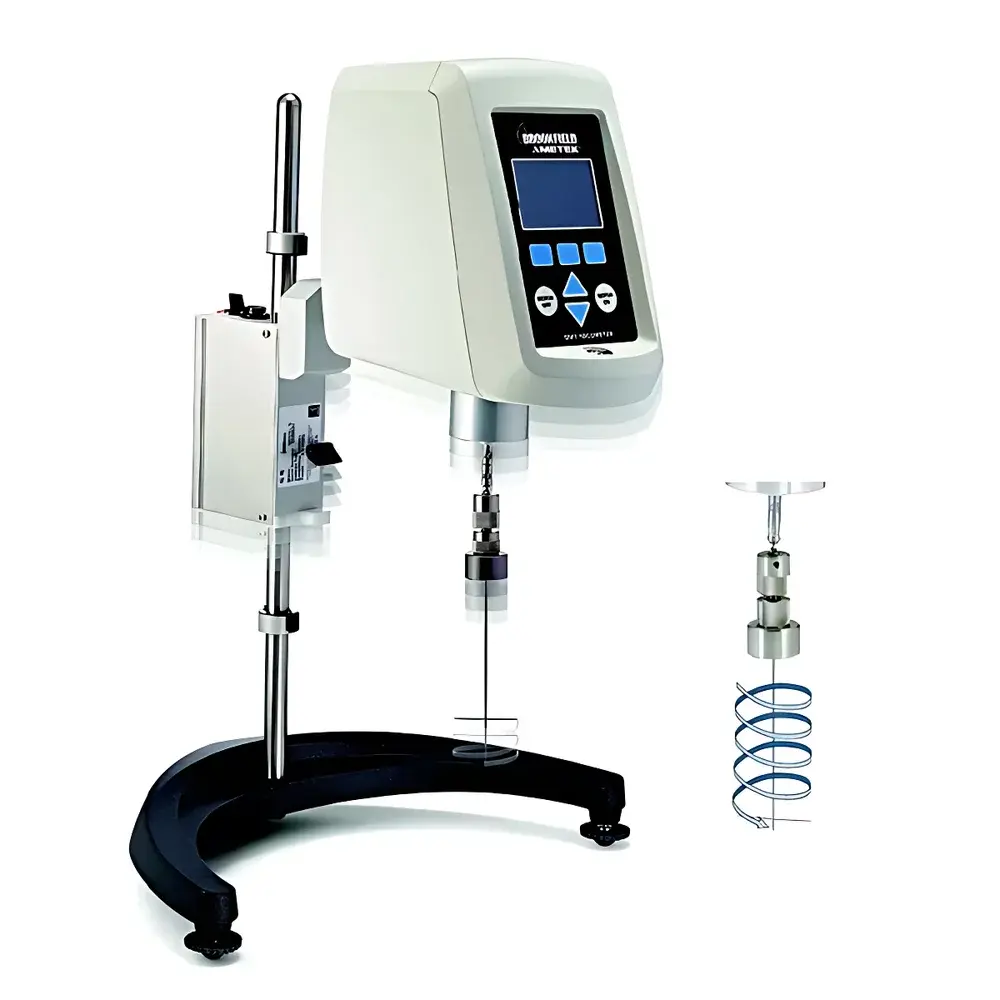
Brookfield Helipath T-Bar Vertical Traverse Stand
| Brand | Brookfield |
|---|---|
| Origin | USA |
| Model | Helipath |
| Application | Vertical traverse accessory for rheological characterization of yield-stress and structured materials |
| Compatibility | Designed for Brookfield DV series viscometers (DVLV, DVM, DV2T, DV3T) and DVNext Advanced Rotational Rheometers |
| Drive Mechanism | Motorized bidirectional vertical translation |
| Motion Profile | Continuous helical path generation via synchronized vertical displacement and instrument rotation |
| Transducer Interface | Standard Brookfield quick-coupling spindle mount |
| Included Components | Helipath stand, T-bar spindle adapter, optional T-bar spindle set (6 sizes) |
| Operating Speed Range | 0.1–20 rpm (instrument-dependent) |
| Viscosity Range (typical, at 0.1 rpm) | LV: 156–3.12×10⁶ cP |
| RV | 2×10³–2×10⁷ cP |
| HA | 4×10³–4×10⁷ cP |
| HB | 1.6×10⁴–1.6×10⁸ cP |
| Units | cP (mPa·s) |
Overview
The Brookfield Helipath T-Bar Vertical Traverse Stand is an engineered mechanical accessory designed to extend the measurement capability of rotational viscometers and rheometers to materials exhibiting yield stress, structural breakdown, and time-dependent flow behavior—such as gels, pastes, creams, putties, waxes, and highly filled suspensions. Unlike conventional coaxial cylinder or cone-plate geometries, which rely on steady-state shear within a fixed gap, the Helipath introduces controlled vertical translation synchronized with instrument rotation. This generates a continuous helical trajectory of the T-bar spindle through the sample volume, ensuring that each measurement point engages fresh, undisturbed material. By eliminating wall slip, cavity formation, and localized structural degradation—common artifacts in yield-stress media—the Helipath enables reproducible quantification of apparent viscosity, yield stress estimation, and structural recovery kinetics under defined shear history.
Key Features
- Motor-driven bidirectional vertical traverse mechanism with programmable stroke length and dwell time
- Integrated synchronization with Brookfield DV-series and DVNext instruments via analog torque and speed feedback loops
- Standard T-bar spindle adapter compatible with all Brookfield viscometer spindles and DVNext modular transducers
- Modular T-bar spindle set (six standardized diameters: T-0, T-1, T-2, T-3, T-4, T-5) for scalable shear rate coverage across viscosity ranges
- Robust aluminum alloy frame with precision linear guide rails and low-backlash timing belt drive for positional repeatability ±0.1 mm
- No-tool installation: Mounts directly onto Brookfield instrument base plate using factory-specified alignment pins and locking screws
- Compliant with ISO 2555, ASTM D1091, and USP <911> guidelines for consistency testing of semisolids
Sample Compatibility & Compliance
The Helipath excels where traditional geometries fail—particularly with heterogeneous, particle-laden, or thermally sensitive systems prone to segregation or surface drying. It accommodates samples from 15 mL to 500 mL in standard Brookfield sample cups or custom cylindrical containers (ID ≥ 38 mm). Its non-invasive penetration profile avoids pre-shearing artifacts, making it suitable for GLP-compliant QC laboratories performing batch release testing per FDA 21 CFR Part 11 requirements. Data integrity is preserved through hardware-level audit trail logging when paired with DV3T or DVNext instruments equipped with firmware v4.2+. The system supports validation protocols aligned with ISO/IEC 17025:2017 for accredited testing laboratories.
Software & Data Management
When used with Brookfield’s Rheo3000 or PC-based ViscoQC software (v5.0+), the Helipath enables automated multi-cycle testing sequences—including ramp-and-hold vertical displacement profiles, oscillatory vertical sweeps, and time-sweep routines with real-time torque, speed, and position logging at 10 Hz resolution. All raw data files (.bvr format) include embedded metadata: instrument serial number, spindle ID, temperature (when connected to optional TC-502 probe), and Helipath motion parameters. Export options include CSV, Excel, and PDF reports compliant with 21 CFR Part 11 electronic signature and audit trail requirements. Custom scripting via COM interface allows integration into LIMS environments.
Applications
- Yield stress estimation of pharmaceutical ointments and topical gels per USP <911>
- Structural stability assessment of cosmetic creams during accelerated aging studies
- Quality control of architectural sealants and caulking compounds per ASTM C920
- Rheological fingerprinting of lithium grease formulations under low-shear conditions
- Process validation of food pastes (e.g., tomato concentrate, nut butters) for pumpability and spreadability
- Research into thixotropic recovery kinetics in battery electrode slurries and ceramic suspensions
FAQ
What distinguishes the Helipath method from standard vane or parallel-plate yield stress measurements?
The Helipath applies a defined vertical displacement while rotating, generating a true volumetric shear history rather than localized interfacial failure. This yields higher reproducibility for heterogeneous systems where vane geometry may overestimate yield due to particle bridging.
Can the Helipath be used with non-Brookfield rheometers?
No—it requires proprietary analog signaling and mechanical coupling interfaces specific to Brookfield DV-series and DVNext platforms. Third-party integration is not supported.
Is calibration traceable to NIST standards?
Yes. Torque calibration is performed using Brookfield-certified reference oils traceable to NIST SRM 2561 and SRM 2562. Vertical displacement accuracy is verified with laser interferometry per ISO 17025-accredited procedures.
How does temperature control integrate with the Helipath setup?
The Helipath stand is fully compatible with Brookfield TC-502 Peltier-controlled bath systems and external circulating baths (e.g., Julabo F25). Temperature data is logged synchronously with rheological parameters in ViscoQC software.
What maintenance is required for long-term reliability?
Annual inspection of timing belt tension and linear rail lubrication (per Brookfield Service Bulletin SB-HL-2023) is recommended. No user-serviceable electronics are present; all motor drivers and position encoders are sealed and warrantied for 36 months.



