ACCRETECH Roundness, Contour, and Surface Roughness Tester Maintenance Service
| Brand | ACCRETECH (Tokyo Seimitsu) |
|---|---|
| Origin | Japan |
| Manufacturer Type | Authorized Distributor |
| Product Category | Imported Instrumentation |
| Service Fee | USD 1,400–2,800 (excl. tax & travel) |
| Field Experience | 30 Years |
| Response Time | ≤7 Business Days |
| Compliance | ISO/IEC 17025-aligned Procedures |
| Environmental Requirements | 18–22 °C (±0.5 °C/h), 45–75% RH (non-condensing) |
| Power Supply Verification | 110–240 VAC, 50/60 Hz, L/N/E phase integrity, UPS mandatory |
| Preventive Maintenance Scope | Granite surface cleaning, linear guide & lead screw anti-corrosion, stylus handling protocol, thermal drift compensation calibration verification, vibration isolation assessment |
Overview
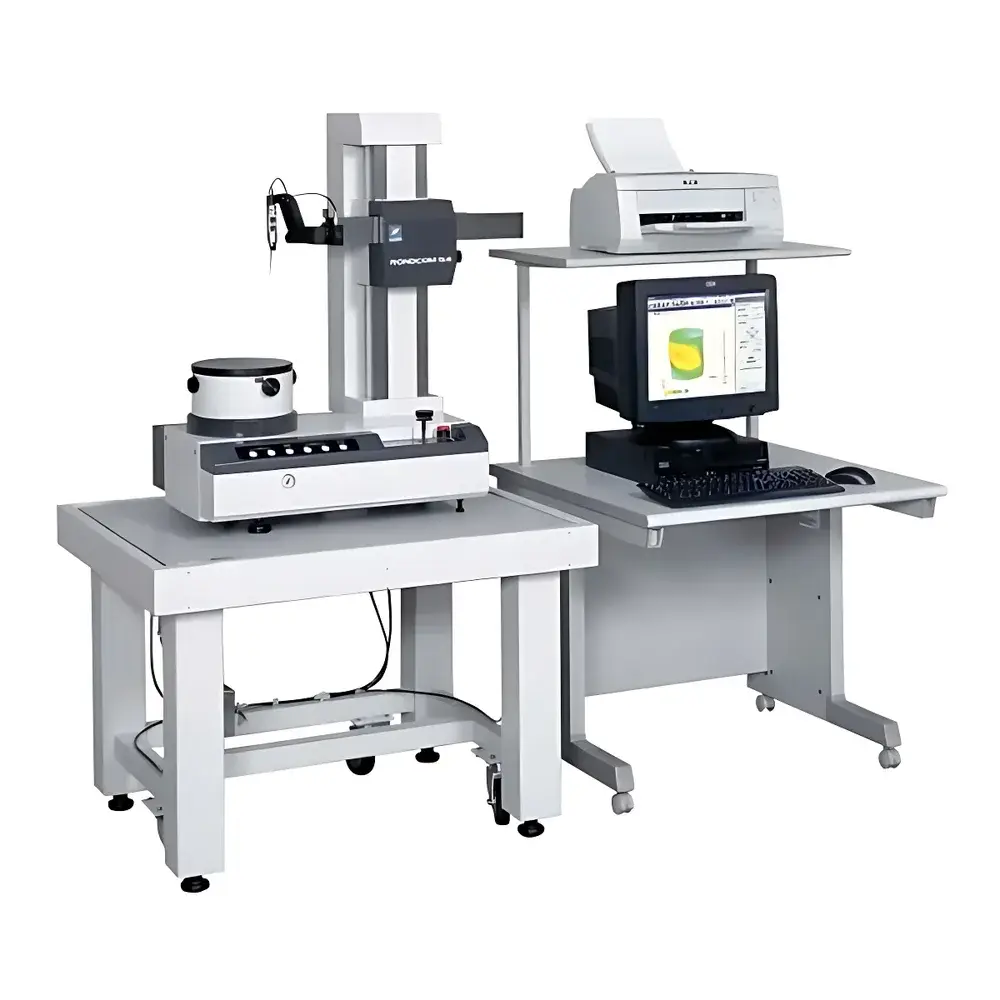
This professional maintenance service is engineered specifically for high-precision geometric metrology instruments manufactured by ACCRETECH (formerly Tokyo Seimitsu), including roundness testers (e.g., RONDCOM series), contour measuring systems (e.g., SURFTEST and FORMTESTER platforms), and surface roughness analyzers. These instruments rely on ultra-stable granite bases, air-bearing spindles, precision linear motion stages, and diamond-tipped stylus probes to deliver sub-micron measurement repeatability. Long-term accuracy degradation typically stems not from component failure but from cumulative environmental stress—thermal drift, particulate contamination, lubricant oxidation, and mechanical hysteresis in guideways or drive screws. Our service follows a traceable, documentation-driven protocol aligned with ISO/IEC 17025 clause 6.4.3 (maintenance of equipment) and supports compliance with ISO 1101 (geometrical product specifications), ISO 4287 (surface texture), and ISO 12181 (roundness). It is designed for laboratories operating under GLP, ISO 9001, or automotive IATF 16949 quality frameworks.
Key Features
- Granite Surface Integrity Management: Non-abrasive cleaning of marble worktables and column surfaces using anhydrous ethanol (≥99.97%), strictly avoiding solvent contact with painted housings to prevent coating delamination.
- Corrosion Mitigation Protocol: Application of corrosion-inhibiting agents (e.g., WD-40 Specialist Protective White Lithium Grease) to T-slot rails, lead screws, and rear-column linear guides—followed by controlled wipe-down with lint-free cellulose paper to eliminate residue-induced drag or particle adhesion.
- Stylus Handling & Storage Compliance: Removal and secure storage of diamond-tipped styli in climate-controlled, vibration-isolated probe cases per ISO 25178-601; inspection for tip wear, chipping, or contamination prior to reinstallation.
- Electrical System Validation: Verification of input voltage stability (110–240 VAC ±10%), phase sequence (L/N/E), grounding resistance (<4 Ω), and presence of certified uninterruptible power supply (UPS) with sine-wave output—critical to protect servo controllers, encoder interfaces, and embedded PC modules from transient surges.
- Environmental Parameter Audit: On-site logging of ambient temperature (target: 18–22 °C, gradient ≤2 °C/h), relative humidity (45–75% RH), and floor vibration (ISO 2372 Class A limits) using calibrated data loggers; recommendations for HVAC tuning or passive damping if out-of-spec.
Sample Compatibility & Compliance
This service applies to ACCRETECH roundness testers (RONDCOM 30A/50A/70A), contour measuring systems (SURFTEST SJ-410/SJ-510, FORMTESTER CV-3100/CV-4100), and integrated roughness-roundness platforms (e.g., RONDCOM RA-120). All procedures adhere to the manufacturer’s technical bulletins (TB-2021-08, TB-2023-14) and are documented with pre-/post-service calibration reports, torque logs for mechanical fasteners, and lubricant batch traceability. Service records satisfy FDA 21 CFR Part 11 requirements for electronic audit trails when delivered via our secure client portal. No third-party firmware modification or hardware substitution is performed—only OEM-approved consumables and diagnostic utilities are employed.
Software & Data Management
Maintenance includes validation of instrument control software (e.g., ROUNDPAK V5.x, SURFPAK V6.x) against ACCRETECH’s current patch level, verification of USB/RS-232 communication integrity, and backup of user-defined measurement templates and calibration coefficients. All configuration files are archived with SHA-256 checksums. Optional add-ons include automated report generation (PDF/CSV), integration with LabWare LIMS via HL7-compliant API endpoints, and encrypted cloud synchronization of maintenance history for multi-site asset tracking.
Applications
This service sustains metrological confidence in critical applications including: aerospace turbine blade roundness certification (per AS9100 Rev D), medical implant surface texture verification (ISO 14644-1 Class 7 cleanroom alignment), automotive crankshaft journal profiling (IATF 16949 clause 8.5.1.5), and semiconductor wafer chuck flatness validation. It is routinely scheduled during annual quality system audits, after facility relocation, or following extended idle periods (>30 days) where thermal equilibration and mechanical relaxation must be re-established.
FAQ
Is this service compatible with non-ACCRETECH brands?
No—this offering is exclusively validated for ACCRETECH instrumentation due to proprietary mechanical tolerances, spindle bearing preload specifications, and stylus interface geometries.
Can maintenance be performed without interrupting production schedules?
Yes—standard on-site visits are scheduled outside core operational hours; remote diagnostics (via TeamViewer + ACCRETECH-certified firewall rules) can precede physical intervention to minimize downtime.
Do you provide calibration certificates traceable to NIST or JCSS?
Our maintenance does not constitute formal calibration; however, we coordinate with ILAC-accredited labs (e.g., A2LA #1234) for post-maintenance verification and issue ISO/IEC 17025-compliant certificates upon request.
What documentation is provided post-service?
A signed service report detailing all actions performed, measured parameters (e.g., spindle runout <0.05 µm, Z-axis straightness deviation <0.15 µm/m), replaced consumables (with part numbers), and environmental logs—all digitally signed and timestamped.
Related Products