
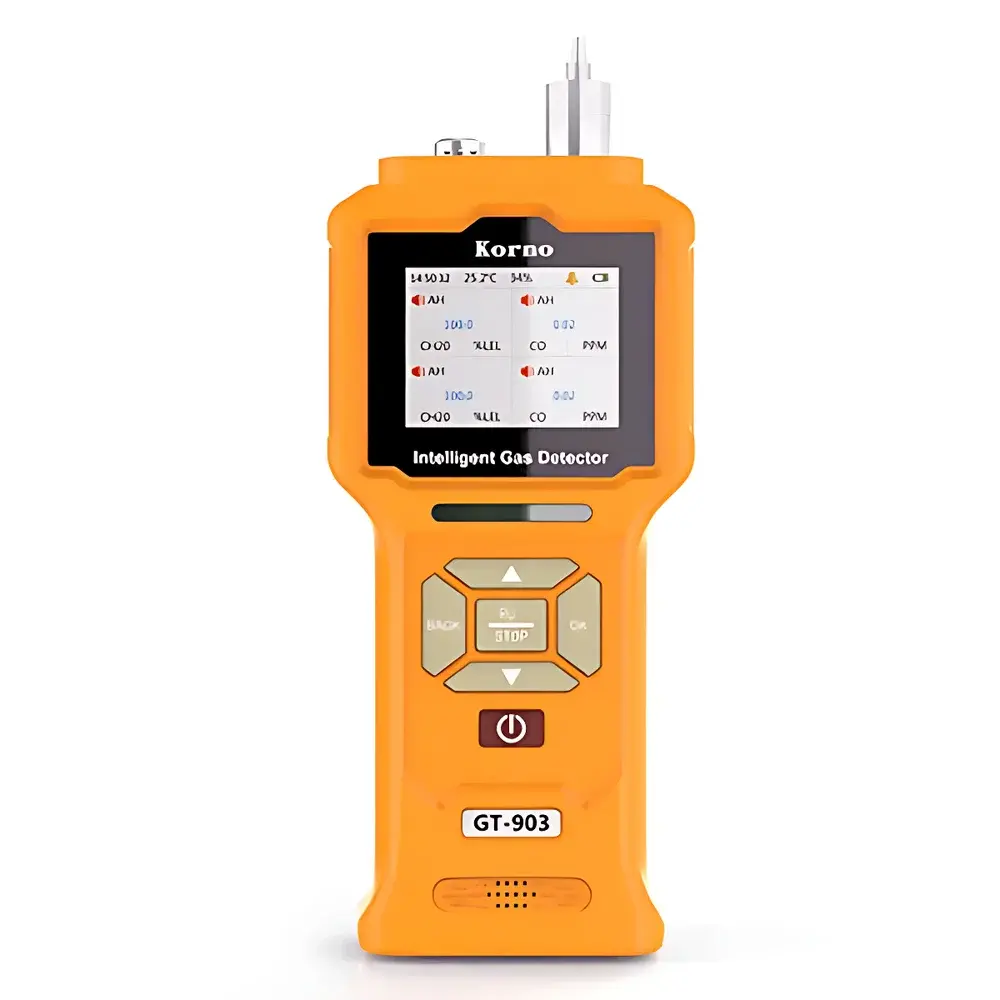
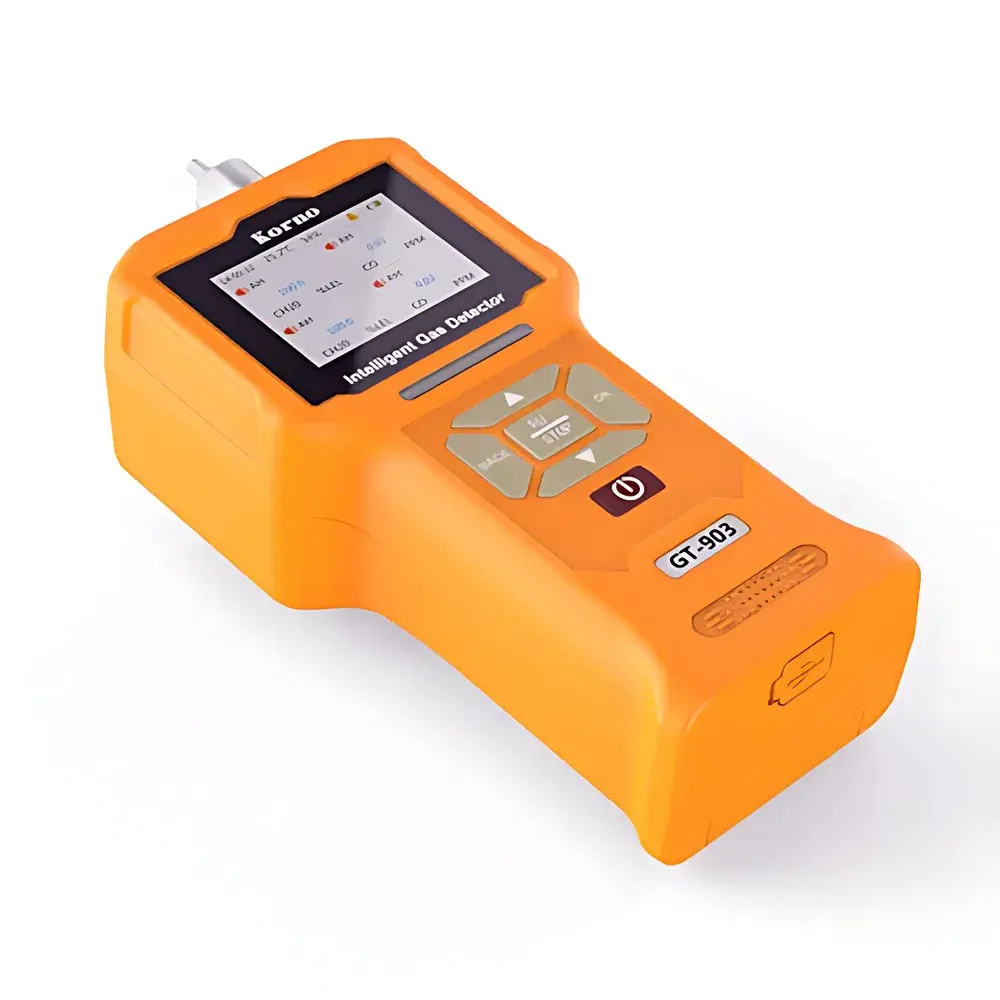
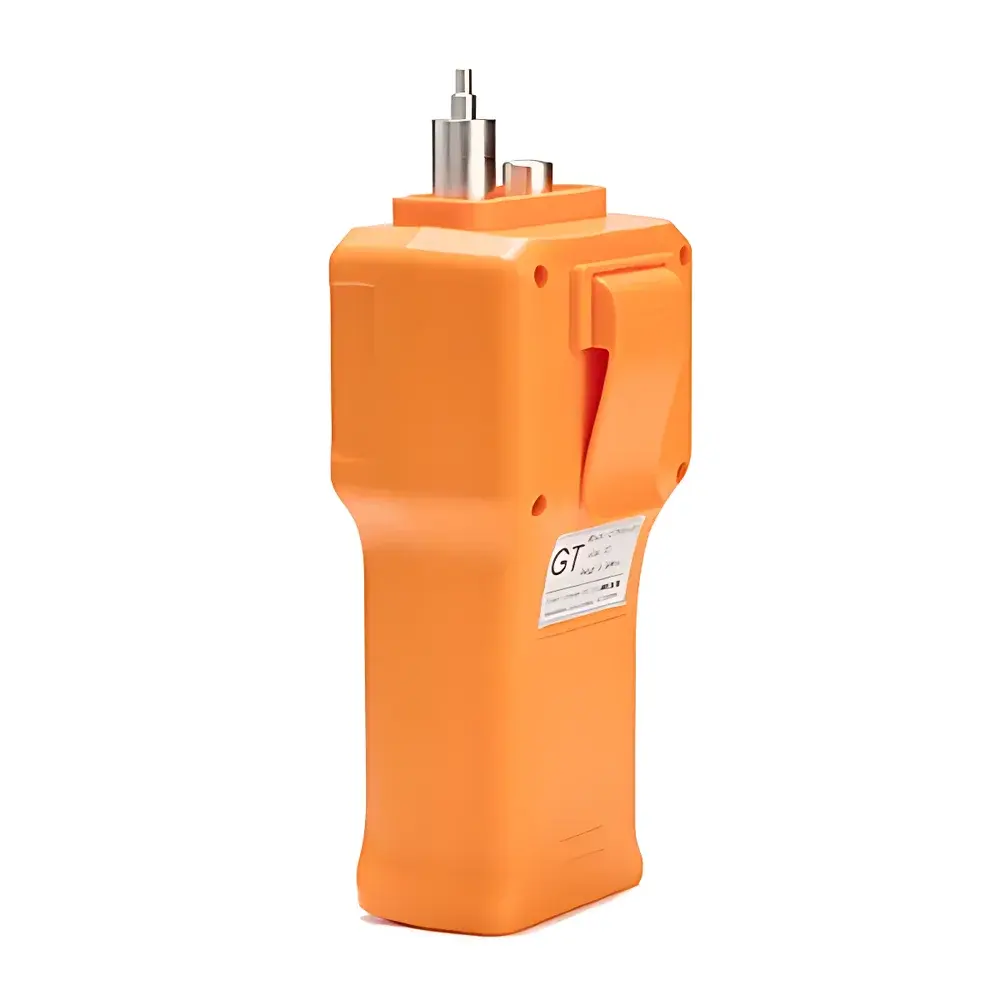
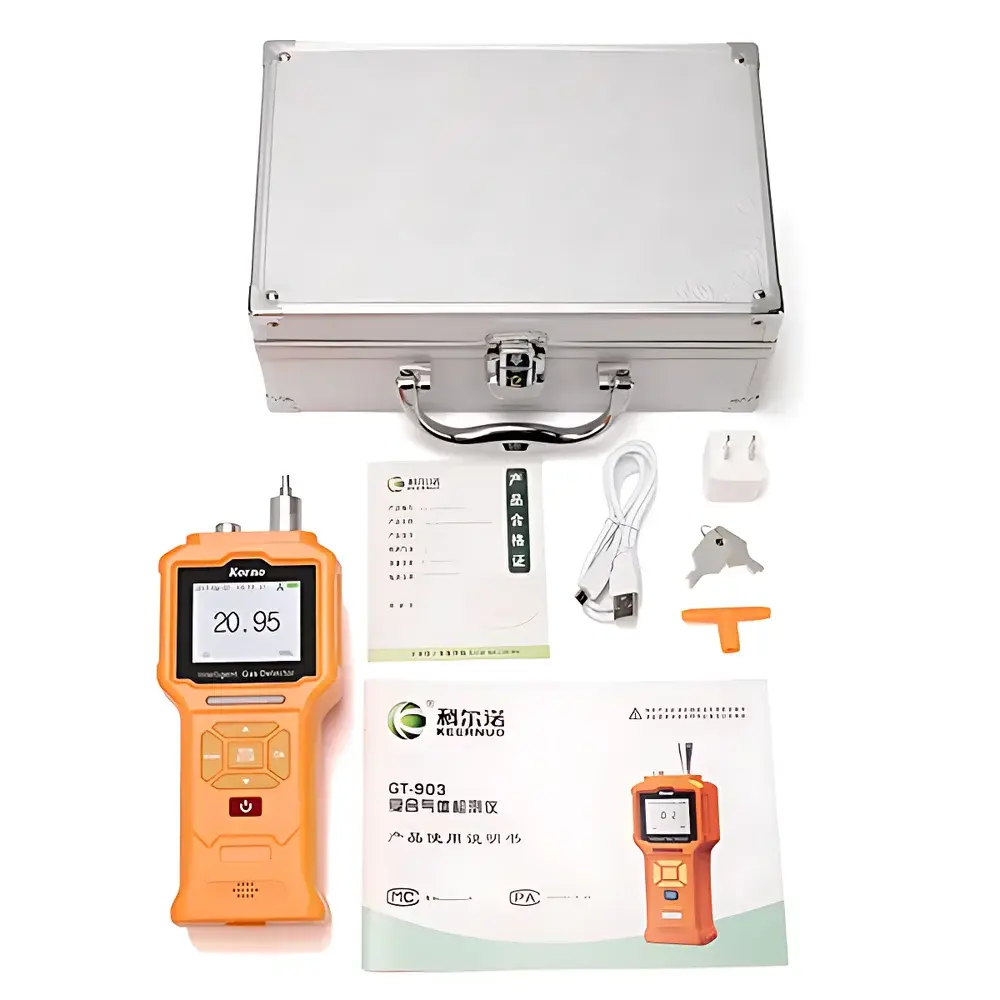
Korno GT-903-H2 Hydrogen Gas Detector with Pumped Sampling
| Brand | Korno |
|---|---|
| Origin | Guangdong, China |
| Manufacturer Type | Manufacturer |
| Country of Origin | China |
| Model | GT-903-H2 |
| Price Range | USD 270 – 1,100 (FOB) |
| Detection Principle | Electrochemical / Thermal Conductivity |
| Gas Detected | H₂ |
| Range Options | 0–100 / 500 / 1,000 / 2,000 / 5,000 / 10,000 / 40,000 ppm |
| Resolution | 0.1 ppm (≤1,000 ppm), 1 ppm (≤40,000 ppm), 0.01% vol |
| T90 Response Time | ≤20 s |
| Accuracy | ≤±3% FS |
| Linearity Error | ≤±2% FS |
| Zero Drift | ≤±2% FS |
| Recovery Time | ≤20 s |
| Sensor Channels | 1–4 configurable |
| Explosion Protection | Ex ib IIC T4 Gb (per GB/T 3836.4–2021) |
| Ingress Protection | IP67 |
| Operating Temp | −20 °C to +50 °C |
| Operating Humidity | ≤95% RH (non-condensing) |
| Pressure Range | 88–112 kPa |
| Battery | 3800 mAh rechargeable polymer Li-ion |
| Display | 2.4″ industrial-grade color LCD |
| Data Storage | 120,000 records (on-device review & USB export) |
| Sampling Method | Built-in micro-diaphragm pump |
| Compliance | GB/T 3836.1–2021, GB/T 3836.4–2021 |
Overview
The Korno GT-903-H2 is a portable, intrinsically safe hydrogen gas detector engineered for continuous, real-time monitoring in hydrogen production, refueling stations, PEM electrolyzer facilities, fuel cell laboratories, and other high-risk hydrogen-handling environments. It employs dual-sensor technology—primarily electrochemical and thermal conductivity sensing—to deliver reliable, cross-validated H₂ concentration measurements across seven selectable ranges (from trace-level 0–100 ppm to high-concentration 0–99.99% vol). Unlike diffusion-based detectors, the GT-903-H2 integrates a calibrated micro-diaphragm sampling pump that actively draws ambient air through a replaceable particulate filter and optional hydrophobic membrane, ensuring representative sample delivery even in low-flow or stagnant zones. Its measurement architecture complies with fundamental metrological requirements outlined in ISO 10156 and aligns with functional safety expectations for early-warning systems under IEC 61508 SIL 2 conceptual design principles. The device operates without external power sources for up to 12 hours under typical sampling duty cycles, making it suitable for both routine patrols and extended unattended deployment.
Key Features
- Intrinsically safe design certified to GB/T 3836.4–2021 (Ex ib IIC T4 Gb), enabling safe use in Zone 1/Zone 2 explosive atmospheres common in hydrogen infrastructure.
- Dual detection principle support: field-replaceable electrochemical sensors for high-sensitivity trace detection (0.1 ppm resolution) and thermal conductivity modules for wide-range %vol quantification—minimizing false negatives in mixed-concentration scenarios.
- Industrial 2.4-inch color TFT display with anti-glare coating, supporting simultaneous visualization of real-time H₂ concentration, battery status, pump operation indicator, temperature/humidity (with optional probe), alarm thresholds, and timestamped trend graphs.
- Onboard data logging capacity of 120,000 measurement records, stored with UTC timestamps, sensor ID, and environmental metadata; exportable via USB-C to CSV-compatible software for audit-ready reporting.
- Configurable alarm logic: dual-stage (pre-alarm and critical alarm), adjustable threshold levels, audible (85 dB @ 30 cm) and visual (flashing red LED + screen alert), plus optional relay output for integration into facility SCADA or emergency shutdown systems.
- Ruggedized housing rated IP67—fully dust-tight and submersible to 1 m for 30 minutes—validated for mechanical shock (IEC 60068-2-27) and vibration resistance (IEC 60068-2-6) in mobile industrial applications.
Sample Compatibility & Compliance
The GT-903-H2 is optimized for hydrogen detection in clean, dry process streams and ambient air. It is compatible with standard stainless steel or PTFE sampling lines and supports optional heated sample lines (−20 °C to +50 °C operational envelope) when deployed near cryogenic or high-humidity zones. The instrument meets national mandatory standards for explosion-proof electrical equipment in China (GB/T 3836.1–2021 and GB/T 3836.4–2021), and its sensor calibration traceability follows JJG 551–2016 (Chinese national verification regulation for gas analyzers). While not CE-marked or ATEX-certified out-of-the-box, its hardware architecture and firmware design accommodate third-party certification pathways for EU or North American markets upon customer request and regional adaptation (e.g., UL 913, CSA C22.2 No. 152).
Software & Data Management
Korno provides PC-based configuration and data analysis software (KornoDataLink v3.2) compatible with Windows 10/11. Users can perform zero/span calibration, adjust alarm setpoints, configure sampling intervals (1–300 s), enable/disable humidity/temperature compensation, and generate PDF-formatted calibration certificates compliant with GLP documentation requirements. All configuration changes are logged with operator ID and timestamp. Firmware updates are delivered via signed binary packages with SHA-256 checksum validation. Audit trails—including sensor replacement history, calibration events, and alarm activations—are retained in non-volatile memory and exportable for regulatory review under internal quality management systems aligned with ISO/IEC 17025 Clause 7.7.
Applications
- Hydrogen refueling station (HRS) leak surveillance at compressor skids, storage vessels, and dispenser manifolds.
- In-line monitoring during PEM water electrolysis to verify purge gas purity and detect membrane crossover.
- QC/QA testing of hydrogen purity per ISO 8573-1 Class 1 (≤0.1 ppm H₂O, ≤0.1 ppm O₂, ≤0.1 ppm total hydrocarbons) — used as a secondary verification tool alongside GC or laser-based analyzers.
- Confined space entry pre-check in fuel cell manufacturing cleanrooms and laboratory gloveboxes.
- Post-maintenance verification after piping weld repairs or valve replacements in hydrogen distribution networks.
- Educational demonstrations of flammability limits (4–75% vol in air) and sensor response dynamics in university chemical engineering labs.
FAQ
What is the recommended calibration frequency for the GT-903-H2 in continuous operation?
For critical safety applications, quarterly bump testing with certified 1,000 ppm H₂ in N₂ is advised, with full two-point (zero/span) calibration every six months or after sensor replacement.
Can the GT-903-H2 be integrated into a central monitoring system?
Yes—via optional 4–20 mA analog output or Modbus RTU over RS-485, supporting integration with PLCs, DCS, or cloud-based IIoT platforms using standard protocol mapping.
Is the thermal conductivity sensor affected by background gas composition?
Yes—TC sensors respond to bulk thermal property changes; accuracy in mixed-gas environments (e.g., H₂/N₂/Ar blends) requires factory-specific matrix compensation or co-location with reference gas chromatography.
Does the device support H₂ detection in inert atmospheres such as argon or nitrogen?
Electrochemical sensors require ≥10% O₂ for stable operation; for inert or hypoxic environments, the thermal conductivity module is the primary detection method and remains fully functional.
What maintenance is required beyond calibration?
Annual inspection of pump diaphragm integrity, filter replacement (every 3 months in dusty environments), and verification of seal compression force on the IP67-rated enclosure gasket per manufacturer’s torque specifications.




