
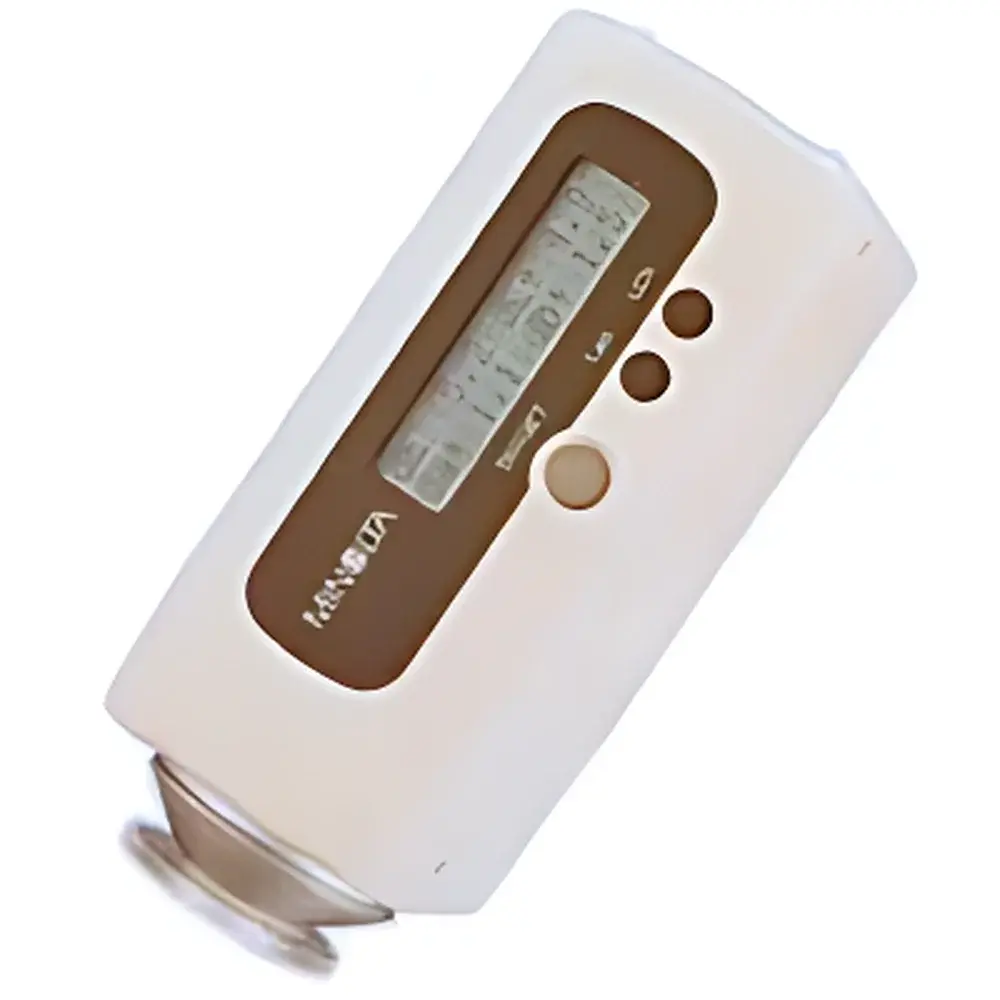
Konica Minolta CR-10 Color Difference Meter
| Brand | Konica Minolta |
|---|---|
| Origin | Japan |
| Model | CR-10 |
| Illumination/Viewing Geometry | 8°/diffuse (d) |
| Measurement Area | Ø8 mm |
| Display Modes | Δ(L*a*b*) & ΔE*ab, or Δ(L*C*H*) & ΔE*ab |
| Standard Observer | CIE 10° |
| Illuminant | CIE D65 |
| Repeatability | σ(ΔE*ab) ≤ 0.1 (measured on white calibration tile, average of multiple readings) |
| Measurement Interval | Approx. 1 second |
| Power Supply | 4 × AA batteries or optional AC adapter AC-A12 |
| Operating Temperature | 0–40 °C, RH < 85% (non-condensing) |
| Standard Accessories | Soft case CR-A68, protective cap CR-A72, wrist strap CR-A73, 4 × AA batteries |
| Optional Accessories | AC adapter AC-A12, printer cable CR-A75 |
Overview
The Konica Minolta CR-10 Color Difference Meter is a compact, handheld spectrophotometric instrument engineered for rapid, reliable color assessment in production environments where portability, ease of operation, and consistency are essential. Based on the CIE L*a*b* color space and calibrated to CIE standard illuminant D65 and the 10° standard observer, the CR-10 employs an 8°/diffuse (8/d) optical geometry—ensuring robust measurement of both matte and moderately textured surfaces while minimizing directional sensitivity. Its Ø8 mm measurement aperture provides sufficient sampling area for representative evaluation of homogeneous materials without excessive averaging artifacts. Designed for routine pass/fail verification rather than spectral analysis, the CR-10 delivers ΔE*ab values with repeatability of ≤ 0.1 ΔE*ab under controlled conditions—meeting baseline requirements for quality control in paint, plastics, textiles, packaging, and consumer electronics manufacturing.
Key Features
- Compact, ergonomic design weighing under 200 g—optimized for one-handed operation and extended use in field or line-side applications.
- 8°/diffuse illumination/viewing geometry compliant with ISO 7724-1 and ASTM E308, enabling consistent measurements across non-specular and low-gloss surfaces.
- Dedicated ΔE*ab calculation engine supporting both CIELAB (ΔL*a*b*) and CIELCH (ΔL*C*H*) delta representations—facilitating interpretation aligned with visual perception models.
- Single-reference memory function: stores one standard color via direct measurement—ideal for simple go/no-go comparisons without external software or calibration databases.
- Low-power architecture powered by four standard AA batteries (typical life > 5,000 measurements), with optional AC adapter (AC-A12) for benchtop continuity.
- Ruggedized housing with rubberized grip and integrated protective cap (CR-A72) ensures operational durability in industrial settings.
Sample Compatibility & Compliance
The CR-10 is validated for use on flat, opaque, and uniformly colored surfaces with moderate surface roughness. It is not intended for transparent, translucent, metallic, or highly specular samples—applications requiring such measurements necessitate instruments with 45°/0° or sphere-based geometries (e.g., CM-2600d). The device conforms to fundamental metrological principles outlined in ISO/CIE 11664-4 (CIELAB color space), ISO 7724-2 (instrumental colorimetry), and JIS Z 8722 (methods of color measurement). While the CR-10 does not provide full GLP/GMP audit trails or electronic records, its fixed calibration and stable repeatability support compliance with internal QC protocols aligned with ISO 9001 clause 7.6 (Control of monitoring and measuring equipment).
Software & Data Management
The CR-10 operates as a standalone instrument with no onboard data logging or USB connectivity. All measurement results—including ΔL*, Δa*, Δb*, ΔC*, ΔH*, and ΔE*ab—are displayed in real time on the integrated LCD screen. For traceable documentation, users may manually record outputs or interface with optional accessories: the CR-A75 printer cable enables direct hardcopy output to compatible thermal printers, preserving measurement context (date/time stamp not embedded; user responsibility). No proprietary software suite is provided; therefore, the instrument is not compliant with FDA 21 CFR Part 11 requirements for electronic records and signatures. Its simplicity reflects a design philosophy prioritizing immediate usability over digital integration—making it suitable for Tier-1 suppliers and SMEs operating under lean QC frameworks.
Applications
- Batch-to-batch color verification in pigment dispersion, coating formulation, and injection molding lines.
- Final product inspection of printed labels, laminated films, and molded housings against master standards.
- Supplier qualification audits where portable, battery-operated verification is required onsite.
- Educational laboratories introducing foundational colorimetry concepts using CIE D65 and L*a*b* metrics.
- Maintenance of color consistency during tooling changes or raw material substitutions—leveraging the single-reference memory for rapid deviation detection.
FAQ
Does the CR-10 support multiple standard references or user-defined tolerances?
No. The CR-10 stores only one reference color, acquired via direct measurement. Tolerance limits must be interpreted manually from displayed ΔE*ab values against internally defined acceptance thresholds.
Can the CR-10 measure textured or curved surfaces accurately?
It is designed for flat, uniform surfaces. Curved or heavily textured substrates may yield inconsistent results due to aperture misalignment and light scatter—validation per ISO 2813 or ASTM D523 is recommended for such cases.
Is factory recalibration required at regular intervals?
Konica Minolta recommends annual verification using certified white and black calibration tiles (CR-200 series). Drift beyond ±0.1 ΔE*ab on the white tile indicates need for service recalibration.
What is the spectral range covered by the CR-10?
The CR-10 is a tristimulus colorimeter—not a spectrophotometer—and does not report spectral reflectance data. Its silicon photodiode array is filtered to approximate CIE 1964 10° color-matching functions.
Is the CR-10 compliant with ISO/IEC 17025 for accredited testing labs?
No. As a Class II colorimeter without documented uncertainty budgets, traceable calibration certificates, or environmental monitoring, it does not meet ISO/IEC 17025 clause 6.4 requirements for accredited calibration or testing activities.




