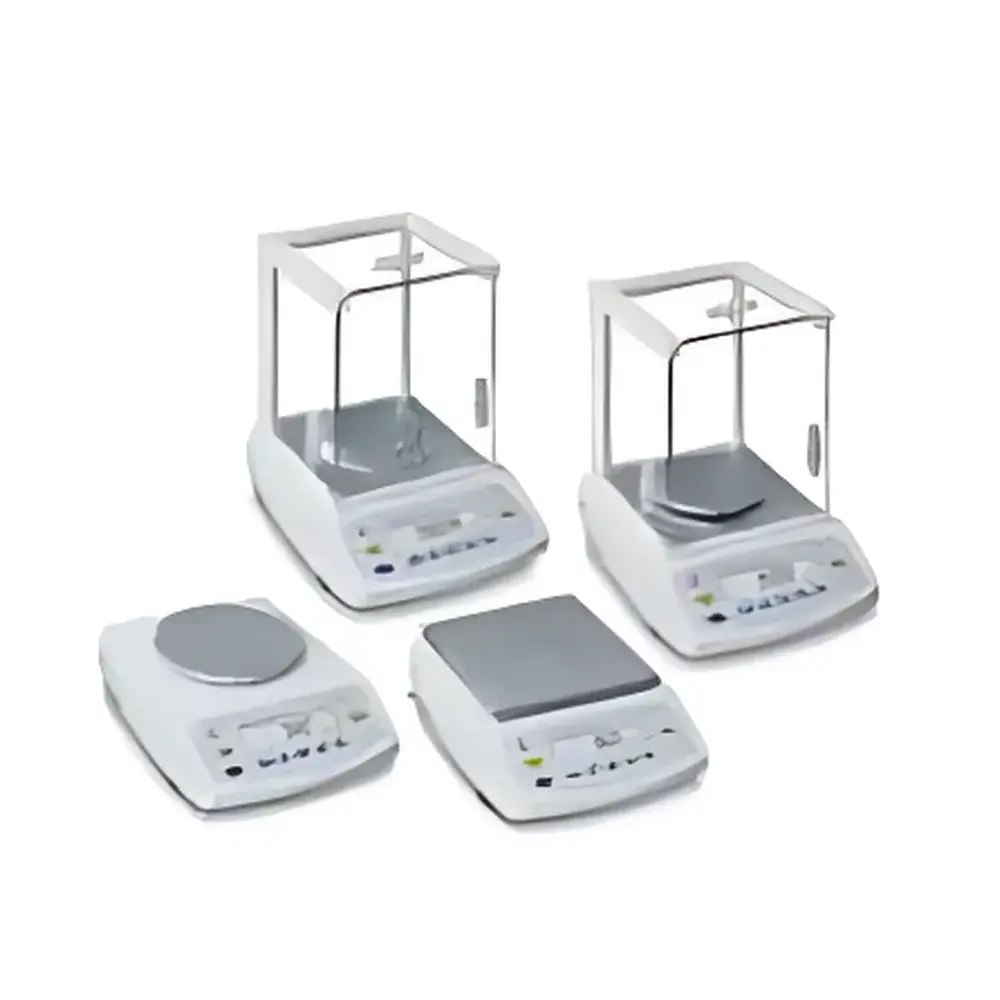
Sartorius BSA-CW Series Fully Automatic Internal Calibration Precision Balance
| Brand | Sartorius |
|---|---|
| Origin | Germany |
| Model | BSA4202S-CW |
| Maximum Capacity | 4200 g |
| Readability | 10 mg |
| Repeatability | ≤10 mg |
| Linearity | ≤20 mg |
| Pan Size | 180 × 180 mm |
| Calibration Type | Motor-Driven Internal Calibration |
| Display | Backlit High-Contrast LCD with 15 mm Character Height |
| Interface | RS-232C Bidirectional |
| Operating Languages | 5 selectable (English, German, French, Spanish, Chinese) |
| Key Operation | Tactile Membrane Keys |
| Compliance | Designed for GLP/GMP environments |
Overview
The Sartorius BSA-CW Series is a line of high-performance precision balances engineered for routine laboratory weighing tasks requiring robust repeatability, traceable calibration, and operational transparency. Built in Germany to Sartorius’ long-standing metrological standards, the BSA4202S-CW model delivers a maximum capacity of 4200 g with 10 mg readability—optimized for applications where sub-gram accuracy must be maintained across shifts, operators, and environmental fluctuations. Its measurement principle relies on electromagnetic force compensation (EMFC), a proven technology ensuring stable, drift-resistant performance under varying ambient conditions. The balance features fully automatic internal calibration driven by a motorized, built-in calibration mass—eliminating manual handling of external weights and minimizing operator-induced variability. This architecture supports compliance with ISO/IEC 17025, USP , and pharmacopeial requirements for analytical balance verification, particularly in quality control laboratories operating under GLP or GMP frameworks.
Key Features
- Motor-driven internal calibration system activated at user-defined intervals or manually via single-key operation—ensuring consistent traceability without external intervention.
- Backlit, high-contrast LCD display with 15 mm character height for legibility under low-light or high-glare conditions—critical for cleanroom or multi-shift environments.
- Intuitive menu-driven interface with five language options (English, German, French, Spanish, Chinese) and cursor-key navigation—reducing training time and minimizing configuration errors.
- Tactile membrane keys with clearly defined layout and logical grouping—designed for gloved-hand operation and ergonomic daily use.
- RS-232C bidirectional communication port as standard; compatible with Sartorius’ optional USB adapter (Y-Cable) for seamless integration into Windows-based LIMS or ELN systems.
- Robust aluminum die-cast housing with stainless steel pan (180 × 180 mm) and draft shield compatibility—supporting stable measurements in non-climate-controlled lab spaces.
Sample Compatibility & Compliance
The BSA4202S-CW accommodates a broad range of sample types—from solid reagents and bulk pharmaceutical intermediates to packaged consumer goods—within its 4200 g capacity and 180 mm square pan. Its 10 mg readability and ≤10 mg repeatability meet minimum weighing requirement (MWR) thresholds defined in USP for Class III balances used in non-analytical QC testing. The internal calibration mechanism complies with ISO 9001 calibration management clauses and facilitates documentation of calibration events—including date, time, operator ID (if integrated with external authentication), and result status—for audit readiness. While not intrinsically compliant with FDA 21 CFR Part 11 out-of-the-box, the balance supports secure, timestamped data export via RS-232 when paired with validated third-party software that implements electronic signatures and audit trails.
Software & Data Management
Data output follows standard ASCII protocol over RS-232, enabling direct parsing by laboratory informatics systems. Sartorius’ optional Data Transfer Software (DTS) provides configurable print/export templates, real-time weight logging, and batch-wise data archiving—compatible with CSV, TXT, and Excel formats. When connected to networked PCs, the balance can feed into centralized QA databases with metadata tagging (e.g., sample ID, method ID, operator code). All calibration logs—including internal calibration timestamps, deviation values, and pass/fail status—are stored in non-volatile memory and retrievable via serial command or DTS interface. No proprietary cloud platform is required; local data sovereignty is preserved by default.
Applications
- Raw material receipt inspection in pharmaceutical and chemical manufacturing facilities.
- Formulation batching and intermediate weight verification in solid-dosage production.
- Stability study sample preparation requiring precise mass allocation across multiple vials.
- Environmental monitoring labs performing gravimetric analysis of particulate filters (e.g., PM10, PM2.5).
- Educational laboratories conducting stoichiometric experiments and density determinations.
- Food and beverage QA departments verifying net content compliance per EU Directive 76/211/EEC or NIST Handbook 133.
FAQ
Does the BSA-CW series support external calibration with certified weights?
Yes—the balance accepts manual calibration using external Class M2 or better weights via the CAL function, though internal calibration remains the recommended routine procedure.
Is temperature compensation automated?
The EMFC sensor incorporates real-time temperature monitoring; drift correction is applied continuously during operation, and internal calibration automatically adjusts for thermal hysteresis.
Can the balance be integrated into a 21 CFR Part 11–compliant workflow?
When used with validated third-party software that adds electronic signature, audit trail, and role-based access controls, the BSA-CW meets technical prerequisites for Part 11 compliance.
What is the warm-up time required before first use?
Sartorius recommends a minimum 30-minute stabilization period after power-on to achieve thermal equilibrium of the load cell and electronics.
How often should internal calibration be performed?
Frequency depends on usage intensity and environmental stability; Sartorius advises calibration at startup, after significant temperature changes (>2 °C), and every 2–4 hours during continuous operation—configurable via the menu system.