
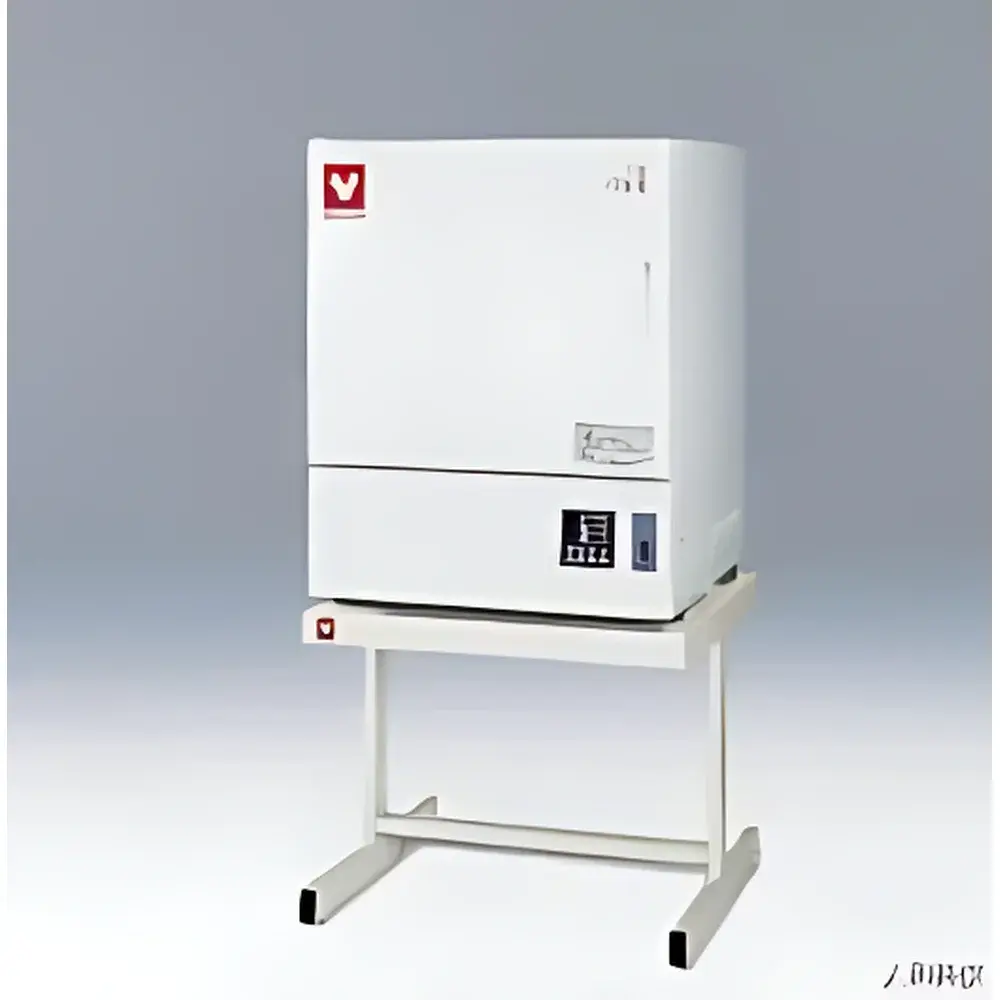
YAMATO SI611C Natural Convection Dry Heat Sterilizer
| Brand | YAMATO |
|---|---|
| Origin | Japan |
| Model | SI611C |
| Convection Type | Natural Convection |
| Temperature Range | Ambient +5°C to 260°C |
| Temperature Control Accuracy | ±2°C (at 260°C) |
| Internal Dimensions (W×D×H) | 600 × 530 × 500 mm |
| Chamber Volume | 159 L |
| Shelf Load Capacity | 15 kg per shelf |
| Number of Shelves | 13 (adjustable at 30 mm intervals) |
| Power Supply | AC 220 V, 6.5 A, 50/60 Hz |
| Heating Power | 1.36 kW |
| Safety Features | Dual independent over-temperature protection (PID controller + mechanical overheat limiter), self-diagnostic circuitry (sensor fault, heater open-circuit, SSR short-circuit), earth leakage circuit breaker, key lock function |
| Controller | 4-digit LED display (green for actual temperature, red for setpoint), 3-segment PID control, programmable timer (1 min–99 h 59 min |
| extended mode | 100–999 h 50 min with standby), 30-step program memory (configurable as 30×1, 15×2, or 10×3 segments) |
| Compliance | Designed and manufactured in accordance with JIS B 8701 (Japanese Industrial Standard for Dry Heat Sterilizers), compatible with ISO 17665-1 and ASTM F1055 requirements for thermal validation of dry heat sterilization processes |
Overview
The YAMATO SI611C is a precision-engineered natural convection dry heat sterilizer designed for laboratories requiring reliable, repeatable, and compliant thermal decontamination of heat-stable instruments, glassware, metal tools, and powders. Unlike forced-air systems, the SI611C relies on gravity-driven air circulation—eliminating fan-induced turbulence and particle redistribution—making it especially suitable for applications where particulate contamination must be minimized (e.g., pharmaceutical QC labs, semiconductor cleanroom support, and sterile device packaging validation). Its operational range spans from ambient +5°C to 260°C, enabling both low-temperature depyrogenation (≥250°C for 45 min per USP ) and high-efficiency sterilization of stainless steel components, borosilicate glass vials, and ceramic filters. The unit is constructed with an inner chamber of SUS304 stainless steel and an outer casing of cold-rolled steel with chemical-resistant epoxy coating—ensuring long-term corrosion resistance in routine lab environments.
Key Features
- Natural convection architecture ensures uniform thermal distribution without mechanical airflow, reducing cross-contamination risk and preserving delicate instrument surfaces.
- Dual-stage temperature safety system: primary 3-segment PID controller with K-type thermocouple feedback, backed by an independent mechanical over-temperature limiter (overheat preventer) certified to JIS C 8370 standards.
- Programmable 30-step controller supports multi-phase thermal cycles—including ramp-hold-cool sequences—essential for validated depyrogenation protocols and material stress testing.
- Self-diagnostic circuit continuously monitors sensor integrity, heating element continuity, SSR functionality, and power supply stability—logging faults in real time for GLP-compliant troubleshooting.
- Full keypad lockout prevents unauthorized parameter changes; optional password-free activation via auxiliary menu keys simplifies SOP-driven operation.
- Extended timing capability (up to 999 hours 50 minutes) with standby mode enables unattended overnight or weekend sterilization runs while maintaining traceability.
- 13-position adjustable shelving (30 mm pitch), each rated for 15 kg load, accommodates diverse vessel configurations—from Petri dishes to 1-L Erlenmeyer flasks—without compromising chamber uniformity.
Sample Compatibility & Compliance
The SI611C is validated for use with non-volatile, thermally stable materials including surgical stainless steel, borosilicate glass, alumina ceramics, and anhydrous powders (e.g., talc, lactose, sodium chloride). It is not intended for plastics, rubber, or organic solvents. Chamber temperature uniformity is maintained within ±20°C at 260°C (per JIS B 8701 Annex B), supporting IQ/OQ/PQ documentation required under FDA 21 CFR Part 11 and EU Annex 15. Optional thermocouple ports (not standard) allow integration with external data loggers for audit-ready thermal mapping. The unit meets electromagnetic compatibility (EMC) requirements per IEC 61326-1 and electrical safety per IEC 61010-1.
Software & Data Management
While the SI611C operates via embedded firmware (no PC connectivity), its controller architecture supports full electronic record retention: all setpoints, run durations, fault codes, and timestamped start/stop events are stored in non-volatile memory. The dual-color LED interface provides immediate visual verification of process status—green for measured temperature, red for target—reducing operator interpretation error. All program steps, deviation corrections, and key-lock states are retained during power interruption (power failure compensation function), ensuring continuity of GMP-critical cycles. For regulated environments, users may integrate optional analog output modules (0–5 V or 4–20 mA) to feed temperature data into centralized SCADA or LIMS platforms.
Applications
- Depyrogenation of glassware and stainless-steel components used in aseptic processing (aligned with USP and Ph. Eur. 5.1.3).
- Pre-sterilization conditioning of filter housings and chromatography columns prior to solvent exposure.
- Moisture removal from hygroscopic reference standards before gravimetric analysis.
- Thermal validation of packaging materials (e.g., Tyvek® pouches) under accelerated aging conditions.
- Heat treatment of calibration weights and metrology tools requiring dimensional stability.
- Research-grade thermal degradation studies of polymers and excipients under controlled oxidative atmospheres.
FAQ
What is the maximum recommended load volume for optimal temperature uniformity?
For compliance with JIS B 8701 uniformity criteria (±20°C at 260°C), total loaded volume should not exceed 70% of the 159 L chamber capacity—approximately 110 L of non-dense, freely ventilated items.
Can the SI611C be used for sterilizing liquids or biological media?
No. Dry heat sterilization is unsuitable for aqueous solutions due to evaporation, boiling, and potential container rupture. This unit is strictly for dry, solid, or powder-phase materials.
Is third-party IQ/OQ protocol support available from YAMATO?
Yes. YAMATO provides factory-issued qualification templates and technical documentation packages aligned with ISO/IEC 17025 and ASTM E2500, including sensor calibration certificates traceable to NMIJ (National Metrology Institute of Japan).
How often should the over-temperature limiter be verified?
Per JIS B 8701 Clause 7.3, functional verification of the mechanical overheat preventer is required prior to each validation cycle and at least once every six months during routine operation.
Does the unit comply with energy efficiency standards such as ENERGY STAR or EU Ecodesign?
While not ENERGY STAR–certified (as no applicable category exists for laboratory dry heat sterilizers), the SI611C meets Japan’s Top Runner Program baseline for industrial heating equipment (JIS C 8901:2020) with 89% thermal efficiency at 250°C steady state.



