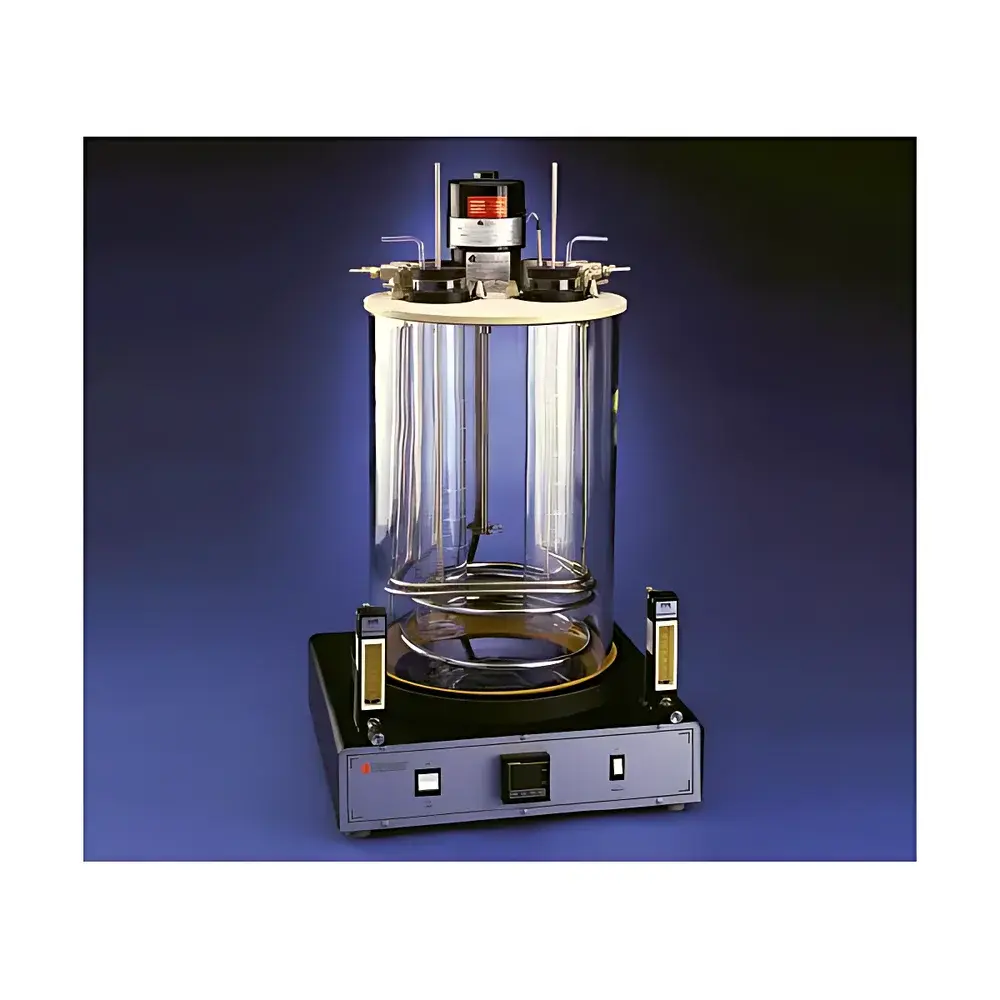
Koehler K26210-3 High-Temperature Foam Characteristics Tester for Lubricating Oils
| Brand | Koehler |
|---|---|
| Origin | USA |
| Model | K26210-3 |
| Standard Compliance | ASTM D6082 |
| Test Temperature | 150 °C |
| Temperature Uniformity | ±0.5 °C |
| Bath Volume | 38.5 L |
| Air Flow Rate | 200 mL/min |
| Power Supply | 220–240 V, 50 Hz |
| Dimensions (W×D×H) | 82 × 38 × 79.4 cm |
| Weight | 28.1 kg |
| Heating System | Immersed copper heater with PID-controlled microprocessor |
| Temperature Display | Dual LED, selectable ℃/°F |
| Construction | Steel base with chemical-resistant polyimide enamel coating |
| Includes | Two 1000 mL calibrated test cylinders, two calibrated antifoam heads, two air inlet tubes, two exhaust tubes, two rubber stoppers, one bath tank, one support stand |
Overview
The Koehler K26210-3 High-Temperature Foam Characteristics Tester is a precision-engineered laboratory instrument designed to evaluate the foaming tendency and foam stability of lubricating oils under thermally accelerated conditions. It operates on the principle of controlled air sparging into a pre-heated oil sample within a calibrated cylindrical vessel, simulating real-world high-temperature, high-shear environments encountered in turbine systems, hydraulic circuits, and gearboxes. The instrument quantifies both foam volume generation during air injection (foaming tendency) and residual foam persistence after cessation of airflow (foam stability), with particular emphasis on elevated temperature performance per ASTM D6082. At 150 °C — the standard test temperature specified in the method — thermal degradation pathways accelerate, revealing critical surfactant depletion, additive breakdown, or base oil volatility effects that influence foam behavior. This enables predictive assessment of operational risks such as lubricant starvation, cavitation, pump inefficiency, and accelerated oxidation.
Key Features
- PID-controlled microprocessor temperature system with dual LED display (℃/°F), ensuring stable setpoint maintenance and real-time monitoring
- Copper-immersed heating element combined with an integrated high-efficiency recirculating stirrer, delivering uniform thermal distribution across the 38.5 L bath volume (±0.5 °C tolerance)
- Dedicated air delivery subsystem featuring calibrated mass flow control at 200 mL/min, compliant with ASTM D6082 requirements for reproducible gas introduction
- Chemically resistant steel frame finished with polyimide enamel coating, engineered for long-term durability in petroleum testing laboratories
- Comprehensive accessory kit including two NIST-traceable 1000 mL graduated test cylinders, two factory-calibrated antifoam heads, matched inlet/exhaust tubing sets, and reusable rubber stoppers
- Integrated over-temperature protection circuitry and fail-safe thermal cutoff to ensure operator safety and equipment integrity during extended high-temperature operation
Sample Compatibility & Compliance
The K26210-3 is validated exclusively for use with mineral-, synthetic-, and semi-synthetic-based lubricating oils, including turbine oils, hydraulic fluids, engine oils, and gear lubricants. It fully satisfies the apparatus specifications and procedural requirements outlined in ASTM D6082 – Standard Test Method for Foaming Characteristics of Lubricating Oils at High Temperature. Its design supports full traceability to national metrology standards through calibrated components and documented thermal performance validation. The system is compatible with GLP-compliant laboratory workflows and supports audit-ready documentation when paired with external data logging systems. While not inherently 21 CFR Part 11–compliant, its stable analog control architecture allows integration with validated electronic lab notebooks (ELNs) and LIMS platforms where regulatory-grade data governance is required.
Software & Data Management
The K26210-3 operates via embedded firmware without proprietary software dependency, prioritizing operational reliability and minimal maintenance overhead. Temperature setpoints, dwell times, and airflow initiation are manually configured using front-panel controls. All measured outputs — initial foam volume (mL), post-aeration foam volume (mL), and foam collapse time (min) — are recorded manually by the operator in accordance with ASTM D6082 reporting conventions. For laboratories requiring digital data capture, the unit’s analog temperature output signal (0–5 V or 4–20 mA, optional upon request) can be interfaced with third-party DAQ systems or SCADA platforms. Calibration records, maintenance logs, and test reports remain the responsibility of the end user per ISO/IEC 17025 clause 7.7 and ASTM E2655 guidelines for instrument qualification.
Applications
- Quality control of new lubricant formulations prior to field deployment
- Comparative evaluation of antifoam additive efficacy under thermal stress
- Failure analysis of in-service oils exhibiting excessive foaming in high-temperature equipment
- Stability screening of re-refined or reclaimed base oils
- Supporting OEM specification compliance for turbine and hydraulic fluid approvals (e.g., GEK 32568, Siemens TLV 9013)
- Research into structure–property relationships between molecular architecture and interfacial rheology in lubricant systems
FAQ
What is the primary purpose of the ASTM D6082 test method?
It evaluates the foaming tendency and foam stability of lubricating oils at elevated temperature (150 °C) to assess suitability for high-heat applications where foam-induced mechanical failure is a risk.
Can the K26210-3 be used for low-temperature foam testing?
No — this instrument is specifically configured for high-temperature operation per ASTM D6082. Low-temperature foam tests (e.g., ASTM D892) require separate apparatus with different thermal and airflow specifications.
Is calibration certification included with the instrument?
The antifoam heads and test cylinders are supplied with individual calibration certificates traceable to NIST standards; annual recalibration is recommended per ASTM D6082 Annex A1 and ISO/IEC 17025 requirements.
Does the unit support automated data export?
Not natively — it is a manually operated, analog-controlled system. Digital data acquisition requires external hardware integration via optional analog output signals.
What maintenance is required for long-term accuracy?
Routine verification of bath temperature uniformity, airflow rate accuracy, and cylinder graduation integrity is advised quarterly; heater and stirrer functionality should be checked before each test sequence.