
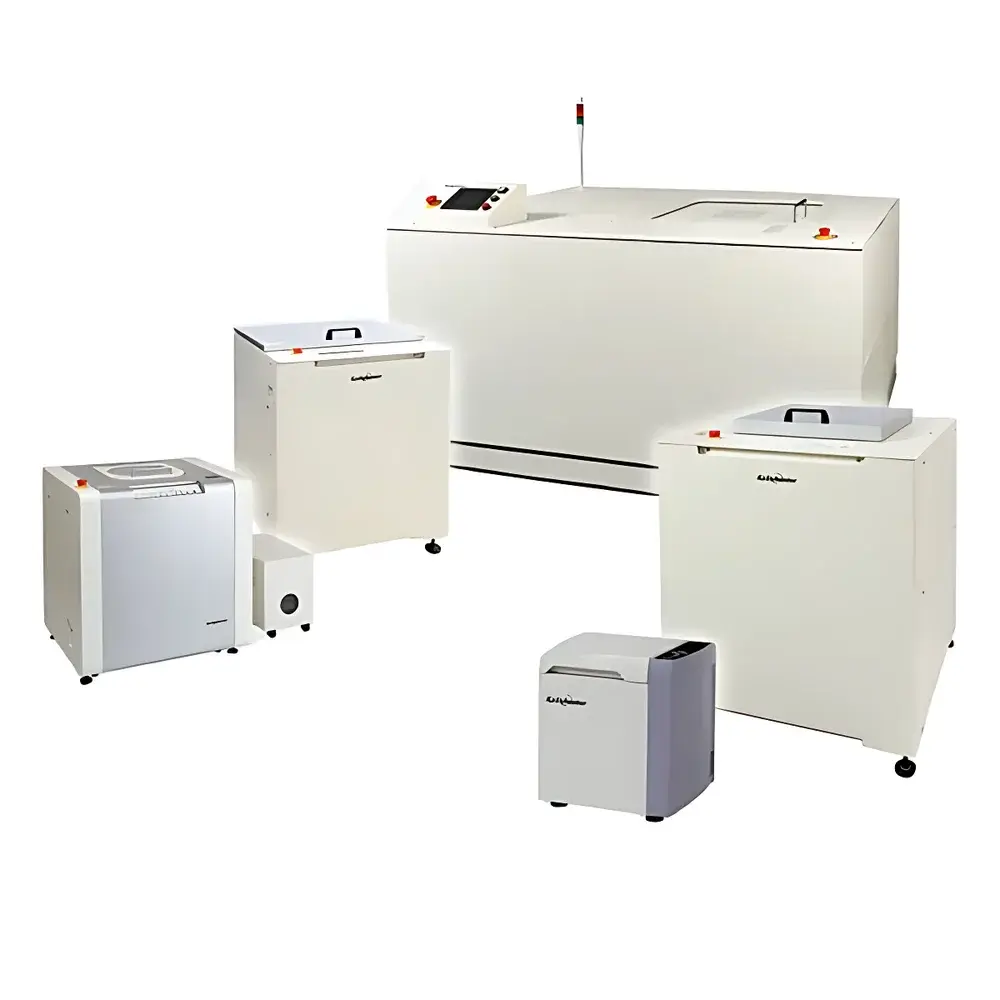
Shashin Kagaku Kakuhunter Planetary-Orbital Mixer and Vacuum Deaerator
| Brand | Shashin Kagaku |
|---|---|
| Origin | Japan |
| Model | Kakuhunter |
| Type | Planetary-Orbital Mixing & Deaeration System |
| Vacuum Option | Available (TV-series) |
| Capacity Range | 30 mL–2000 mL per vessel |
| Drive Configuration | Independently Controlled Orbital (Revolution) and Rotational (Rotation) Axes |
| Speed Control | 9-step orbital speed, 10-step rotational speed |
| Compliance | Designed for ISO/IEC 17025-aligned lab environments, compatible with GLP documentation workflows |
Overview
The Shashin Kagaku Kakuhunter is a precision-engineered planetary-orbital mixing and deaeration system designed for high-fidelity homogenization and microbubble elimination in viscous pastes, conductive inks, ceramic slurries, and electronic packaging materials. Unlike conventional stirrers or vacuum-only deaerators, the Kakuhunter employs dual-axis motion—simultaneous orbital revolution and independent rotational spin—to generate controlled shear gradients and dynamic surface renewal. This dual-motion architecture induces Couette-type flow within the sample vessel while disrupting interfacial tension at gas–liquid boundaries, enabling concurrent dispersion, wetting, and vacuum-assisted degassing (when equipped with TV-series vacuum modules). The system is widely deployed in R&D labs and pilot-scale production lines for photovoltaic silver paste formulation, low-temperature co-fired ceramic (LTCC) tape casting, die-attach material preparation, and analytical sample conditioning prior to SEM, XRD, or rheological characterization.
Key Features
- Independent control of orbital (revolution) and rotational (spin) speeds—enabling precise tuning of shear rate profiles without mechanical coupling constraints
- Multi-stage programmable speed settings: 9 discrete orbital speed steps (200–2200 rpm), 10 rotational speed steps (proportional tracking: 3%–40% of orbital speed, depending on mode)
- Vacuum-integrated variants (TV-series) feature integrated vacuum chambers with pressure monitoring and adjustable hold-time protocols (down to ≤10 Pa absolute)
- Modular cup and syringe compatibility—from 30 mL vials and standard Luer-lock syringes (≤55 mL) up to custom dual-vessel configurations (max. 2 × 2000 mL)
- Real-time temperature monitoring via embedded PT100 sensor (optional), supporting thermal profiling during extended mixing cycles
- No-tool vessel mounting system enables rapid changeover between material batches—eliminating cross-contamination risk and reducing cleaning downtime
- Stainless-steel construction with IP54-rated enclosure; CE-marked and compliant with IEC 61000-6-2/6-4 electromagnetic compatibility standards
Sample Compatibility & Compliance
The Kakuhunter accommodates a broad spectrum of non-Newtonian and thixotropic formulations—including metal pastes (Ag, Cu, Ni), glass frit suspensions, polymer binders, photoresist dispersions, and nanoparticle-loaded inks. Its sealed mixing geometry minimizes airborne particulate ingress, making it suitable for Class 10,000 cleanroom environments. When operated under vacuum (TV-series), the system meets ASTM D2240–22 requirements for bubble content assessment in elastomeric compounds and aligns with USP guidance for subvisible particle evaluation in pharmaceutical suspensions. Audit trails for speed, time, vacuum level, and temperature (if equipped) support 21 CFR Part 11-compliant data integrity when integrated with validated LIMS or ELN platforms.
Software & Data Management
While the base Kakuhunter operates via intuitive front-panel controls with LED status feedback, optional RS-485 or Ethernet interfaces enable remote parameter upload/download and cycle logging. All operational parameters—including orbital speed, rotational ratio, dwell time, vacuum ramp rate, and endpoint pressure—are timestamped and exportable as CSV files. Firmware supports user-defined recipe storage (up to 99 profiles), password-protected administrator access, and automatic error-code reporting (e.g., overload detection, vacuum leak alert). For regulated environments, optional validation packages include IQ/OQ documentation templates aligned with ISO/IEC 17025 and GMP Annex 11 requirements.
Applications
- Preparation of homogeneous silver pastes for screen-printed solar cells—reducing void formation and improving line aspect ratio
- Deagglomeration and air removal from glass frit–organic vehicle blends used in multilayer ceramic capacitor (MLCC) electrode printing
- Rapid dispersion of functional fillers (e.g., BN, AlN) into thermal interface materials without introducing secondary voids
- Conditioning of high-viscosity epoxy adhesives prior to dispensing or wafer bonding
- Sample homogenization for X-ray fluorescence (XRF) calibration standards and ICP-MS slurry analysis
- Batch-to-batch reproducibility testing in QC laboratories performing ASTM D1847 (viscosity of paint materials) or ISO 2556 (bubble content in plastics)
FAQ
What distinguishes orbital revolution from rotational spin in the Kakuhunter’s motion profile?
Orbital revolution moves the entire sample cup around a central axis—generating bulk displacement and macroscopic shear. Rotational spin rotates the cup about its own vertical axis—inducing internal laminar flow and interfacial shearing. Their independent control allows decoupling of macro-mixing intensity from micro-deaeration efficiency.
Can the Kakuhunter handle highly abrasive slurries containing alumina or silicon carbide particles?
Yes—standard cups are fabricated from SUS316L stainless steel with electropolished interior surfaces. Optional tungsten-carbide-coated cups are available for extended service life in >50 vol% abrasive systems.
Is vacuum capability required for all applications?
No—non-vacuum models (SI/SV/T-series) are sufficient for low-viscosity (100 Pa·s, high-solid-content slurries (>70 wt%), or applications requiring <0.1% residual air volume.
How is traceability maintained during routine operation?
Each cycle logs device ID, operator code (via keypad entry), start/stop timestamps, selected program number, and final vacuum pressure (if applicable)—all stored in non-volatile memory with overwrite protection and USB export capability.
Does the system support automated integration with robotic liquid handlers?
Yes—digital I/O ports (TTL-level) allow external trigger input for start/stop commands and status output (mixing complete, vacuum achieved, fault condition), facilitating integration into automated sample prep workcells.



