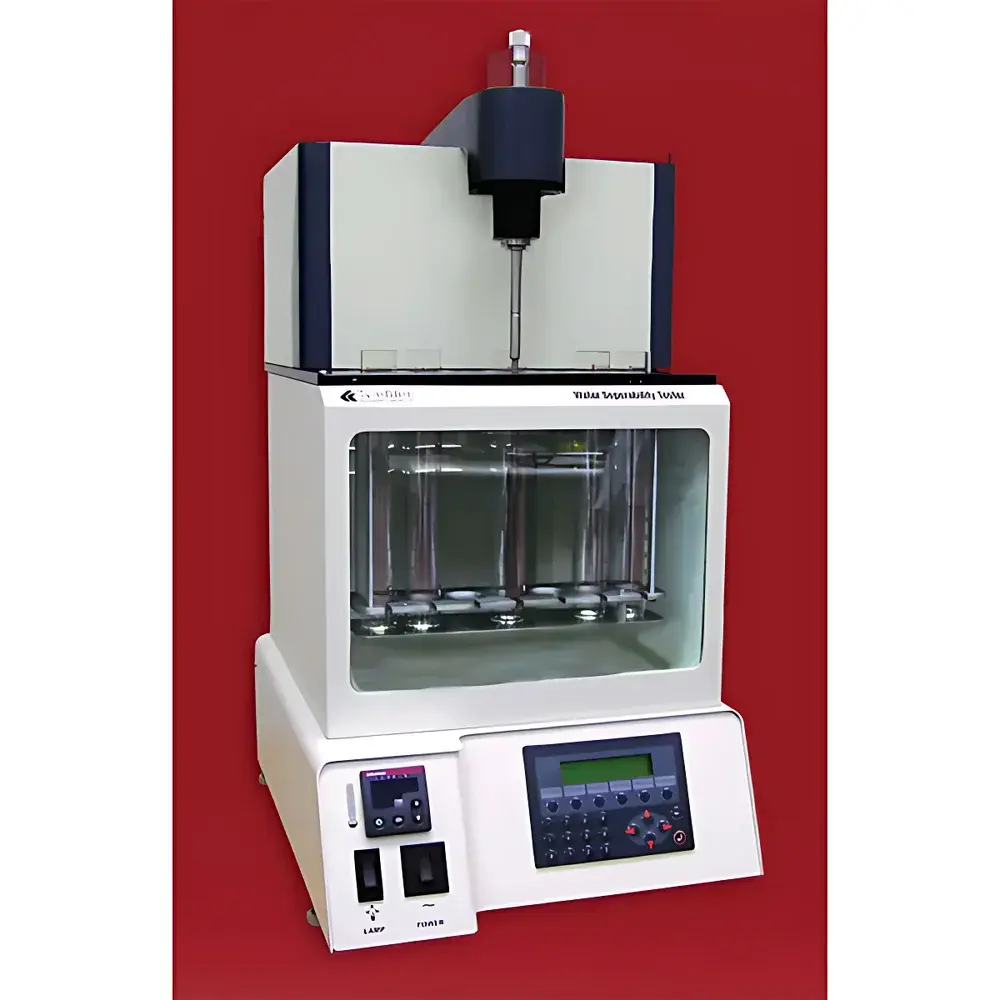
Koehler K39495 Petroleum and Synthetic Fluid Water Separability Tester
| Brand | Koehler |
|---|---|
| Origin | USA |
| Model | K39495 |
| Temperature Range | 25–84 °C |
| Temp. Stability | ±0.05 °C |
| Stirring Speed | 0–2000 rpm |
| Stirring Accuracy | ±1 rpm |
| Simultaneous Test Capacity | 7 × 100 mL samples |
| Bath Medium | Water or white mineral oil |
| Bath Volume | 15.15 L |
| Power Supply | 220–240 V / 50 Hz / 12 A |
| Dimensions (W×D×H) | 52.7 × 38.75 × 74.9 cm |
| Heating Power | 75 W (1/10 hp) |
| Bath Material | Transparent polycarbonate (25.5 × 28 × 24 cm) |
| Standards Compliance | ASTM D1401, D6074, D6158 |
Overview
The Koehler K39495 Petroleum and Synthetic Fluid Water Separability Tester is a precision-engineered laboratory instrument designed to quantify the ability of lubricating oils and synthetic fluids to separate from water under controlled agitation and thermal conditions. Based on the fundamental principle of interfacial destabilization kinetics—where emulsion breakdown is monitored visually over time—the instrument implements standardized protocols that rely on defined temperature, mixing intensity, and phase-volume ratios. This method directly assesses a critical performance parameter: resistance to emulsification and efficiency of water rejection during service, especially in turbine, hydraulic, and circulating systems where moisture ingress is inevitable. The system operates by homogenizing equal volumes of test fluid and distilled water at specified temperatures (e.g., 54 °C or 82 °C per ASTM D1401), followed by timed observation of phase separation—specifically the time required for formation of a distinct, clear interface between the oil and aqueous layers, and subsequent measurement of residual emulsion volume.
Key Features
- Seven-position Pyrex™-lined constant-temperature bath with transparent front viewing window and integrated LED illumination for unambiguous visual assessment of phase separation dynamics.
- Microprocessor-based digital temperature controller featuring ±0.05 °C stability across the full operating range (25–84 °C), with dual safety mechanisms: automatic overheat cutoff and low-bath-level detection.
- Digitally controlled high-torque stirrer (75 W, 1/10 hp) delivering precise rotational speeds from 0 to 2000 rpm with ±1 rpm accuracy; programmable stirring duration up to 99.99 minutes.
- Intuitive push-button interface enabling independent adjustment of temperature setpoint, stirring speed, and timing—all parameters automatically stored upon confirmation.
- Polycarbonate bath vessel (25.5 × 28 × 24 cm) resistant to thermal shock and chemical exposure, accommodating standard 100 mL test tubes; compatible with both aqueous and non-aqueous bath media (water or white mineral oil).
- Rapid thermal equilibration: typical stabilization at 54 °C or 82 °C achieved within ≤10 minutes, minimizing throughput delays without compromising thermal uniformity.
Sample Compatibility & Compliance
The K39495 supports testing of a broad spectrum of petroleum-derived and synthetically formulated fluids—including turbine oils, hydraulic fluids, compressor oils, gear oils, and ester- or polyglycol-based lubricants—as specified in ASTM D1401, D6074, and D6158. Its design fully satisfies the mechanical, thermal, and dimensional requirements of ISO 6614, DIN 51599, FTM 791-3201, and NF T60-125. Each test position maintains identical thermal and hydrodynamic boundary conditions, ensuring inter-test reproducibility and inter-laboratory comparability. The system’s compliance with these standards makes it suitable for use in quality control laboratories operating under ISO/IEC 17025, API Q1, or ASME NQA-1 frameworks. No modifications or add-ons are required to meet audit-ready documentation expectations for routine QC release testing.
Software & Data Management
While the K39495 operates as a standalone benchtop instrument with embedded digital controls, its operational parameters—including temperature setpoint, stir speed, duration, and user-defined test IDs—are retained in non-volatile memory. All settings persist through power cycles, eliminating reconfiguration overhead between runs. Though no proprietary software suite is bundled, the instrument’s deterministic behavior and traceable calibration pathways support integration into LIMS environments via manual data entry or external timestamped log sheets. For laboratories subject to FDA 21 CFR Part 11 or GLP/GMP requirements, the device supports audit-trail-compatible documentation when paired with validated SOPs governing operator training, daily verification checks (e.g., thermometer calibration, stir speed validation), and raw data recording in bound lab notebooks or electronic systems.
Applications
- Quality assurance of new lubricant batches prior to shipment, verifying conformance to OEM-specified water separability limits.
- Monitoring in-service oil degradation in power generation and marine applications, where prolonged water retention accelerates oxidation and corrosion.
- Formulation development of demulsibility-enhanced additives, enabling comparative screening of candidate chemistries under identical shear and thermal stress profiles.
- Root-cause analysis of field failures linked to poor water shedding—e.g., servo valve sticking, filter blinding, or rust formation in hydraulic reservoirs.
- Regulatory submission testing for military specifications (e.g., MIL-PRF-25017, MIL-PRF-17331) requiring documented adherence to FTM 791-3201.
FAQ
What standards does the K39495 explicitly support?
ASTM D1401, D6074, D6158; ISO 6614; DIN 51599; FTM 791-3201; and NF T60-125.
Can the bath operate with media other than water?
Yes—white mineral oil may be used as an alternative bath medium for tests requiring elevated temperatures beyond water’s boiling point, provided viscosity and thermal conductivity remain within instrument specifications.
Is calibration certification included with shipment?
The unit ships with factory verification of temperature and stir speed accuracy; NIST-traceable calibration certificates are available as an optional add-on.
How is test tube alignment maintained during agitation?
Each of the seven positions features a precision-machined sleeve that centers the 100 mL test tube vertically and restricts lateral displacement, ensuring consistent shear distribution across all samples.
What maintenance is required for long-term reliability?
Routine cleaning of the bath chamber and stir shaft; annual verification of temperature sensor drift and stir motor torque output using calibrated reference instruments.