
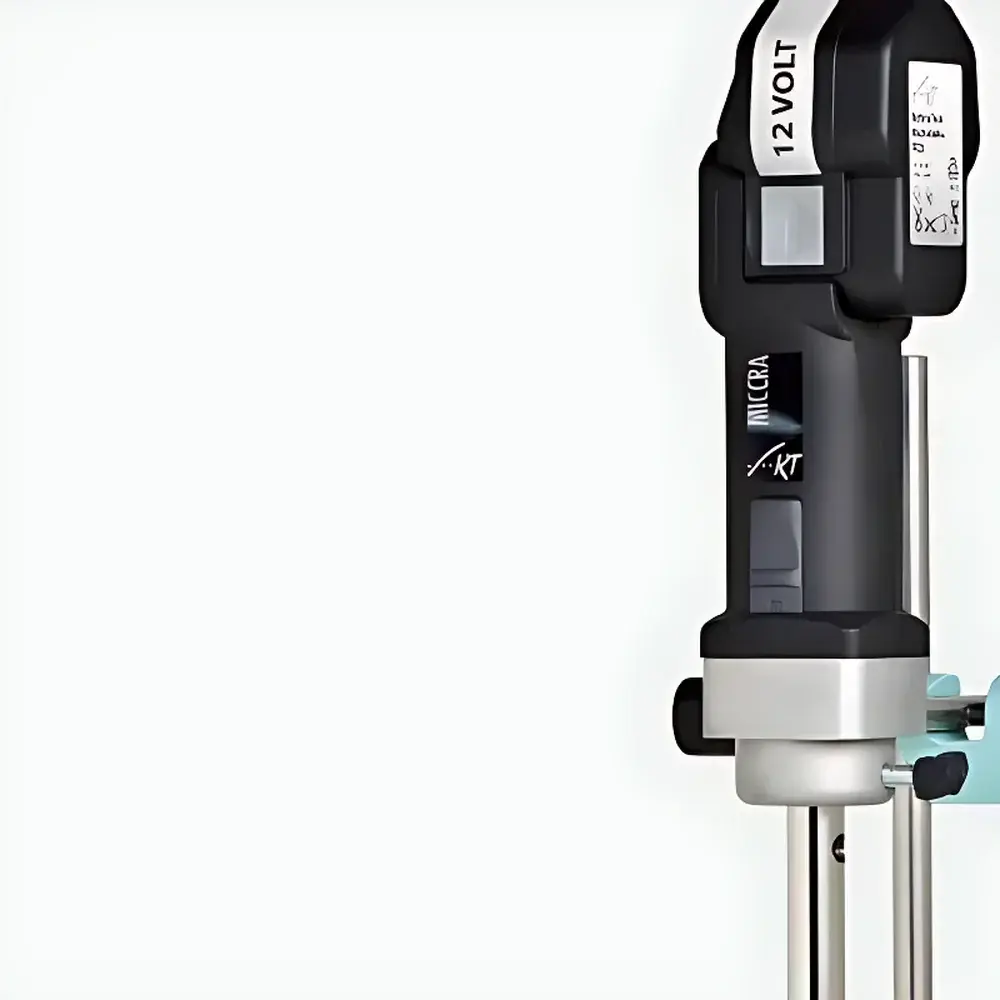
ART MICCRA D-3/PA Cordless High-Performance Disperser
| Brand | ART |
|---|---|
| Origin | Germany |
| Model | MICCRA D-3/PA |
| Power Source | Rechargeable Lithium-Ion Battery |
| Drive Type | Planetary Gear Motor |
| Maximum Speed | 12,000 rpm |
| Shaft Diameter Compatibility | Up to 10 mm |
| Weight (without tool) | 1.8 kg |
| IP Rating | IP54 |
| Operating Temperature Range | 5–40 °C |
| Compliance | CE, RoHS, ISO 9001-certified manufacturing |
Overview
The ART MICCRA D-3/PA is the world’s first high-torque, fully cordless disperser engineered for true field-deployable operation in laboratory, pilot-scale, and industrial R&D environments. Unlike conventional benchtop dispersers reliant on AC power or tethered battery packs, the D-3/PA integrates a high-capacity lithium-ion battery with a planetary gear motor system—delivering consistent torque output across its full speed range (up to 12,000 rpm) without voltage drop or thermal throttling. Its measurement principle is based on high-shear mechanical dispersion via rotating rotor-stator assemblies, enabling efficient particle size reduction, deagglomeration, and homogeneous phase integration in low- to medium-viscosity liquids (≤ 5,000 mPa·s). Designed for reproducible dispersion under variable ambient conditions, the unit maintains rotational stability even during extended handheld use—making it suitable for applications where sample integrity, spatial flexibility, and real-time process assessment are critical.
Key Features
- True cordless architecture: Integrated rechargeable battery supports ≥ 2.5 hours of continuous operation at 8,000 rpm (typical usage profile), with intelligent charge-level indicator and fast-recharge capability (0–100% in ≤ 90 min).
- Planetary gear drive: Delivers high starting torque (≥ 0.45 N·m) and minimal speed deviation (< ±2% at rated load), essential for consistent dispersion of abrasive or dense suspensions.
- Ergonomic handheld design: Weighing only 1.8 kg (without dispersing tool), balanced center-of-gravity and non-slip polymer housing reduce operator fatigue during prolonged manual operation.
- Dust- and splash-resistant enclosure (IP54): Certified for use in non-hazardous environments with transient exposure to humidity, dust, or light splashing—enabling deployment in cleanrooms, outdoor sampling sites, or mobile analytical labs.
- Tool-free quick-change shaft system: Accepts standard 6–10 mm diameter dispersing elements (e.g., toothed discs, saw-tooth rotors, anchor impellers) per DIN ISO 8504-2; no wrenches or alignment fixtures required.
- Thermal management: Passive cooling fins combined with duty-cycle monitoring prevent motor overheating during intermittent high-load cycles (e.g., pigment pastes, ceramic slurries).
Sample Compatibility & Compliance
The MICCRA D-3/PA accommodates a broad spectrum of sample types—including aqueous and organic suspensions, polymer emulsions, nanocomposite precursors, pharmaceutical suspensions, and food-grade colloids—provided viscosity remains within operational limits and dispersing tools are chemically compatible. It supports compliance with key quality frameworks: instrument design and manufacturing adhere to ISO 9001 standards; electrical safety conforms to EN 61000-6-3 (EMC) and EN 61000-6-2 (immunity); and mechanical construction meets CE Directive 2006/42/EC for machinery. While not intrinsically safe for ATEX zones, its IP54 rating permits use in controlled GMP environments when paired with validated dispersing tools and documented cleaning procedures (e.g., SOP-based residue verification per USP ).
Software & Data Management
The D-3/PA operates as a standalone instrument without embedded firmware or digital connectivity—intentionally designed for robustness, minimal maintenance, and regulatory simplicity. All operational parameters (speed, runtime, charge status) are displayed via dual LED indicators; no software installation, cloud synchronization, or cybersecurity protocols are required. This analog-first architecture ensures full auditability in GLP/GMP settings where electronic records must comply with FDA 21 CFR Part 11—eliminating validation burdens associated with data logging systems. Users maintain full traceability through manual logbooks or external time-stamped video documentation of dispersion protocols.
Applications
- Rapid formulation screening: On-site dispersion of pigment concentrates, battery electrode slurries, or cosmetic bases without relocating samples to fixed lab infrastructure.
- Field-based QC testing: Real-time homogenization of environmental water samples prior to filtration or ICP-MS analysis; ideal for mobile environmental monitoring units.
- Pilot-plant process development: Scalable dispersion trials using identical rotor geometry as production-scale equipment—supporting DOE studies with minimized scale-up uncertainty.
- Academic research: Portable shear stress application in rheology education, nanoparticle synthesis, or biopolymer dispersion where spatial constraints limit access to mains-powered equipment.
- Pharmaceutical preformulation: Low-oxygen dispersion of oxygen-sensitive APIs using inert-gas-purged vessels—facilitated by unrestricted mobility and absence of power cords near gloveboxes.
FAQ
Is the MICCRA D-3/PA suitable for viscous pastes above 5,000 mPa·s?
No—its motor and thermal design are optimized for low- to medium-viscosity fluids. For higher-viscosity applications, ART recommends the D-9 series with geared AC drive.
Can the battery be replaced by the end user?
Yes—the battery pack is field-replaceable using two Torx T10 screws; replacement units are available as spare parts with full CE marking and UN38.3 transport certification.
Does the device support speed ramping or programmable profiles?
No—it features fixed-speed selection via rotary dial (10 preset steps from 1,000–12,000 rpm) to ensure mechanical reliability and simplify regulatory documentation.
What certifications apply to the dispersing tools?
All standard ART dispersing elements are manufactured to ISO 8504-2 and supplied with material traceability (3.1 mill certificates); stainless steel variants comply with ASTM A276 and EN 10088-1.
How is calibration verified for this instrument?
Speed accuracy is factory-verified using NIST-traceable tachometry; users may perform periodic verification with an optical tachometer—no recalibration is required under normal operating conditions.



