Galvanic ViscoSite (Nametre) Online Viscometer
| Brand | Galvanic |
|---|---|
| Origin | USA |
| Manufacturer Type | Authorized Distributor |
| Origin Category | Imported |
| Model | ViscoSite (Nametre) |
| Price Range | USD 14,000 – 70,000 |
| Measurement Principle | Torque-based Micro-Oscillation Rheometry |
| Probe Types | LV, MV, HV, XV (XV only for VL800) |
| Viscosity Range | 0.1–5,000,000 cP (customizable beyond) |
| Calibration | NIST-traceable Newtonian fluids pre-calibrated at factory |
| Accuracy | ±1% of reading |
| Repeatability | ±0.25% of reading |
| Linearity | ±1% |
| Operating Temperature (Process) | –40 to 450 °C (with optional cooling jacket) |
| Internal Probe Temp Range | –40 to 200 °C |
| Max Flow Velocity | 2 m/s |
| Vibration Frequency | Up to 700 Hz |
| Probe Materials | 316L stainless steel, NEMA 4X-rated housing |
| Process Connection | ANSI 3" 300#, DN80 PN40 flange |
| Cable | MIL-SPEC, up to 1000 m |
Overview
The Galvanic ViscoSite (Nametre) Online Viscometer is an industrial-grade, in-line rheological monitoring system engineered for continuous, real-time viscosity measurement in demanding process environments. It operates on the principle of torque-based micro-oscillation rheometry — a method grounded in controlled mechanical resonance rather than rotational drag or capillary flow. A precision-machined probe, driven by a calibrated electromagnetic coil, oscillates at a fixed amplitude and variable frequency (up to 700 Hz). When immersed in process fluid, viscous resistance induces phase lag and damping; the system maintains constant oscillation amplitude by dynamically adjusting drive current. This current demand is linearly correlated to dynamic viscosity under defined shear conditions, enabling robust, non-intrusive quantification without moving parts in contact with flow. Unlike rotational or capillary viscometers, the ViscoSite does not require sample extraction, bypass loops, or periodic recalibration — its factory calibration is NIST-traceable and remains stable over time, provided mechanical integrity is preserved.
Key Features
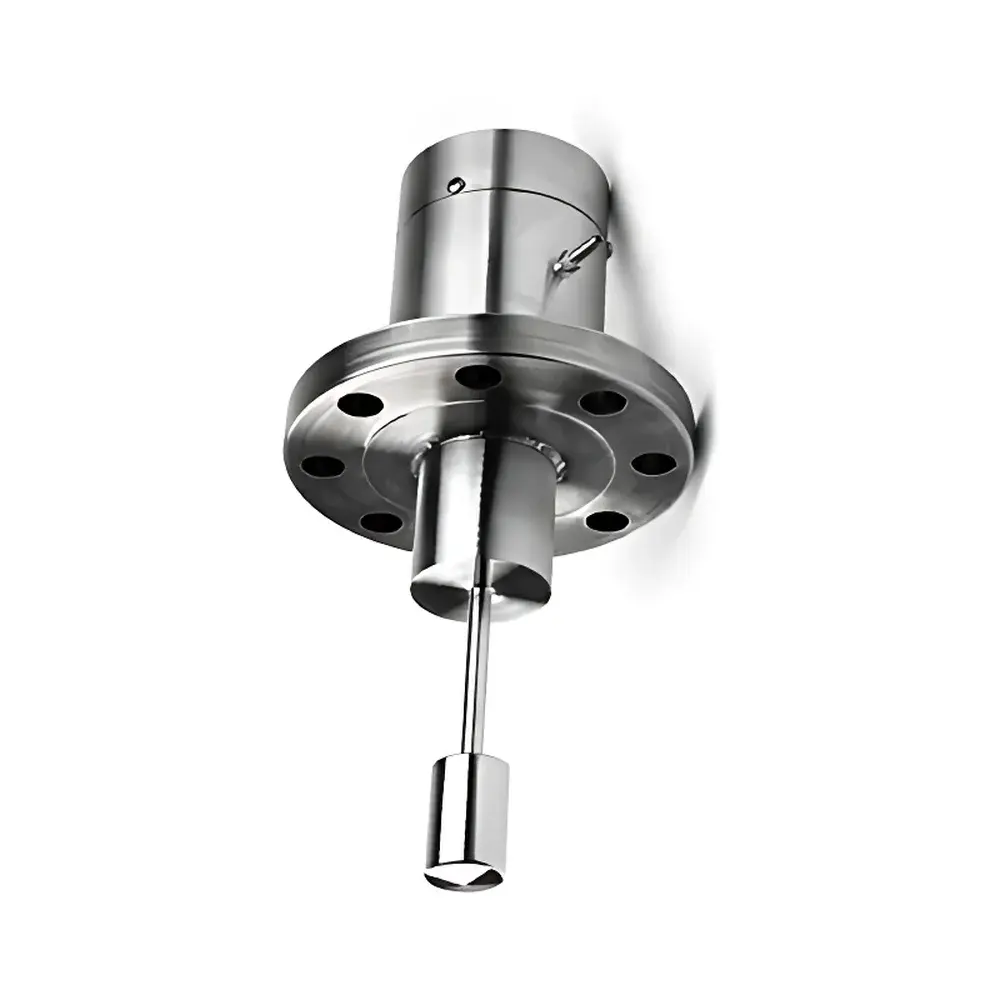
- True in-line operation: Weld-mountable probe design ensures hermetic process isolation and eliminates leak paths or gasket degradation risks.
- Multi-parameter compensation: Integrated Pt100 RTD provides simultaneous temperature measurement; optional analog inputs accept pressure and density signals for real-time viscosity correction per ASTM D2983 and ISO 2555 protocols.
- Configurable probe geometry: Four standard probe variants (LV, MV, HV, XV) optimize sensitivity across viscosity ranges from 0.1 cP to 5,000,000 cP — including high-shear, high-temperature, and non-Newtonian applications.
- Dead-zone mitigation: Optional NAE (Non-Active Extension) neck extends probe immersion depth into low-velocity zones, preventing material buildup, carbonization, or false-low readings in high-viscosity polymer melts or catalyst slurries.
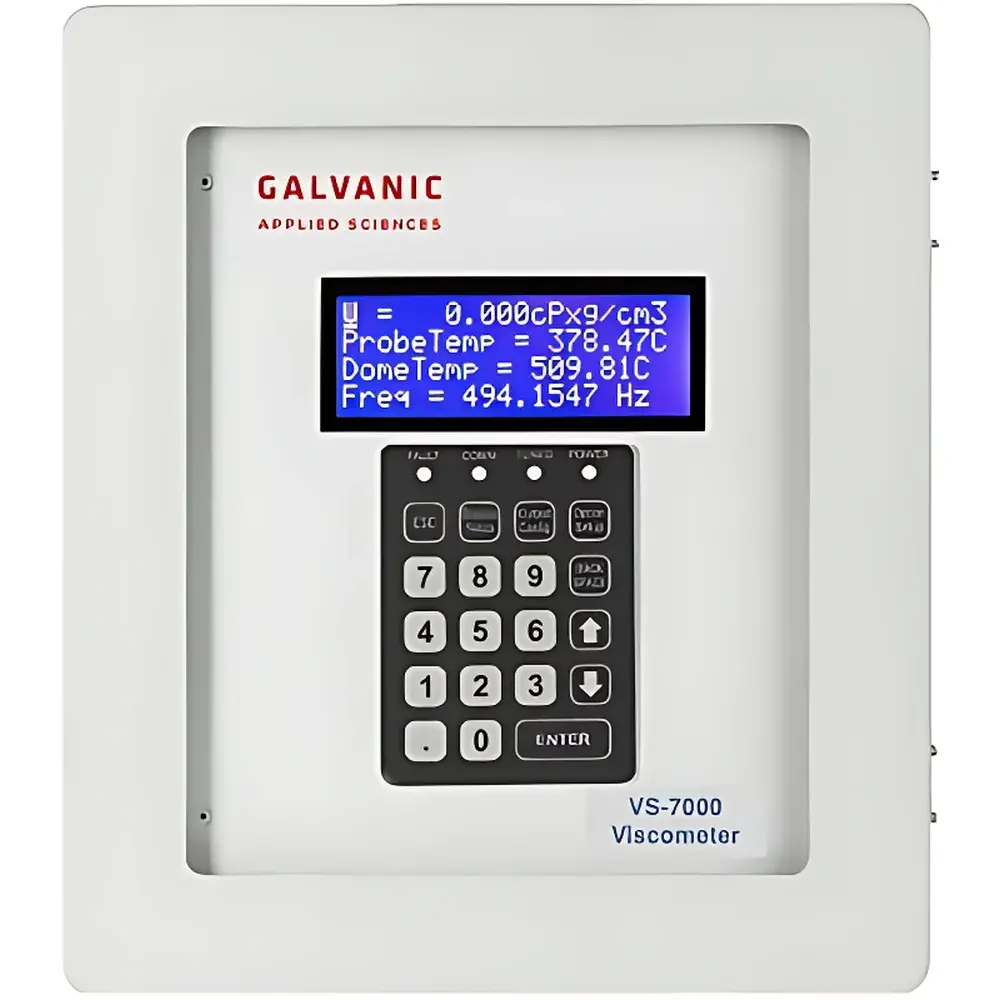
- Real-time operational diagnostics: Transmitter-mounted LED indicates active probe oscillation status; vibration frequency is continuously monitored and logged for predictive maintenance.
- Ruggedized construction: 316L stainless steel probe body, NEMA 4X-rated electronics enclosure, and MIL-SPEC cabling rated for 1000 m distance support deployment in hazardous, high-vibration, or remote locations.
Sample Compatibility & Compliance
The ViscoSite is validated for use with Newtonian and moderately shear-thinning non-Newtonian fluids, including solvents, monomers, resins, asphalt, edible oils, pharmaceutical suspensions, and polymer melts. It tolerates suspended solids up to 30% v/v (depending on particle size distribution), moderate gas entrainment, and transient thermal gradients. Its design conforms to ASME B31.3 process piping requirements and meets IEC 61508 SIL 2 functional safety readiness for integration into SIS loops. All factory calibrations are traceable to NIST Standard Reference Materials (SRMs), supporting compliance with FDA 21 CFR Part 11 when paired with audit-trail-enabled software (e.g., Galvanic Insight Suite). The instrument satisfies ISO/IEC 17025 documentation requirements for in-process metrology and supports GLP/GMP validation protocols via IQ/OQ/PQ templates.
Software & Data Management
The ViscoSite interfaces seamlessly with Galvanic’s Insight Suite — a secure, browser-based platform supporting OPC UA, Modbus TCP, and HART-IP communication. Raw current, temperature, frequency, and compensated viscosity values are timestamped with millisecond resolution and stored locally (onboard SD card) and/or remotely (SQL or cloud-hosted database). Trending dashboards enable overlay of viscosity vs. temperature, pressure, or reactor batch ID. Alarm thresholds are configurable per ISA-18.2 standards, with email/SMS notifications and event-driven data export (CSV, PDF, XML). Full audit trail functionality logs all configuration changes, user logins, and calibration events — satisfying FDA 21 CFR Part 11 electronic record requirements when deployed with digital signature and role-based access control.
Applications
- Polymerization reactors: Monitoring gel point onset and molecular weight development in PET, PVC, and epoxy synthesis.
- Fuel blending: Real-time viscosity verification during diesel/biodiesel mixing to ensure ASTM D975 compliance.
- Pharmaceutical manufacturing: In-line consistency control of ointments, gels, and suspension concentrates per USP <911>.
- Food processing: Continuous QC of chocolate, sauces, and dairy emulsions across thermal hold zones.
- Waste treatment: Sludge dewatering optimization via viscosity feedback to centrifuge feed control loops.
- Adhesives & coatings: Batch-to-batch consistency assurance for acrylics, epoxies, and UV-curable formulations.
FAQ
Is field recalibration required after installation?
No. Each ViscoSite unit is factory-calibrated using NIST-traceable Newtonian reference fluids across its specified range. Recalibration is only necessary if the probe sustains physical damage or undergoes repair.
Can the ViscoSite measure non-Newtonian fluids accurately?
It provides reliable relative viscosity trends and endpoint detection for shear-thinning systems (e.g., polymer melts), but absolute apparent viscosity values assume Newtonian behavior within the probe’s characteristic shear rate profile (~10–1000 s⁻¹, depending on model and flow velocity).
What is the maximum allowable process pressure?
Standard probes are rated for ANSI 300# flanges (515 psi at 100 °C); custom high-pressure versions (up to 2500 psi) are available upon request.
How does temperature compensation work?
The integrated Pt100 RTD measures local fluid temperature at the probe surface. Compensation uses a user-configurable Arrhenius or Vogel–Fulcher–Tammann model, applied in real time to raw viscosity output.
Is explosion-proof certification available?
Yes. ATEX II 2G Ex db IIB T4 Gb and IECEx DBVS 20.0031X certifications are available for Zone 1 installations; CSA C/US Class I Div 1 options also supported.
Related Products