
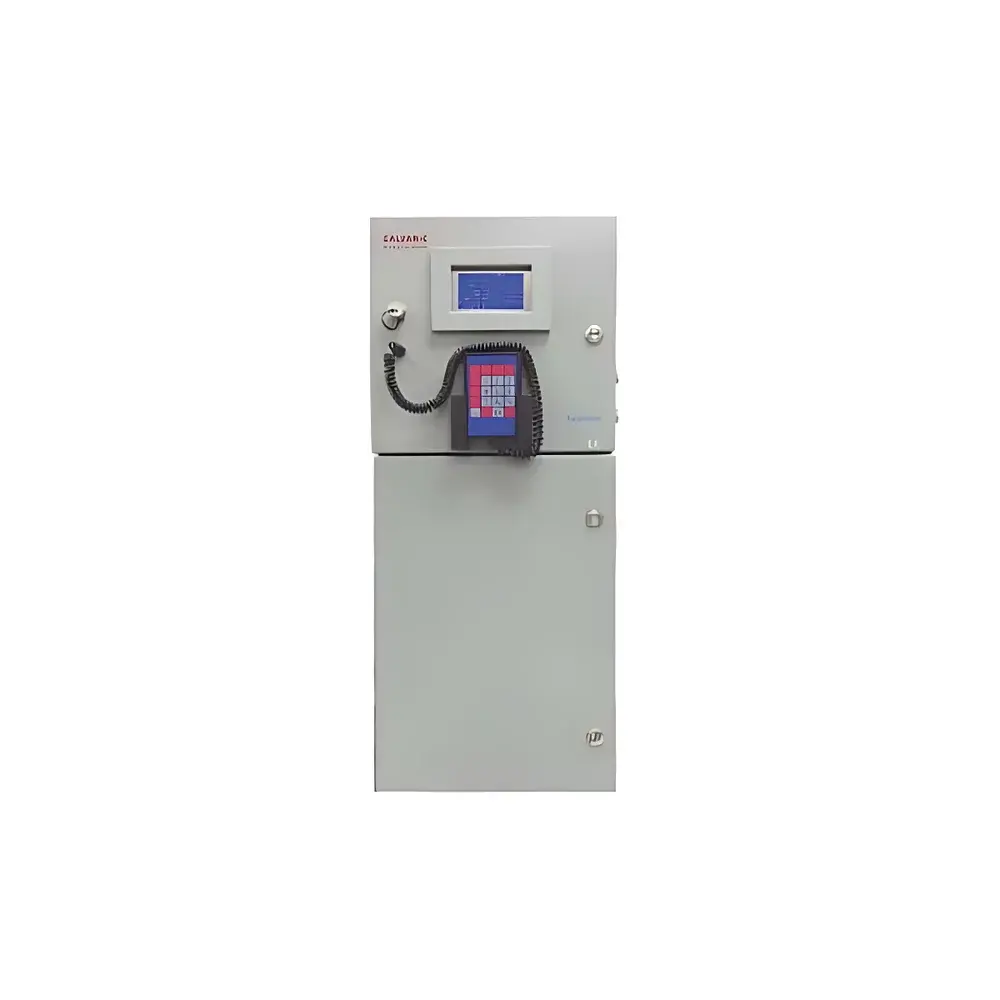
Galvanic Accuseies Series Online Sulfuric Acid Analyzer for Phenol-Acetone Process
| Brand | Galvanic |
|---|---|
| Origin | USA |
| Model | Accuseies Series |
| Measurement Principle | Colorimetric Titration with Dual-Wavelength Photometric Endpoint Detection (650 nm / 810 nm) |
| Range Options | 0–20 mg/L or 0–500 mg/L H₂SO₄ |
| Accuracy | ±1% of full scale |
| Linearity | ±1% FS |
| Repeatability | ±1% RSD |
| Analysis Cycle Time | 15 min per sample |
| Sample Flow Rate | 200 mL/min |
| Max Sample Pressure | <5 psi |
| Suspended Solids Limit | <1,000 µm |
| Operating Temperature | −20 °C to +60 °C |
| Dimensions | 1016 mm (H) × 406 mm (W) × 241 mm (D) |
| Weight | 45.3 kg |
| Power Supply | 24 VDC or 90–240 VAC |
| Enclosure Rating | NEMA 4X (IP65) |
| Communication | 4–20 mA, Modbus RTU (RS232/RS485), Modbus TCP/IP, USB, Ethernet |
| Digital I/O | 8 programmable dry/wet contacts (24 VDC) |
| Analog Outputs | Up to 8 isolated 4–20 mA loops (self-powered) |
| Sample Interface | 1/4″ compression fitting |
| Environmental Resistance | H₂S- and Cl₂-resistant materials |
| System Architecture | Physically isolated electronic control unit and wet chemistry module |
Overview
The Galvanic Accuseies Series Online Sulfuric Acid Analyzer is an industrial-grade, fully automated photometric titration system engineered specifically for continuous sulfuric acid concentration monitoring in phenol-acetone process streams—particularly at the hydrolysis effluent stage of bisphenol-A (BPA) production. Unlike generic conductivity or pH-based proxies, this analyzer employs a validated colorimetric titration method with dual-wavelength photometric endpoint detection (650 nm measurement wavelength and 810 nm reference wavelength), ensuring high specificity for sulfate ion in complex, organic-laden matrices containing residual phenol, acetone, and condensation byproducts. Its robust architecture eliminates cross-sensitivity to turbidity, color interference, and ionic strength variations common in BPA plant effluents. Designed for integration into existing DCS/PLC environments, it operates unattended for 24/7 cycle analysis—automating reagent dosing, endpoint recognition, post-measurement cleaning, zero calibration, and waste handling without operator intervention.
Key Features
- Fully autonomous operation: Integrated peristaltic pumps, solenoid valves, and heated reaction cell enable complete reagent delivery, titration, endpoint detection, rinse, and waste evacuation within each 15-minute cycle.
- Dual-wavelength photometry: Simultaneous 650 nm absorbance measurement and 810 nm reference correction compensate for background color drift and particulate scattering—critical for real-time accuracy in non-clear process liquors.
- Modular multi-stream capability: Wet chemistry module supports up to six independent sample inlets, allowing sequential analysis of primary stream plus up to five auxiliary points (e.g., feed, recycle, neutralization tank, final effluent).
- Electronically isolated architecture: Control motherboard and fluidic subsystem are physically separated; failure in one domain does not compromise data logging, alarm generation, or DCS communication.
- Explosion-rated variants: Certified ATEX II 2G Ex db IIB T4 Gb, CSA Class I Div 1 Group B/C/D, and Russian TR CU 012/2011 (GOST-R) versions available for Zone 1/Division 1 hazardous areas.
- Comprehensive diagnostics: Embedded self-test routines monitor reagent levels, sample presence, electrode response stability, optical path cleanliness, and pump occlusion—triggering configurable relay alarms and Modbus status flags.
Sample Compatibility & Compliance
The analyzer is validated for use with aqueous process streams containing ≤1,000 µm suspended solids, operating under pressures <5 psi and ambient temperatures from −20 °C to +60 °C. Its fluidic path utilizes chemically inert PFA, ETFE, and ceramic components resistant to H₂S, chlorine, and low-pH sulfuric acid exposure. All wetted materials comply with USP Class VI and FDA 21 CFR Part 177 requirements for indirect food contact. The system supports audit-ready operation under GLP and GMP frameworks: full event logging (including reagent lot numbers, calibration timestamps, and user-initiated actions), electronic signatures via password-protected GUI, and tamper-evident configuration history—all exportable in CSV or XML format. It meets IEC 61511 SIL 2 functional safety requirements when integrated with external SIS logic solvers.
Software & Data Management
The embedded Linux-based controller runs Galvanic’s AccuView™ firmware, accessible via web browser (HTTPS), native Windows GUI (USB/Ethernet), or OPC UA server. Configuration includes programmable assay sequences: pre-titration blank subtraction, variable reagent addition volumes, post-measurement flush duration, and adaptive zero-point recalibration intervals. All measurements are timestamped with microsecond precision and stored locally (8 GB internal flash) with automatic rollover. Data export supports Modbus register mapping, MQTT publishing to cloud historians (e.g., OSIsoft PI, Ignition), and scheduled FTP/SFTP transfers. Audit trails record every parameter change, calibration event, and alarm activation—including operator ID, IP address, and reason code—satisfying FDA 21 CFR Part 11 electronic record and signature requirements.
Applications
This analyzer is deployed at critical control points across phenol-acetone plants: real-time monitoring of sulfuric acid concentration in hydrolysis reactor effluent to optimize caustic neutralization dosage; feedback control of acid recovery columns; verification of acid carryover into downstream crystallizers; and compliance reporting for wastewater discharge permits (e.g., EPA 40 CFR Part 414). Its performance has been verified per ASTM D1093 (Standard Test Method for Sulfuric Acid in Industrial Chemicals) and ISO 9297 (Water Quality — Determination of Sulfate — Turbidimetric Method) through third-party validation studies conducted at licensed BPA manufacturing sites in North America and Asia.
FAQ
What sample preparation is required prior to analysis?
None—samples enter directly via 1/4″ compression fitting; the system handles filtration-free analysis of liquids with particles ≤1,000 µm.
Can the instrument be calibrated using certified reference standards?
Yes—NIST-traceable sulfuric acid standard solutions (0–20 mg/L and 0–500 mg/L) are supported; calibration curves are stored with expiration dates and uncertainty budgets.
Is remote firmware update supported?
Yes—secure over-the-air (OTA) updates via HTTPS or local USB stick; version rollback and integrity checksum verification are enforced.
How is reagent consumption managed?
Reagent reservoirs include level sensors; low-level alerts trigger email/SMS notifications and can halt analysis until replenishment.
Does the system support regulatory audit requirements?
Yes—full 21 CFR Part 11 compliance including electronic signatures, audit trail encryption, role-based access control, and immutable log archiving.







