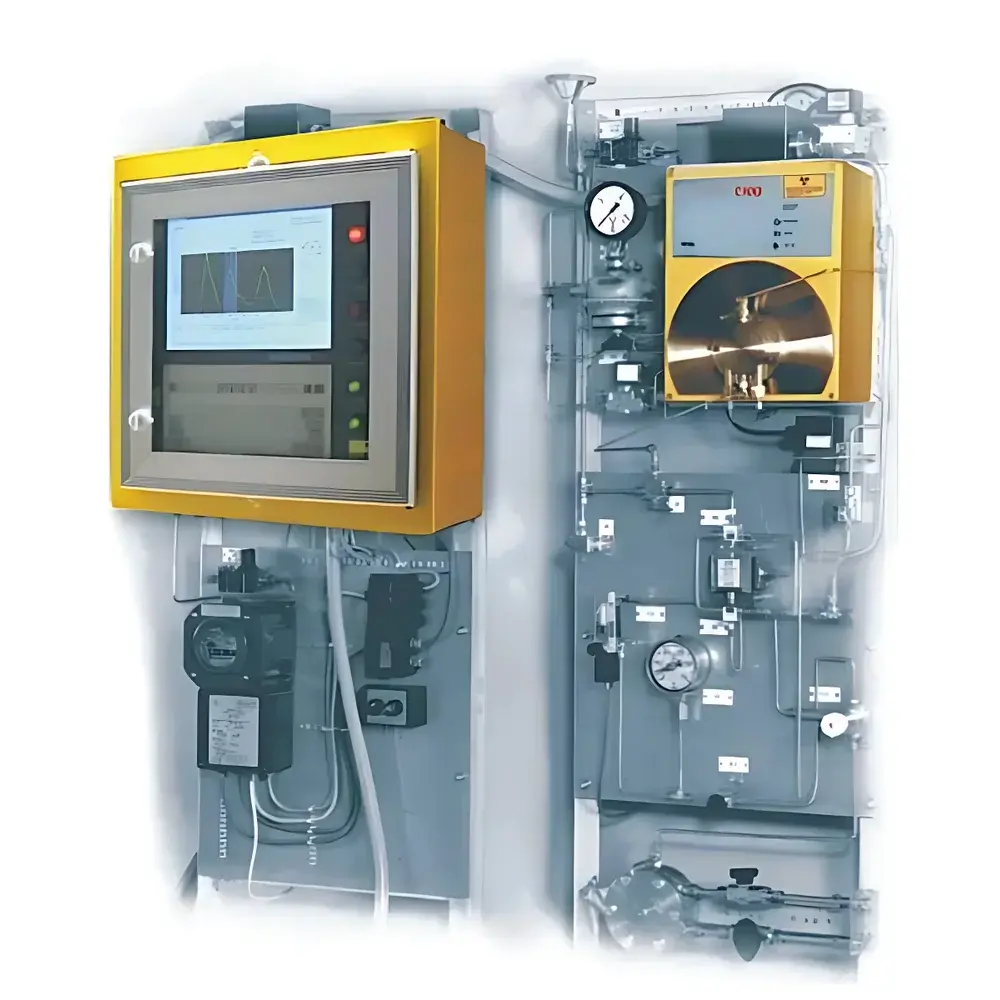
Metorex C100 Online Total Sulfur Analyzer by Energy-Dispersive X-ray Fluorescence
| Origin | Netherlands |
|---|---|
| Manufacturer Type | Authorized Distributor |
| Origin Category | Imported |
| Model | Metorex C100 |
| Detection Principle | Energy-Dispersive X-ray Fluorescence (EDXRF) |
| Portability | Fixed-Installation |
| Analyte | Total Sulfur |
| Measurement Range | 0.5 ppm to 10 wt% |
| Analysis Mode | Real-Time Continuous Monitoring |
| Detection Limit | 0.5 ppm (S, in liquid hydrocarbons) |
| Accuracy | Compliant with ASTM D4294 and ASTM D7212 |
| Regulatory Compliance | Designed for GLP/GMP environments |
Overview
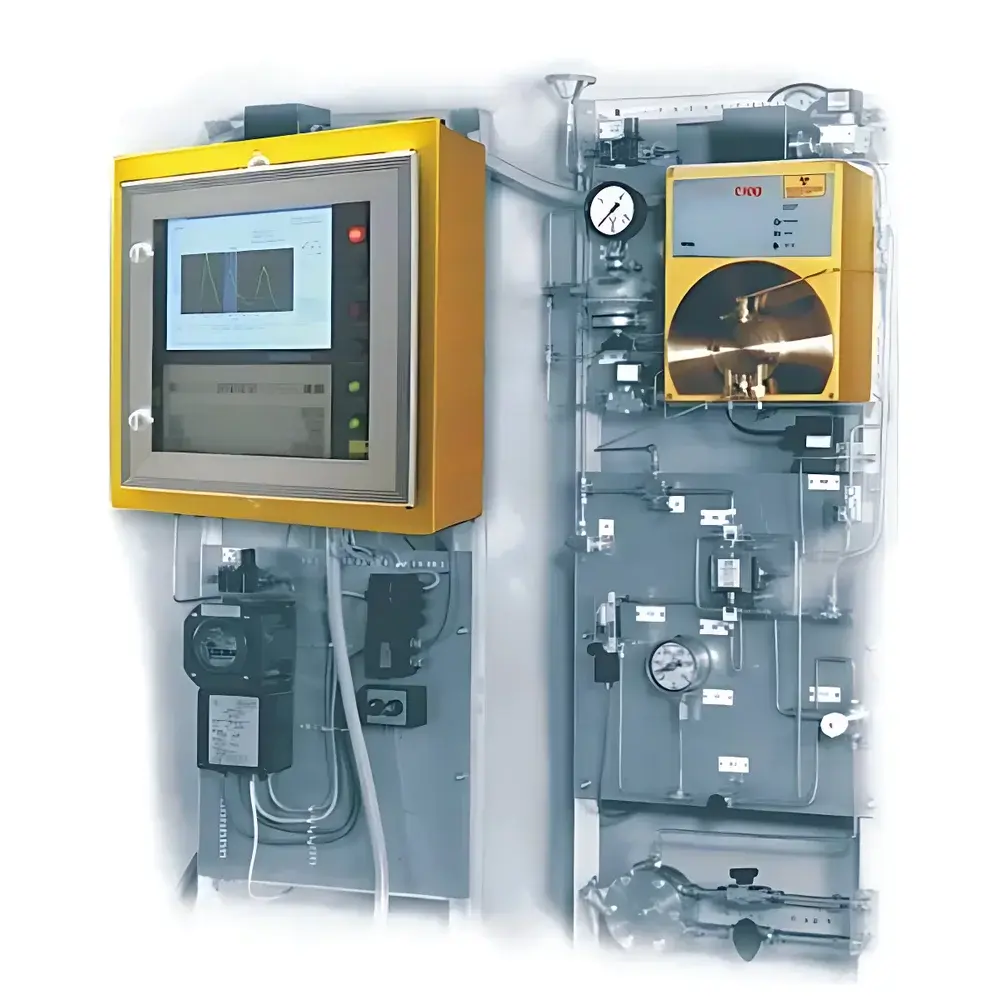
The Metorex C100 Online Total Sulfur Analyzer is a fourth-generation, fixed-installation elemental analyzer engineered for continuous, real-time quantification of total sulfur in liquid petroleum streams—including diesel, gasoline, naphtha, and crude oil—using Energy-Dispersive X-ray Fluorescence (EDXRF) spectroscopy. Unlike combustion-based or wet-chemical methods, the C100 operates on a non-destructive, direct excitation principle: incident X-rays from a sealed-tube source induce characteristic secondary (fluorescent) X-ray emission from sulfur atoms (Kα line at 2.307 keV) within the flowing sample. The intensity of this emitted radiation is linearly proportional to sulfur concentration across a dynamic range spanning 0.5 ppm to 10 wt%. As the world’s first commercial online EDXRF sulfur analyzer developer, Metorex has refined this architecture over four decades to eliminate moving parts, high-temperature reactors, carrier gases, or sample phase change—resulting in inherently stable, low-maintenance operation suitable for harsh refinery process environments.
Key Features
- Real-time continuous measurement with sub-second response time, enabling closed-loop process control and rapid detection of sulfur excursions.
- Patented high-resolution proportional counter detector with active background suppression—rejecting incomplete charge collection events to minimize spectral noise, especially critical for light-element (Z = 14–20) analysis including sulfur.
- Dual-window flow cell design: primary polymer window (e.g., polyimide or diamond-like carbon coated) resists fouling and chemical degradation; secondary protective window safeguards the detector against accidental rupture or particulate ingress.
- Integrated leak detection system automatically isolates the measurement cell and shuts off X-ray emission if window integrity is compromised—ensuring ALARA-compliant radiation safety.
- Optional heated flow cell (up to 80 °C) accommodates viscous feedstocks up to 100 cSt, maintaining laminar flow and consistent path length without pre-heating or dilution.
- Self-calibrating optical path: built-in reference source and internal standard correction compensate for long-term detector gain drift and electronic offset, ensuring ±0.35 ppm repeatability in diesel matrix (verified per ASTM D4294 precision protocols).
- X-ray tube power supply includes soft-start and thermal monitoring—eliminating warm-up delays and extending tube lifetime beyond 20,000 operating hours.
Sample Compatibility & Compliance
The C100 is validated for use with hydrocarbon liquids meeting API gravity ranges from 10° to 90° API and viscosity ≤100 cSt at process temperature. It is insensitive to variations in hydrogen-to-carbon ratio, density, or aromaticity—critical for feed-forward control in hydrotreating units. The analyzer conforms to ASTM D4294 (Standard Test Method for Sulfur in Petroleum and Petroleum Products by Energy-Dispersive X-ray Fluorescence Spectrometry) and ASTM D7212 (Standard Test Method for Low-Sulfur Content in Gasoline and Diesel Fuel by Wavelength-Dispersive X-ray Fluorescence Spectrometry, adapted for EDXRF with low-background proportional counting). Its hardware architecture and optional software modules support compliance with ISO/IEC 17025, USP /, and FDA 21 CFR Part 11 requirements when deployed in regulated manufacturing environments (e.g., refinery QC labs under GMP).
Software & Data Management
The C100 integrates with Metorex’s PES (Process Evaluation System) control unit, providing a web-accessible HMI with configurable alarm thresholds, trend logging, and export of time-stamped concentration data in CSV or OPC UA format. Firmware includes automated calibration verification routines using certified reference standards traceable to NIST SRMs. Audit trail functionality records all user actions—including method changes, calibration events, and maintenance logs—with tamper-resistant timestamps. Optional data historian integration enables synchronization with DCS/SCADA systems for predictive maintenance modeling and sulfur mass balance reconciliation across distillation and desulfurization units.
Applications
- Petroleum refining: In-line monitoring of product sulfur in hydrotreater effluents, reformer feeds, and finished gasoline/diesel blending streams—enabling real-time catalyst activity assessment and regulatory compliance reporting (e.g., Euro 6, Tier 3, China VI).
- Catalyst analysis: Quantification of trace metals (Co, Mo, Ni, V, K) and poisons (Na, Ca, Si) in spent FCC or hydroprocessing catalyst slurries via slurry-mode adaptation.
- Chemical process control: Monitoring bromine, manganese, or cobalt concentrations in acetic acid oxidation reactors or polyester polymerization catalyst systems.
- Environmental compliance: Continuous sulfur monitoring in sour water strippers and amine regenerator overheads to prevent SOx emissions violations.
- Downstream quality assurance: Verification of ultra-low-sulfur diesel (ULSD) specification adherence prior to pipeline injection or marine bunkering.
FAQ
Does the C100 require sample digestion or combustion?
No. It performs direct, non-destructive EDXRF analysis—no sample preparation, no oxygen or argon gas, no high-temperature oxidation.
Can it measure sulfur in high-salinity or water-contaminated fuels?
Yes, provided free water is removed upstream; emulsified water may attenuate X-ray transmission and must be addressed via coalescer or centrifugal separation.
What is the typical installation footprint and utility requirement?
The MHA (Measurement Head Assembly) requires 450 mm × 300 mm × 250 mm space and 230 VAC / 50–60 Hz power; cooling is air-only; no compressed air or chilled water required.
How often does the system require recalibration?
Factory calibration remains stable for ≥6 months under continuous operation; quarterly verification with certified reference materials is recommended per ASTM D4294 Section 9.
Is remote diagnostics supported?
Yes—via secure TLS-encrypted web interface with role-based access control; firmware updates and spectral diagnostics can be performed remotely with customer authorization.