NAMETRE ViscoLiner Online Viscometer
| Origin | USA |
|---|---|
| Manufacturer Type | Authorized Distributor |
| Origin Category | Imported |
| Model | ViscoLiner |
| Price Range | USD 14,000 – 70,000 |
| Measurement Range | 0.1–1,000,000 cP |
| Temperature Range | −40 °C to +450 °C |
| Max Pressure Rating | 350 bar |
| Repeatability | ±0.25% |
| Accuracy | ±2% |
| Response Time | 1 s |
| Integrated Temperature Sensor | PT100 RTD |
| Temperature Compensation | Yes |
| Flow-Immune Measurement Principle | Vibrational Resonance |
Overview
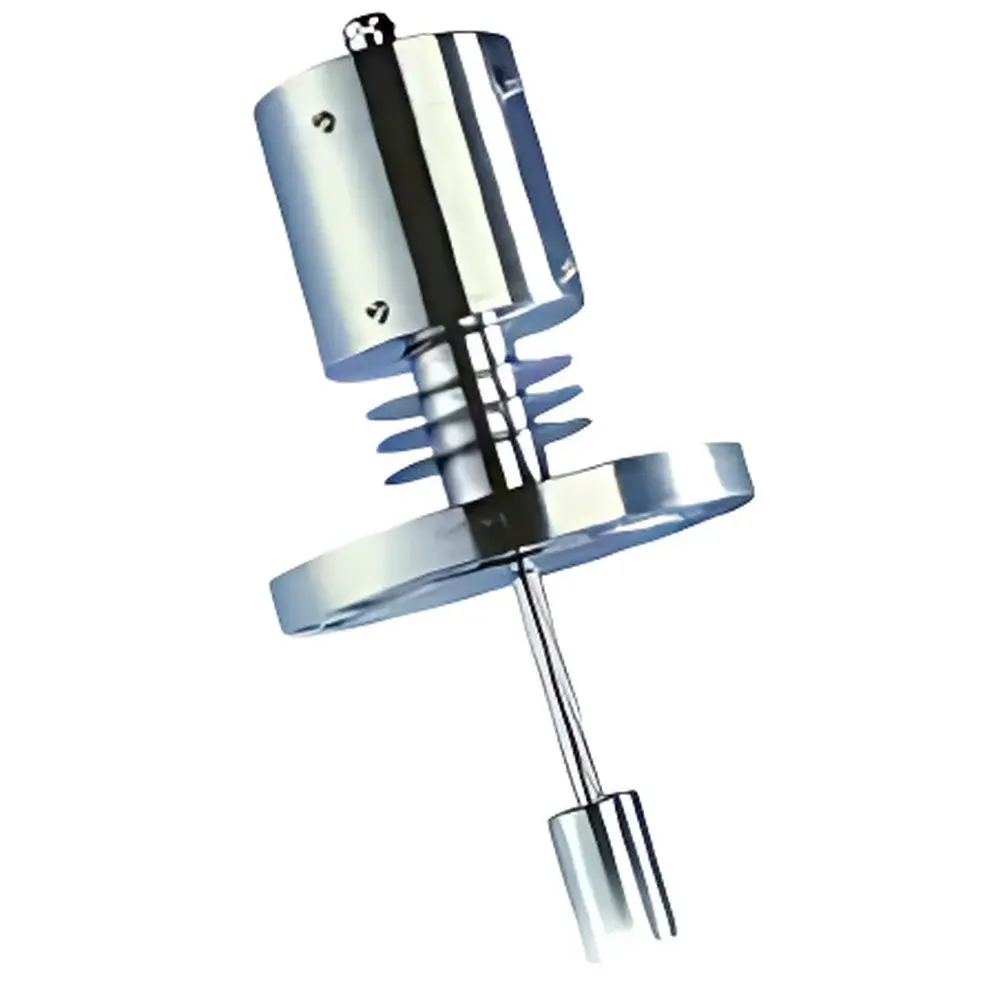
The NAMETRE ViscoLiner Online Viscometer is an industrial-grade, in-line process viscometer engineered for continuous, real-time viscosity monitoring under harsh operational conditions. Unlike rotational or capillary-based systems, the ViscoLiner employs a robust vibrational resonance principle—measuring the damping effect of fluid on a precisely tuned, oscillating sensor element immersed directly in the process stream. This physics-based method delivers intrinsic immunity to flow turbulence, pipe velocity profiles, agitation, mixing shear, and transient gas entrainment (including air bubbles or pressurized nitrogen sparging), eliminating measurement artifacts common in dynamic industrial environments. Designed for permanent installation in pipelines, reactors, extruders, and blending vessels, the ViscoLiner provides true process-integrated rheological data without requiring sample extraction, bypass loops, or offline lab correlation—enabling closed-loop process control with minimal operator intervention.
Key Features
- Vibrational resonance sensing technology ensures stable, flow-independent viscosity output across laminar, transitional, and turbulent flow regimes.
- Wide operational envelope: supports process temperatures from −40 °C to +450 °C and pressures up to 350 bar, with material options including Hastelloy C-276, Inconel 625, and ceramic-coated variants for corrosive or high-wear applications.
- Integrated PT100 RTD embedded within the sensing tip enables simultaneous, co-located temperature measurement at the exact point of viscosity determination—critical for accurate thermal compensation.
- Onboard temperature compensation algorithm applies ISO/ASTM-compliant Arrhenius or Vogel–Fulcher–Tammann models to normalize viscosity readings to a reference temperature, mitigating drift caused by thermal transients.
- Sub-second response time (≤1 s) facilitates detection of rapid viscosity shifts during polymerization, curing, emulsification, or solvent evaporation events.
- Repeatability of ±0.25% and accuracy of ±2% (full scale) meet requirements for GMP-compliant manufacturing environments and support statistical process control (SPC) implementation.
Sample Compatibility & Compliance
The ViscoLiner accommodates Newtonian and non-Newtonian fluids—including solvents, resins, adhesives, paints, coatings, edible oils, pharmaceutical suspensions, and molten polymers—without calibration drift due to particle loading, fiber content, or suspended solids (up to 40% w/w). Its hygienic, crevice-free wetted surface design complies with ASME BPE-2022 for biopharmaceutical applications; sanitary clamp and tri-clamp mounting options are available. For regulated industries, the device supports 21 CFR Part 11-compliant audit trails when integrated with compatible DCS/SCADA platforms, and its firmware adheres to IEC 62443-4-2 security requirements. Documentation packages include IQ/OQ protocols, material certifications (EN 10204 3.1), and traceable calibration certificates per ISO/IEC 17025.
Software & Data Management
ViscoLiner units interface via 4–20 mA analog output, HART 7, or Modbus TCP/IP to distributed control systems. The optional ViscoLink™ configuration and diagnostics software (Windows-based) enables remote setup, real-time trend visualization, alarm thresholding, and historical data export in CSV or OPC UA format. All measurements include timestamped metadata (temperature, damping factor, signal-to-noise ratio, sensor health status), supporting root-cause analysis during deviation investigations. Data logging intervals are configurable from 100 ms to 1 hour, and raw sensor outputs can be archived for retrospective rheological modeling or machine learning training datasets.
Applications
- Polymer production: Monitoring melt viscosity during extrusion, pelletizing, and reactive injection molding to prevent gel formation or molecular weight degradation.
- Chemical synthesis: Tracking real-time viscosity evolution in batch and continuous stirred-tank reactors (CSTRs) during condensation, polycondensation, or crosslinking reactions.
- Food & beverage: Controlling consistency of sauces, dairy concentrates, and plant-based formulations without thermal shock from sampling.
- Pharmaceuticals: Ensuring uniformity of suspensions, ointments, and controlled-release matrix systems in compliance with USP and EP 2.9.35.
- Oil & gas: Measuring heavy crude or bitumen dilution ratios inline to optimize pipeline transport viscosity and reduce pumping energy.
FAQ
Does the ViscoLiner require periodic recalibration?
No routine recalibration is required under stable operating conditions. A full verification using certified reference oils (e.g., Cannon-Fenske standards traceable to NIST) is recommended annually or after mechanical impact, extreme thermal cycling, or process chemistry changes.
Can it measure non-Newtonian fluids accurately?
Yes—the vibrational resonance method reports apparent viscosity at the effective shear rate induced by the sensor’s oscillation amplitude and frequency, which remains consistent across installations. For QC/QA trending, this provides highly reproducible relative values even for shear-thinning or thixotropic materials.
Is explosion-proof certification available?
Yes—ATEX II 2G Ex db IIB T4 Gb, IECEx Db Ex db IIB T4 Gb, and UL/cUL Class I Div 1 Groups B, C, D certifications are available for specific housing configurations.
How is sensor fouling managed in viscous or particulate-laden streams?
The ViscoLiner offers optional ultrasonic cleaning modules (20–40 kHz) and pneumatic purge ports compatible with instrument air or inert gas, enabling automated maintenance cycles without process shutdown.