
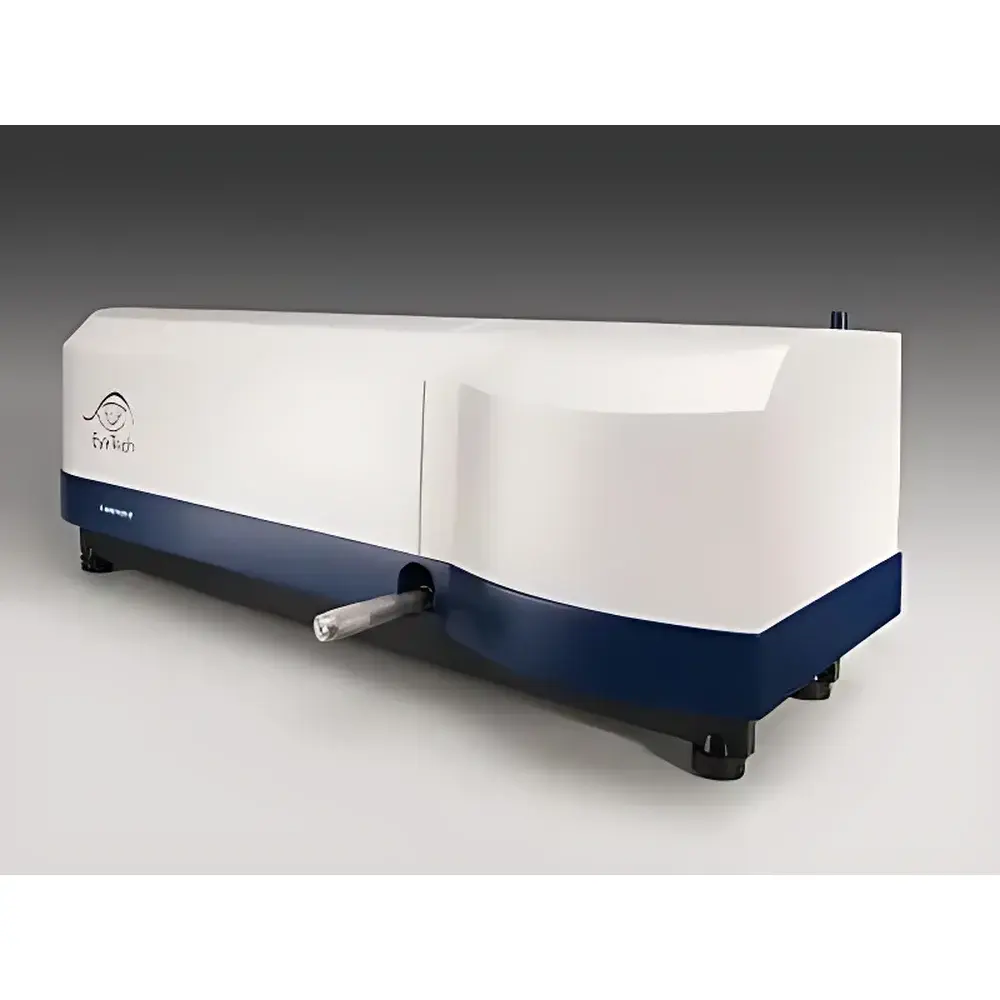
Eyetech-Shape DSA-10 Dynamic Particle Morphology Analyzer
| Origin | Imported |
|---|---|
| Manufacturer Type | Authorized Distributor |
| Model | Eyetech-Shape DSA-10 |
| Price | Upon Request |
| Measurement Principle | High-Speed Synchronized Stroboscopic Imaging + Digital Image Analysis |
| Particle Size Range | 1 µm – 6 mm |
| Camera Resolution | 640 × 480 px monochrome CCD |
| Strobe Frequency | 1 Hz or 30 Hz (adjustable) |
| Illumination | Software-controlled variable-intensity stroboscopic light source |
| Optical Configuration | Interchangeable dual-magnification lens system (3 objective lenses included) |
| Focus | Motorized focus control |
| Analysis Speed | >10,000 particles per minute (typical), full geometric characterization per frame in <1 s |
| Output Data | Equivalent circular diameter, projected area, perimeter, aspect ratio, convexity, roundness, solidity, elongation, and custom shape factor distributions |
Overview
The Eyetech-Shape DSA-10 Dynamic Particle Morphology Analyzer is a high-precision, laboratory-grade instrument engineered for real-time, two-dimensional morphological characterization of particles in motion. Unlike static imaging or ensemble-averaging techniques such as laser diffraction, the DSA-10 employs synchronized stroboscopic illumination coupled with high-frame-rate video microscopy to freeze transient particle dynamics—enabling accurate measurement of both size and shape parameters without requiring sample immobilization or flow cessation. This principle is grounded in time-resolved digital image acquisition under controlled illumination timing, ensuring that each captured frame represents a geometrically stable snapshot of freely moving particles suspended in gas or liquid streams—or dispersed as a monolayer on a substrate. The system complies with core principles outlined in ISO 13322-2 (Particle size analysis — Image analysis methods — Part 2: Dynamic image analysis) and supports traceable, repeatable quantification aligned with ASTM E2457 (Standard Practice for Determining Particle Size Distribution of Powders Using Image Analysis). Its design targets applications where non-spherical geometry significantly influences functional performance—such as pharmaceutical powder flowability, catalyst attrition resistance, mineral processing efficiency, and additive manufacturing feedstock qualification.
Key Features
- Real-time dynamic imaging: Captures morphologically resolved data from particles in continuous motion using programmable stroboscopic synchronization (1 Hz or 30 Hz), eliminating motion blur while preserving statistical representativeness.
- Modular optical architecture: Equipped with three interchangeable objective lenses and a dual-magnification configuration, enabling seamless adaptation across the full 1 µm – 6 mm measurement range without hardware recalibration.
- Motorized precision focusing: Fully software-controlled Z-axis actuation ensures consistent depth-of-field alignment across heterogeneous sample batches and extended acquisition sessions.
- Open-system interface design: Standardized mechanical and electrical interfaces support integration with third-party sample introduction modules—including pneumatic dispersers, wet dispersion cells, vibratory feeders, and automated slide loaders.
- Routine-based workflow automation: Users define, save, and recall complete analysis protocols—including illumination settings, thresholding parameters, shape filters, and reporting templates—for GxP-aligned reproducibility and operator-independent operation.
Sample Compatibility & Compliance
The DSA-10 accommodates diverse sample states: dry powders conveyed via air jet, slurries pumped through flow cells, aerosols imaged in laminar sheath flow, and static monolayers deposited on glass slides. It is routinely deployed in environments governed by GLP and GMP frameworks, with software supporting audit trail generation, electronic signature capability, and user-access-level permissions compliant with FDA 21 CFR Part 11 requirements. All shape descriptors—including aspect ratio, convexity, roundness, and solidity—are calculated per ISO 9276-6 and validated against NIST-traceable reference standards. System calibration verification is performed using certified microsphere and irregular-shape reference materials supplied with documented uncertainty budgets.
Software & Data Management
Acquisition and analysis are managed through the proprietary DSA-Control Suite, a Windows-based application offering full instrument control, real-time preview, batch processing, and database-driven result management. Each acquired image is automatically enhanced using adaptive contrast normalization and noise-reduction algorithms prior to binary segmentation. Geometric parameters are computed using sub-pixel edge detection and moment-based contour analysis. Processed results populate a structured SQLite database supporting SQL queries, customizable report generation (PDF, CSV, Excel), and histogram-based cumulative distribution plotting. Raw images and metadata—including timestamp, strobe phase, magnification, and illumination intensity—are archived with SHA-256 checksums to ensure data integrity and long-term traceability.
Applications
- Pharmaceutical development: Quantifying granule sphericity and surface roughness to predict tablet compaction behavior and dissolution kinetics.
- Mineral processing: Classifying crushed ore particles by angularity and elongation to optimize grinding circuit efficiency and flotation selectivity.
- Food science: Assessing starch granule morphology changes during gelatinization or extrusion to correlate with rheological endpoints.
- Advanced ceramics: Monitoring agglomerate breakup dynamics in slurry processing to establish critical shear thresholds.
- Battery materials: Characterizing cathode/anode active material morphology evolution after cycling to infer degradation mechanisms.
FAQ
What particle size range is supported by the DSA-10?
The system reliably resolves particles from 1 micrometer to 6 millimeters, depending on selected magnification and optical configuration.
Can the DSA-10 analyze particles in liquid suspension without centrifugation or sedimentation?
Yes—its stroboscopic imaging mode captures sharp images of particles in laminar or turbulent flow, provided the dispersion medium is optically transparent and velocity is within the system’s motion-freezing capability.
Is the software compliant with regulatory requirements for electronic records?
Yes—the DSA-Control Suite includes full 21 CFR Part 11 compliance features: role-based access control, immutable audit trails, electronic signatures, and secure data export protocols.
How does the DSA-10 handle overlapping or clustered particles?
Advanced deconvolution algorithms apply watershed segmentation and topological splitting based on gradient magnitude and concavity analysis, minimizing overcounting while preserving morphological fidelity.
Can custom shape descriptors be added to the analysis output?
Yes—the software SDK allows users to implement user-defined shape metrics via Python scripting, with compiled functions integrated directly into the analysis pipeline and report engine.



