
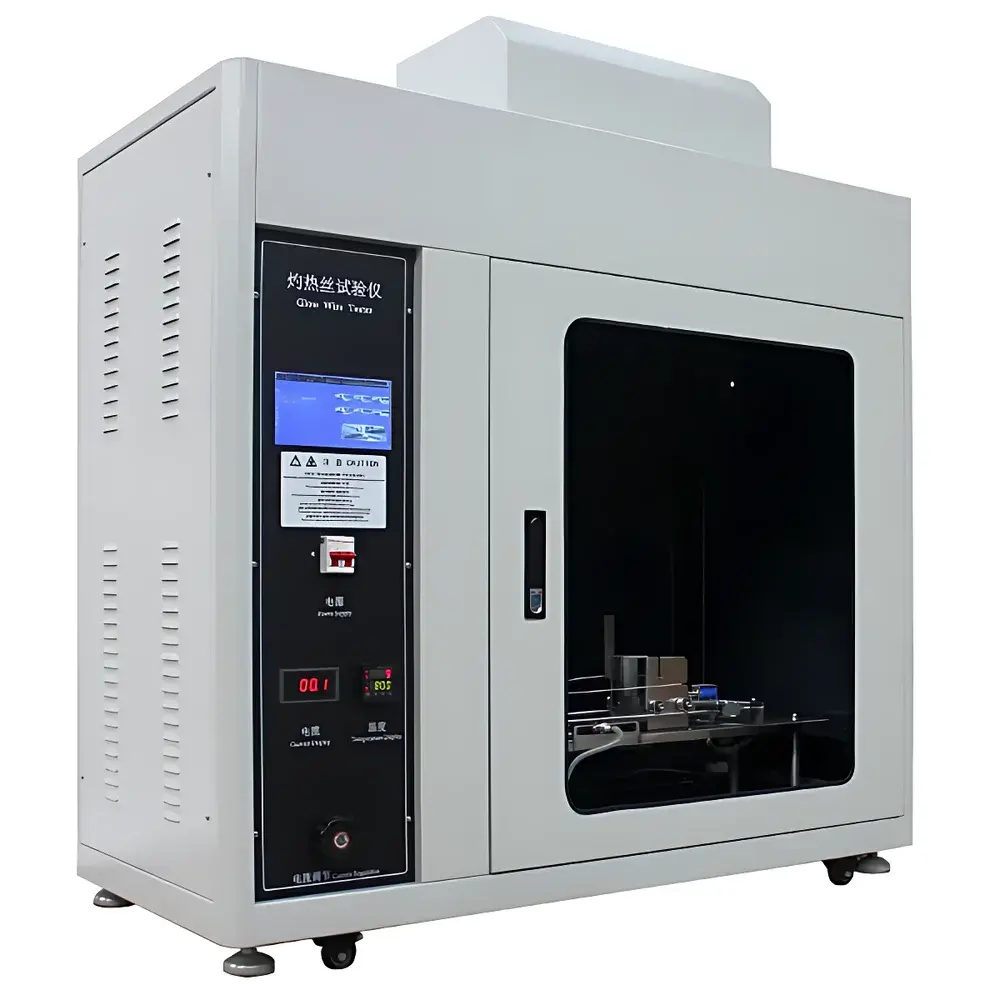
Aerospace ZRS-2 Touchscreen Glow-Wire Test Apparatus
| Brand | Aerospace |
|---|---|
| Origin | Beijing, China |
| Model | ZRS-2 |
| Temperature Range | 500–1000 °C ±2 °C |
| Glow-Wire Duration | 0–999.9 s ±0.1 s |
| Ignition Time & Flame-Out Time Measurement | 0–999.9 s ±0.1 s |
| Thermocouple | Φ0.5 mm K-type armored |
| Glow-Wire Material | Ni80/Cr20 alloy wire, Φ4 mm |
| Penetration Depth | 7 mm ±0.5 mm |
| Applied Force | 1.0 N ±0.2 N |
| Actuation Speed | 14 mm/s |
| Repeatability Error | ≤1% |
| Compliance | GB/T 5169.10–2017, GB 4706.1, IEC 60695-2-10/11/12/13 |
Overview
The Aerospace ZRS-2 Touchscreen Glow-Wire Test Apparatus is a precision-engineered instrument designed to evaluate the ignition resistance and flame propagation behavior of solid non-metallic materials used in electrical and electronic equipment housings, insulators, and structural components. It operates on the principle of controlled thermal stress application via a standardized resistive heating element—the glow-wire—whose temperature, contact force, penetration depth, and dwell time are precisely regulated in accordance with internationally harmonized fire safety test protocols. The apparatus implements the glow-wire ignition temperature (GWIT) and glow-wire flammability index (GWFI) test methods defined in IEC 60695-2-10 through IEC 60695-2-13, as well as national standards including GB/T 5169.10–2017 and GB 4706.1. Unlike open-flame ignition tests, this method simulates abnormal heat stress conditions arising from fault currents or overheating components, enabling objective assessment of material self-extinguishing capability under thermally induced ignition scenarios.
Key Features
- High-resolution 7-inch capacitive touchscreen interface with intuitive navigation, real-time parameter monitoring, and multi-language support (English, Chinese, Spanish).
- Programmable temperature control from 500 °C to 1000 °C at ±2 °C accuracy, achieved using a PID-regulated DC power supply and calibrated K-type armored thermocouple (Φ0.5 mm).
- Precise mechanical actuation system delivering consistent 1.0 N ±0.2 N contact force, 7 mm ±0.5 mm penetration depth, and 14 mm/s linear motion speed—fully compliant with IEC 60695-2-10 Annex A requirements.
- Automated timing functions for glow-wire application duration (0–999.9 s), ignition time (time to first flame), and flame-out time (time from flame cessation to complete extinction), all recorded with ±0.1 s resolution.
- Integrated safety interlocks including overtemperature cutoff, door-open detection, and automatic glow-wire retraction upon test completion or emergency stop activation.
- Robust stainless-steel combustion chamber with built-in LED illumination, fume extraction port (compatible with standard ducting), and removable ash tray for residue containment.
Sample Compatibility & Compliance
The ZRS-2 accommodates flat, rigid solid specimens up to 100 mm × 100 mm × 13 mm in dimension, mounted vertically or horizontally per test standard requirements. Specimens must be representative of final product geometry and surface finish, including painted, coated, or laminated variants. Standard accessories—including calibrated 0.5 N weights, stainless-steel gauge for penetration verification, pine board substrate (as specified in IEC 60695-2-11), and ceramic receiving tray—ensure full procedural traceability. All operational parameters and mechanical tolerances conform to the dimensional, thermal, and metrological specifications outlined in IEC 60695-2-10 (Glow-Wire Apparatus), IEC 60695-2-11 (GWFI), IEC 60695-2-12 (GWIT), and IEC 60695-2-13 (Glow-Wire Flammability Test). The system supports GLP-compliant documentation when integrated with external lab information management systems (LIMS).
Software & Data Management
The embedded firmware enables storage of up to 1,000 test records with timestamped metadata: operator ID, test standard selected, setpoint temperature, applied force, observed ignition/flame-out times, pass/fail status, and user annotations. Data export is supported via USB flash drive in CSV format for downstream analysis in Excel or statistical process control (SPC) platforms. While the unit does not include FDA 21 CFR Part 11-compliant electronic signatures or audit trail functionality out-of-the-box, its deterministic event logging architecture allows integration into validated GMP/GLP environments when paired with qualified third-party data acquisition software meeting ALCOA+ principles (Attributable, Legible, Contemporaneous, Original, Accurate, Complete, Consistent, Enduring, Available).
Applications
- Qualification testing of polymeric enclosures, connectors, circuit board substrates, and insulating spacers in household appliances, IT equipment, lighting fixtures, and industrial control panels.
- Material screening during R&D for flame-retardant polymer formulations (e.g., halogen-free FR-PC, PBT, PA66, LCP) and comparative GWIT/GWFI benchmarking against competitive grades.
- Production line quality assurance where batch-to-batch consistency of ignition resistance must be verified per ISO/IEC 17025-accredited test procedures.
- Technical due diligence for CE marking compliance (EN 60335-1, EN 60950-1, EN 62368-1) and UL recognition programs requiring glow-wire evaluation evidence.
- Supporting failure analysis investigations involving thermal runaway events, solder joint overheating, or component-level short-circuit scenarios.
FAQ
What standards does the ZRS-2 comply with?
The instrument meets the mechanical, thermal, and procedural requirements of IEC 60695-2-10, -2-11, -2-12, and -2-13, as well as GB/T 5169.10–2017 and GB 4706.1.
Is calibration certification included with delivery?
A factory calibration report verifying thermocouple response, force transducer linearity, and timer accuracy is supplied; users are responsible for periodic recalibration per ISO/IEC 17025 guidelines.
Can the ZRS-2 perform both GWFI and GWIT determinations?
Yes—by executing sequential tests at incrementally increasing temperatures (for GWIT) or fixed temperature levels (for GWFI), following the decision tree in IEC 60695-2-12 and -2-11 respectively.
What maintenance is required for long-term reliability?
Routine inspection of glow-wire integrity, cleaning of chamber interior and exhaust path, verification of door seal compression, and annual verification of thermocouple drift and load cell output.
Does the system support remote operation or network connectivity?
No native Ethernet or Wi-Fi interface is provided; however, USB-based data export and external PLC-triggered start/stop signals via dry-contact I/O terminals enable integration into automated test cells.



