
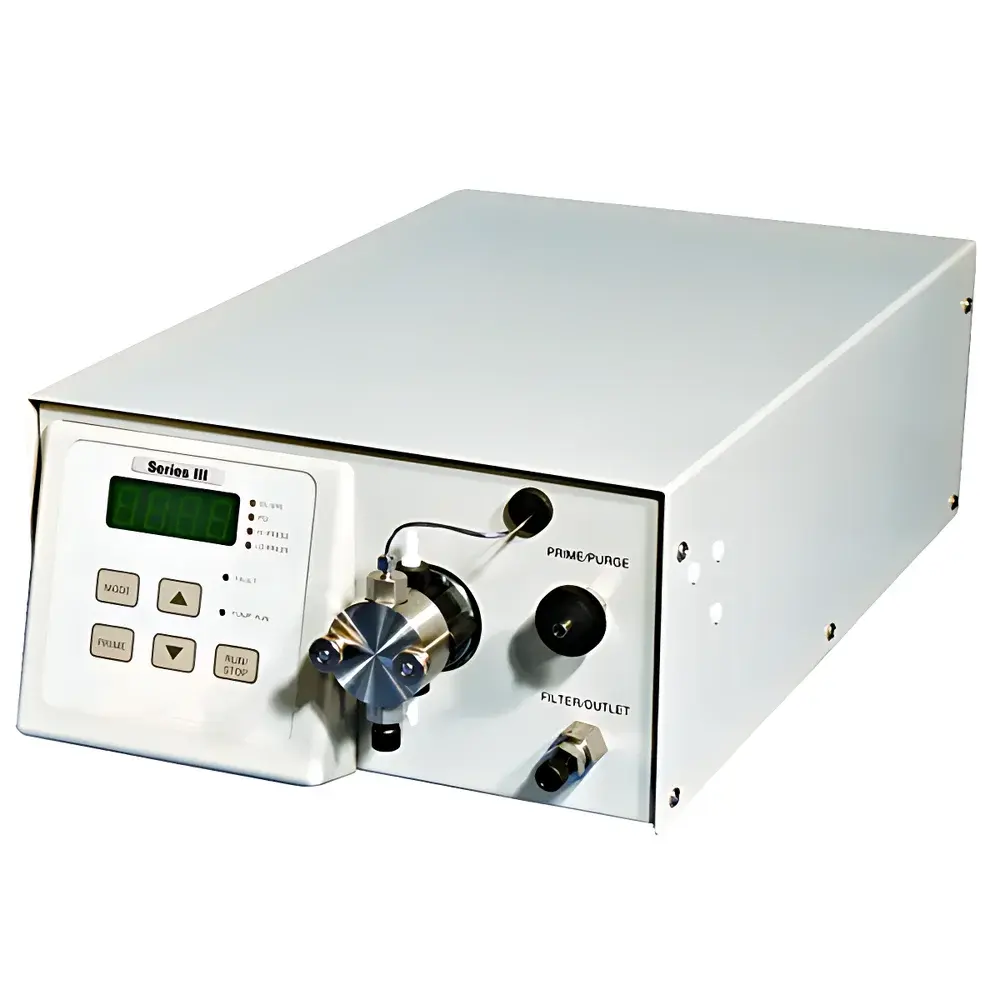
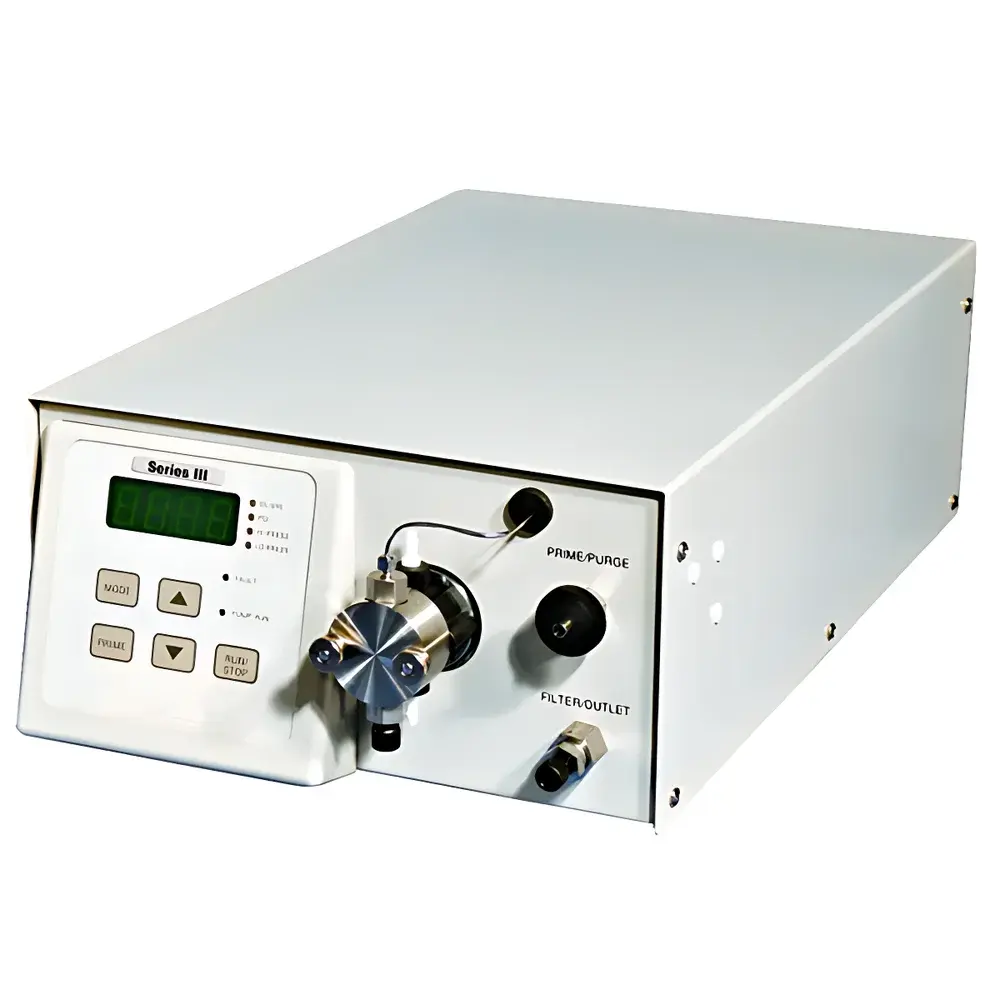
SSI SeriesIII High-Pressure Liquid Chromatography Pump
| Brand | SSI |
|---|---|
| Origin | USA |
| Model | SeriesIII |
| Pump Type | Isocratic (Single-Solvent) HPLC Pump |
| Construction | Stainless Steel Flow Path with Optional PEEK Fittings |
| Pressure Protection | Dual High/Low-Pressure Limit Shutdown |
| Control Interface | Front-Panel Keypad + LED Display + RS-232 Serial Port |
| Self-Cleaning Capability | Integrated Pump Head Flush Function + Quick-Release Drain Valve |
| Flow Path Design | Dual Check Valve Architecture |
| Seal Maintenance | Tool-Free Seal Ring Replacement |
| Operational Duty | Continuous Duty Rated for Stable Flow Delivery |
Overview
The SSI SeriesIII High-Pressure Liquid Chromatography Pump is an isocratic solvent delivery system engineered for precision, reliability, and long-term operational stability in analytical and preparative HPLC applications. Based on positive displacement reciprocating piston technology, the SeriesIII employs dual check valve architecture to ensure unidirectional solvent flow and eliminate backflow—critical for maintaining baseline integrity and column lifetime. Its stainless steel fluidic path provides chemical resistance across a broad range of mobile phases, including aqueous buffers, organic solvents (acetonitrile, methanol), and mildly corrosive additives. Optional PEEK fittings allow compatibility with aggressive solvents or pH-extreme conditions where metal leaching must be minimized. Designed for continuous-duty operation, the pump delivers consistent flow rates under sustained high-pressure loads (up to 6000 psi typical), minimizing pulsation and reducing mechanical stress on packed columns—thereby extending column service life and improving retention time reproducibility.
Key Features
- Dual independent sapphire or ruby check valves with integrated seat geometry ensure >99.9% forward-flow efficiency and prevent solvent back-leakage during dwell volume transitions.
- Integrated self-cleaning pump head with programmable flush cycles reduces particulate accumulation and prevents seal degradation from crystallized buffer salts or precipitated analytes.
- Front-panel keypad interface with multi-segment LED display enables real-time monitoring of pressure (psi/bar), set flow rate (mL/min), and system status without external software dependency.
- Hardware-based high/low pressure limit circuitry triggers immediate pump shutdown upon detection of blockage (e.g., clogged frit or column failure) or low-solvent condition—meeting essential safety requirements defined in ISO 17025-compliant laboratories.
- RS-232 serial port supports bidirectional communication with legacy chromatography data systems (CDS), enabling remote flow/pressure parameter adjustment, event logging, and integration into automated method sequences.
- Tool-free seal ring replacement design minimizes maintenance downtime; standard fluoropolymer seals are rated for >3000 hours of operation under typical HPLC conditions.
Sample Compatibility & Compliance
The SeriesIII is compatible with all standard 1/16″ OD stainless steel and PEEK capillary tubing used in analytical-scale HPLC systems (e.g., 4.6 mm ID columns). It supports mobile phase viscosities up to 5 cP and operates reliably across ambient temperature ranges (15–35°C). The pump conforms to IEC 61010-1 safety standards for laboratory equipment and meets electromagnetic compatibility (EMC) Class B requirements per FCC Part 15. While not inherently 21 CFR Part 11 compliant, audit-trail-capable CDS platforms (e.g., Thermo Chromeleon, Waters Empower) may log SeriesIII control commands and pressure events when configured via RS-232 with timestamped firmware reporting. The unit is suitable for GLP/GMP environments when deployed within validated instrument qualification protocols (IQ/OQ/PQ).
Software & Data Management
No proprietary driver software is required for basic operation. The RS-232 interface uses ASCII command protocol (e.g., “FLOW=0.8”, “PRESSURE?”, “STOP”) with CR/LF termination—fully documented in the OEM technical manual. Third-party LabVIEW VIs, Python pySerial scripts, and MATLAB instrument control toolboxes can directly interface with the pump for custom sequence automation. Pressure and flow setpoint data are logged externally by the host CDS; internal memory retains only last-set parameters after power cycle. Firmware does not support onboard method storage or electronic signature functionality.
Applications
- Routine quality control analysis of pharmaceutical actives and excipients per USP and EP 2.2.46 guidelines.
- Environmental testing of pesticide residues in water matrices using EPA Method 531.1 and 8081B workflows.
- Food safety screening for mycotoxins (aflatoxin B1, ochratoxin A) in cereals and nuts under AOAC 2005.02 validation criteria.
- Academic research requiring stable isocratic elution for polymer molecular weight distribution analysis via SEC/GPC.
- Method development labs performing robustness testing of gradient delay volume and dwell time effects.
FAQ
What is the maximum operating pressure of the SeriesIII pump?
The pump is rated for continuous operation up to 6000 psi (414 bar); short-term excursions to 6500 psi are permissible with appropriate safety margin.
Can the SeriesIII be upgraded to gradient capability?
No—SeriesIII is a fixed-ratio isocratic pump. Gradient functionality requires separate low-pressure mixing modules or dual-pump configurations not supported by this model.
Does the pump include built-in leak detection?
It does not feature active leak sensing; however, rapid pressure drop detection via the low-pressure shutdown threshold serves as an indirect indicator of major seal or fitting failure.
Is PEEK fluidic path available as standard or only optional?
Stainless steel is standard; PEEK inlet/outlet unions and seal housings are field-installable options ordered separately (Part No. PEEK-KIT-S3).
How often should the check valves be replaced during routine use?
Under normal operation with filtered, degassed solvents, check valves typically require replacement every 12–18 months or after 5000 hours—whichever occurs first.





