
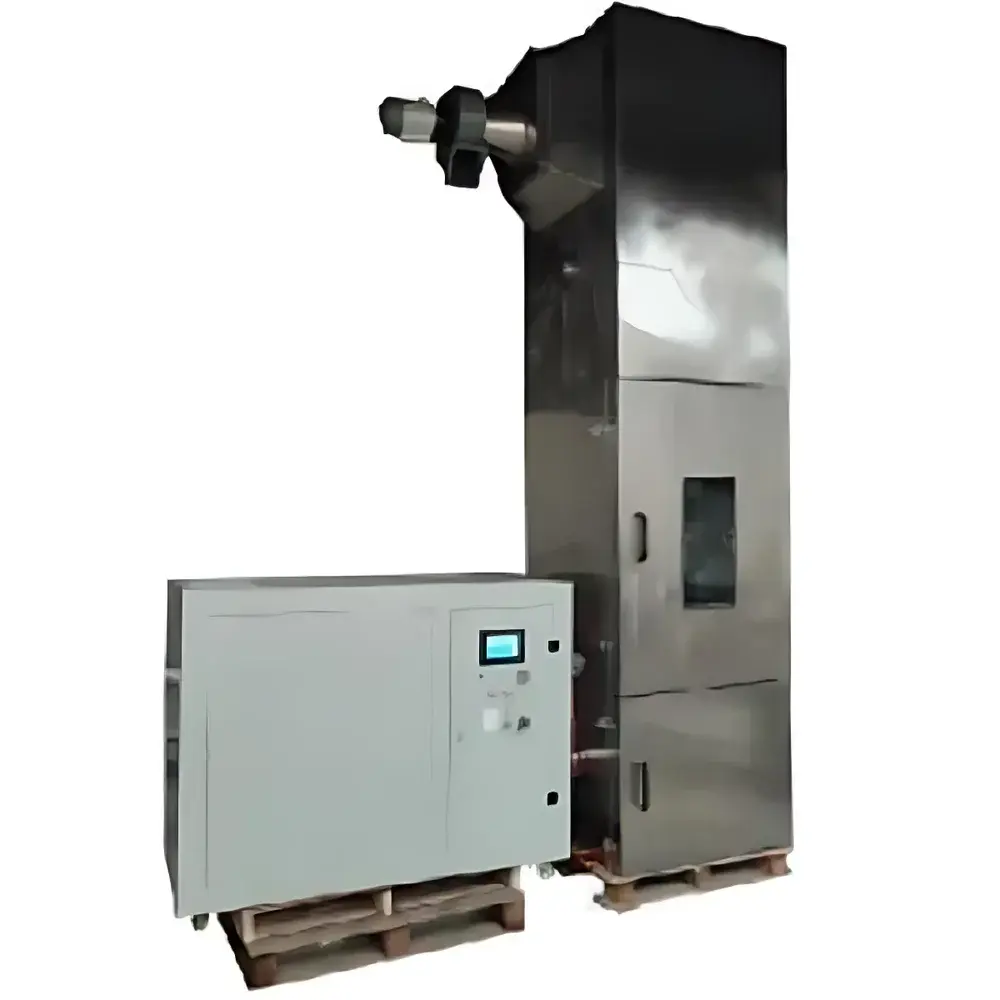
Brookfield CTN-1 Building Material Flame Retardancy Test Chamber
| [Brand | Aerospace Zongheng |
|---|---|
| Origin | Beijing, China |
| Manufacturer Type | Authorized Distributor |
| Model | CTN-1 |
| Application | Building Materials Flame Retardancy Testing |
| Measurement Object | Non-combustible/Flame-Retardant Building Materials |
| Repeatability Error | ±0.1% |
| Power Supply | AC 220/380 V, 50–60 Hz, ~0.5 kW |
| Airflow Velocity | (0.260 ± 0.026) m/s |
| Airflow Accuracy | ±0.1 m/s |
| Timer Accuracy | <1 s/h |
| Differential Pressure Range | 0–100 Pa |
| Fuel Gas | ≥95% Methane |
| Test Duration | 10 min |
| Combustion Chamber Material | AISI 304 Stainless Steel |
| Dimensions (L×W×H) | 3020 mm × 1020 mm × 3930 mm] |
Overview
The Brookfield CTN-1 Building Material Flame Retardancy Test Chamber is a standardized, vertically oriented combustion test apparatus engineered for precise evaluation of flame propagation resistance in building materials under controlled thermal loading conditions. It operates in strict accordance with GB/T 8625—2005, the Chinese national standard equivalent to ISO 1182 and ASTM E136 for non-combustibility assessment, and serves as a critical compliance tool for classification under GB 8624 (Chinese fire performance rating system). The chamber employs a vertical furnace configuration with regulated methane–air combustion, calibrated thermal load delivery via four embedded thermocouples, and real-time monitoring of flue gas temperature, pressure differential, and airflow uniformity. Its core measurement principle relies on quantifying residual specimen length after 10-minute exposure to a defined radiant–convective heat flux (~540 °C average at specimen surface), while simultaneously tracking whether flue gas temperature exceeds 200 °C — both primary pass/fail criteria per GB/T 8625—2005. The system integrates PLC-based automation with touchscreen HMI for sequence control, eliminating manual intervention during ignition, gas flow regulation, timing, and data logging.
Key Features
- PLC + industrial-grade touchscreen HMI for fully automated test sequencing, including pre-heating, thermal calibration, ignition, and timed termination
- Integrated high-precision methane mass flow control (35.0 ± 0.5 L/min) and air flow regulation (17.5 ± 0.2 L/min) to maintain stoichiometric combustion stability
- Five-channel flue gas thermocouple array (Type K, Class II) with automatic averaging and real-time deviation alerting
- Four-point thermal load calibration system using certified stainless-steel calibration plates and dedicated thermocouples
- Differential pressure monitoring (0–100 Pa range) with active feedback loop to sustain furnace draft at –15 ± 10 Pa during operation
- AISI 304 stainless-steel combustion chamber with reinforced insulation and zero-flame-leakage door seal design
- Onboard environmental conditioning: integrated HVAC unit maintaining ambient chamber temperature at 23 ± 2 °C and RH 50 ± 5% during specimen conditioning phase
- Automated high-voltage spark ignition with position-adjustable electrode and fault-detection logic for arc continuity
Sample Compatibility & Compliance
The CTN-1 accommodates rectangular specimens up to 80 mm thick (±5 mm tolerance), cut to representative dimensions reflecting actual field installation — including layered composites, coated substrates (e.g., intumescent-coated timber), fiber-reinforced polymers, mineral wool boards, and structural sandwich panels. Specimen preparation follows mandatory grouping protocols: isotropic materials require three replicate sets; anisotropic or textile-based materials require four sets — two from longitudinal and two from transverse orientations; asymmetric materials demand two sets from each face. All specimens undergo mandatory conditioning per GB/T 2918—2018 (ISO 291): 23 ± 2 °C / 50 ± 5% RH until mass change ≤0.1% over 24 h (or minimum 28-day stabilization if equilibrium unconfirmed). The system supports full traceability for GLP and GMP-aligned laboratories, with audit-ready calibration logs for airflow velocity, pressure differential, timer accuracy, and thermocouple linearity — all documented per ISO/IEC 17025 requirements.
Software & Data Management
The proprietary control software provides synchronized acquisition from 12 thermocouple channels (wall, thermal load, flue gas), differential pressure sensor, airflow meter, and timer module. Data is timestamped at 1 Hz resolution and stored in CSV-compatible binary format with embedded metadata (operator ID, batch number, calibration status, ambient conditions). Exported datasets include: (i) time-series flue gas temperature averages, (ii) thermal load deviation profiles across four calibration points, (iii) pressure drift logs, and (iv) event-marked ignition/start/stop/timer-reset timestamps. Software enforces electronic signature authentication prior to report generation and maintains immutable audit trails compliant with FDA 21 CFR Part 11 Annex 11 requirements. Calibration certificates, maintenance records, and user training logs are archived within the same secure database structure.
Applications
The CTN-1 is deployed in national building material testing centers (e.g., CNAS-accredited labs), third-party certification bodies (CMA, CAL), and R&D departments of insulation, cladding, and interior finish manufacturers. Primary use cases include: qualification of mineral fiber boards against Class A1 (non-combustible) per GB 8624–2012; verification of fire-retardant treated wood products for B1 rating; validation of fire barrier systems in curtain wall assemblies; and comparative assessment of intumescent coating efficacy on steel substrates. It also supports pre-certification screening for CE marking under EN 13501–1, where results may be cross-referenced with cone calorimeter (ISO 5660) and smoke density (GB/T 8627) data to assign Euroclass ratings.
FAQ
What standards does the CTN-1 comply with?
It is fully aligned with GB/T 8625—2005, and its operational parameters satisfy technical equivalency to ISO 1182, ASTM E136, and EN ISO 1182 for non-combustibility determination.
Is methane purity strictly required at ≥95%?
Yes — lower purity introduces uncontrolled hydrogen/carbon monoxide fractions that alter flame temperature profile and invalidate thermal load calibration per Clause 3.1 of GB/T 8625—2005.
How often must airflow uniformity be verified?
Per Section 3.2 of the standard, air velocity homogeneity testing across five designated points in the stabilization grid must be performed semiannually.
Can the CTN-1 be used for materials thinner than 10 mm?
Yes — specimens must reflect actual installed thickness; however, minimum practical thickness is governed by structural integrity during mounting and is typically ≥6 mm for rigid boards.
Does the system support remote diagnostics or firmware updates?
Firmware updates are performed locally via encrypted USB key; remote diagnostic access requires optional VPN-enabled Ethernet gateway (sold separately) and adheres to IEC 62443-3-3 security protocols.



