
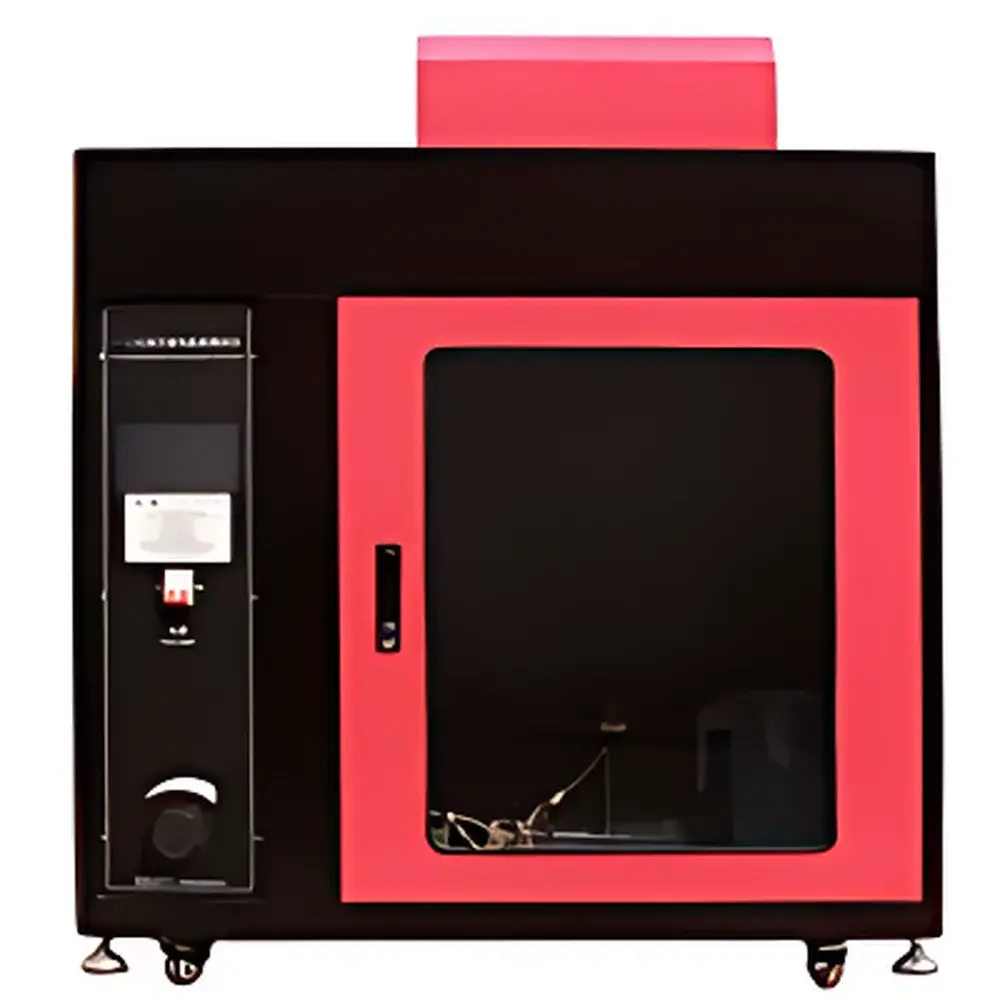
HCTI-6553 High-Voltage Tracking and Erosion Tester
| Brand | Aerospace Zongheng |
|---|---|
| Origin | Beijing, China |
| Manufacturer Type | Authorized Distributor |
| Country of Origin | China |
| Model | HCTI-6553 |
| Price Range | USD 10,500 – 16,200 |
Overview
The HCTI-6553 High-Voltage Tracking and Erosion Tester is an engineered test system designed to evaluate the comparative resistance of insulating materials—particularly polymers, laminates, and composite dielectrics—to electrical tracking and erosion under severe environmental conditions. It operates in accordance with the core principles defined in GB/T 6553–2014 (equivalent to IEC 60112:2020), simulating real-world degradation mechanisms where conductive contaminants (e.g., ammonium chloride solution) bridge electrode gaps on inclined specimen surfaces under sustained AC voltage stress (45–65 Hz). The instrument quantifies material performance by measuring time-to-failure (tracking initiation), voltage endurance (at fixed or stepwise increments), and post-test erosion depth—providing objective data for comparative ranking, material qualification, and compliance verification against international insulation standards.
Key Features
- Five-channel parallel testing architecture enables simultaneous evaluation of five specimens per test cycle, improving throughput and statistical reliability.
- Programmable high-voltage AC output (0–6.0 kV, adjustable in 0.1 kV steps) with built-in overvoltage protection and automatic shutdown upon current exceedance (>60 mA for ≥2 s).
- Precision-controlled contamination delivery: dual-tube per channel (supply + return), calibrated peristaltic pumps (default 5 mL/min ±0.1 mL/min), and standardized eight-layer filter paper pads (0.2 ±0.02 mm thick) ensuring uniform electrolyte distribution across the 50 mm × 120 mm test surface.
- Integrated touch-screen HMI with dedicated calibration, parameter setup, real-time current/voltage monitoring, and automated data logging—including timestamped failure mode classification (“Tracking Failure”, “Ignition”, or “Pass”).
- Inclined specimen mount (45° ±2°) with precision-machined brass electrodes (50.0 ±0.5 mm spacing), non-metallic sample holder, and adjustable crossbeam assembly compliant with Figure 2 and Figure 4 of GB/T 6553–2014.
- Comprehensive safety interlocks: grounded chassis, insulated enclosure, audible over-range alert, and forced power cutoff during abnormal current events.
Sample Compatibility & Compliance
The HCTI-6553 accommodates rigid flat specimens measuring at least 50 mm × 120 mm × 6 mm (other thicknesses permitted with full reporting per Clause 7.1 of GB/T 6553–2014). Specimens must be cleaned using isopropanol followed by deionized water; surface conditioning via 400-grit SiC sandpaper (with DI water slurry) is permitted when wettability is insufficient, provided this is documented. Test liquids are prepared per Clause 4: 0.100% ±0.002% NH₄Cl + 0.020% ±0.002% nonionic surfactant in deionized water, with resistivity verified at (3.95 ±0.05) Ω·m at 23 ±1 °C. All operational procedures, electrode geometry, and pass/fail criteria align with GB/T 6553–2014, IEC 60112:2020, ASTM D3638–17, and UL 746A Annex B. The system supports both Method A (Constant Voltage, 6 h duration) and Method B (Stepwise Voltage, 1 h/stage) as defined in Clause 8.
Software & Data Management
The embedded control firmware provides traceable, audit-ready data handling. Each test session generates a timestamped record containing: applied voltage, elapsed time, real-time current waveform snapshot (sampled at 100 Hz), failure mode flag, and operator-entered test ID. Data export is supported via USB to CSV format for integration into LIMS or QA documentation systems. All parameter changes—including voltage adjustments, pump calibrations, and test start/stop actions—are logged with user ID and timestamp, satisfying basic requirements for GLP-compliant environments. While not certified to FDA 21 CFR Part 11, the system’s deterministic behavior, immutable event logging, and manual signature fields in exported reports facilitate internal validation for ISO/IEC 17025-accredited laboratories.
Applications
This tester is routinely deployed in R&D and QC labs serving the electrical insulation, automotive wiring harness, consumer appliance, and rail transport sectors. Typical use cases include: qualification of flame-retardant thermoplastics (e.g., PBT, PA66-GF30) for connector housings; comparative assessment of silicone rubber formulations used in outdoor insulators; validation of epoxy molding compounds for high-voltage PCB substrates; and screening of recycled polymer blends for re-use in low-voltage enclosures. Results directly inform material selection decisions, support UL/CSA/IEC certification submissions, and feed into Failure Modes and Effects Analysis (FMEA) for safety-critical components.
FAQ
What is the standard test liquid composition and how often must its resistivity be verified?
The standard test liquid consists of 0.100% ±0.002% analytical-grade ammonium chloride (NH₄Cl) and 0.020% ±0.002% nonionic surfactant in deionized water. Resistivity must be measured prior to each test batch and confirmed within (3.95 ±0.05) Ω·m at 23 ±1 °C.
Can the HCTI-6553 perform tests according to both Method A and Method B?
Yes—the instrument supports both Constant Voltage (Method A, 6 h duration) and Stepwise Voltage (Method B, 1 h per increment) protocols, with automatic voltage ramping and current-triggered termination logic.
Is specimen surface preparation mandatory before testing?
Yes. Specimens must be cleaned with isopropanol and rinsed with deionized water. If the surface fails to wet uniformly within the observation period, light abrasion with 400-grit SiC paper (using DI water) is required—and must be reported in the test documentation.
Does the system include provisions for exhaust management during combustion events?
Yes—a dedicated exhaust duct (included in standard configuration) connects to facility fume hoods or local ventilation systems to safely evacuate smoke and decomposition byproducts during ignition events.
How is pump flow rate calibrated, and how frequently should recalibration occur?
Calibration uses a 10 mL graduated cylinder and the touchscreen “Pump Calibration” menu. It is recommended before first use, after maintenance, and at least once per month in routine operation to ensure adherence to ±0.1 mL/min tolerance per GB/T 6553–2014 Clause 5.2.
Related Products





