
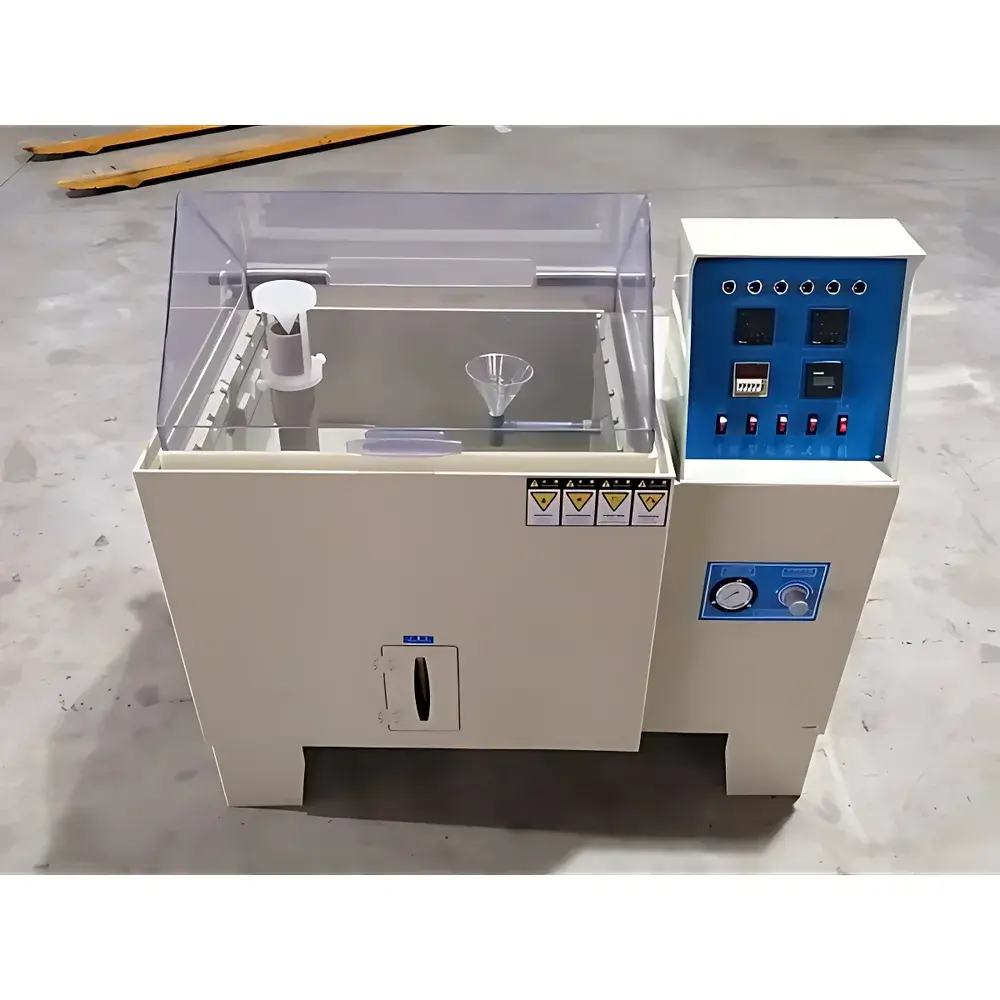
DD KJ YW-060 Precision Salt Spray Corrosion Test Chamber
| Brand | DD KJ |
|---|---|
| Origin | Chongqing, China |
| Manufacturer Type | Authorized Distributor |
| Country of Origin | China |
| Model | YW-060 |
| Internal Volume | 60 L |
| Temperature Range (Chamber) | 35–55 °C |
| Temperature Range (Saturated Air Chamber) | 45–75 °C |
| Temperature Fluctuation | ≤ 0.5 °C |
| Temperature Uniformity | < 2 °C |
| Temperature Deviation | ±2 °C |
| Ramp-up Time to Operating Temperature | ≤ 60 min |
| Power Consumption | 1.0 kW |
| Supply Voltage | 220 V, 50 Hz |
| Internal Dimensions (W×D×H) | 600 × 400 × 400 mm |
| External Dimensions (W×D×H) | 1100 × 650 × 900 mm |
| Standard Accessories | V- and O-type Sample Racks |
| Compliance | ASTM B117, ISO 9227, JIS Z2243 |
Overview
The DD KJ YW-060 Precision Salt Spray Corrosion Test Chamber is an engineered environmental simulation system designed for accelerated corrosion evaluation of metallic and coated materials under controlled saline aerosol exposure. It operates on the principle of continuous or cyclic salt fog generation via compressed air atomization of a standardized sodium chloride solution (typically 5% w/w NaCl), followed by precise regulation of chamber temperature, humidity, and saturation conditions. Unlike general-purpose environmental chambers, the YW-060 implements a dual-zone thermal architecture—separate control of test chamber and saturated air chamber—to ensure strict adherence to ASTM B117 and ISO 9227 protocols. Its robust stainless-steel construction, corrosion-resistant internal lining, and calibrated spray nozzles deliver high reproducibility in corrosion rate assessment across repeated test cycles. The system supports both neutral salt spray (NSS), acetic acid salt spray (AASS), and copper-accelerated acetic acid salt spray (CASS) testing modes when configured with optional reagent delivery modules.
Key Features
- Stainless-steel 316L chamber body and PVC-coated interior surfaces for long-term resistance to chloride-induced pitting and stress corrosion cracking
- Dual independent PID-controlled heating zones: main test chamber (35–55 °C) and saturated air chamber (45–75 °C), enabling precise compliance with ISO 9227 temperature gradient requirements
- High-stability compressed-air atomization system with adjustable nozzle pressure (0.8–1.2 bar) and calibrated spray deposition rate (1.0–2.0 mL/80 cm²/h)
- Integrated digital temperature monitoring with real-time logging and ±0.5 °C accuracy across all operational setpoints
- Low-maintenance design featuring removable sample racks (standard V- and O-type configurations), easy-access drain ports, and front-panel liquid level indicators
- Compliance-ready hardware architecture supporting future integration with GLP/GMP-compliant data acquisition systems
Sample Compatibility & Compliance
The YW-060 accommodates flat, cylindrical, or irregularly shaped specimens up to 400 mm in height and 600 mm in width, with total mass not exceeding 15 kg per test cycle. Samples are mounted on non-conductive, corrosion-inert support fixtures to prevent galvanic coupling artifacts. The chamber meets the physical and procedural specifications of key international standards including ASTM B117 (Neutral Salt Spray Testing), ISO 9227 (Corrosion Tests in Artificial Atmospheres), and JIS Z2243 (Salt Spray Testing Methods). Optional accessories—including pH-adjustable solution reservoirs, CO₂ injection kits for simulated marine-atmosphere cycling, and programmable timer modules—enable extension into multi-phase corrosion protocols aligned with ISO 14993 (Cyclic Corrosion Testing). All standard configurations are suitable for internal QC validation and pre-certification screening under ISO/IEC 17025-accredited laboratories.
Software & Data Management
The YW-060 operates as a standalone analog-digital hybrid platform with front-panel LED interface for manual parameter setting and real-time status display. While no embedded PC-based software is included in the base configuration, the unit features RS-485 serial output (Modbus RTU protocol) for seamless integration with third-party SCADA systems, LabVIEW environments, or enterprise LIMS platforms. When connected to external data loggers compliant with FDA 21 CFR Part 11, full audit trails—including operator ID, timestamped temperature/spray events, and calibration history—can be generated and archived. Firmware updates and calibration certificate management are performed via USB port using vendor-provided configuration utilities, ensuring traceability to NIST-traceable reference standards.
Applications
- Qualification of protective coatings (e.g., zinc-nickel plating, epoxy primers, chromate conversion layers) on aerospace fasteners and structural alloys
- Comparative corrosion resistance assessment of automotive brake calipers, exhaust manifolds, and battery enclosures under simulated coastal service conditions
- Material selection support for marine instrumentation housings exposed to chloride-rich ambient environments
- Accelerated aging validation of printed circuit board (PCB) conformal coatings and solder mask integrity
- Pre-qualification screening of medical device housing materials (e.g., surgical instrument trays, implant packaging) per ISO 10993-15 biocompatibility guidance
FAQ
What standards does the YW-060 comply with out-of-the-box?
The base configuration meets ASTM B117 and ISO 9227 requirements for neutral salt spray testing, including temperature stability, spray uniformity, and solution pH control.
Can the YW-060 perform cyclic corrosion tests?
Yes—when equipped with optional programmable timer modules and auxiliary solution reservoirs, it supports ISO 14993-compliant multi-stage sequences (e.g., salt spray → dry → humid → wet).
Is the chamber suitable for testing electronic assemblies?
It is appropriate for non-powered components and enclosures; however, powered operation during testing is prohibited due to electrical safety and condensation risks.
What maintenance intervals are recommended?
Daily visual inspection of nozzles and solution levels; monthly cleaning of saturator chamber and air filters; annual recalibration of temperature sensors against certified references.
Does DD KJ provide installation and IQ/OQ documentation?
Yes—upon request, factory-verified Installation Qualification (IQ) and Operational Qualification (OQ) protocols aligned with ISO/IEC 17025 and GMP Annex 15 are available as add-on services.
Related Products



