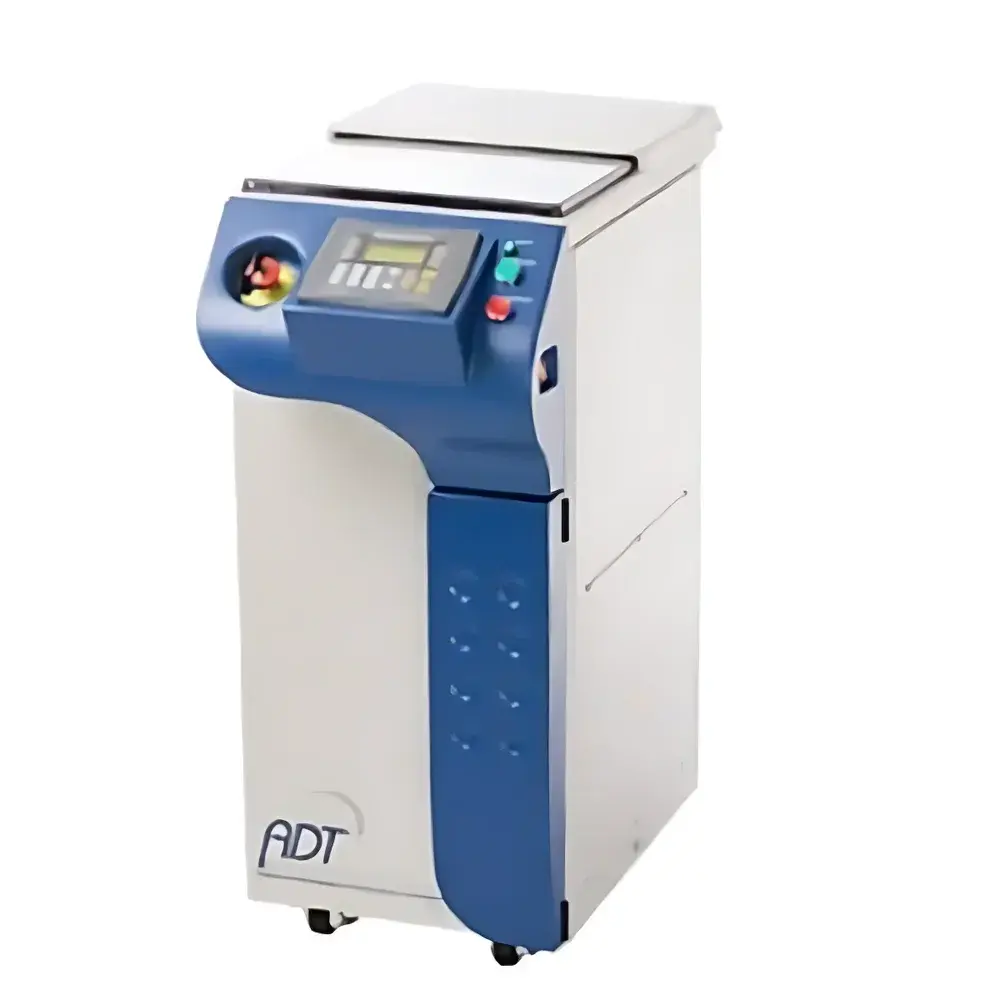
ADT WCS-977 Wafer Cleaning System
| Brand | ADT |
|---|---|
| Model | WCS-977 |
| Type | Wet Process Wafer Cleaning Equipment |
| Chamber Capacity | 6-inch and 8-inch wafers |
| Dimensions (W×D×H) | 410 × 625 × 980 mm |
| Power Supply | 230 VAC, 50 Hz, 5 A |
| CDA Pressure | 0.5–0.6 MPa |
| CDA Consumption | ≤3 m³/h |
| DI Water Pressure | 0.2–0.3 MPa |
| DI Water Consumption | ≤100 L/h |
| Rotation Speed Range | 500–3000 rpm |
| Vacuum Source | Integrated vacuum generator |
| CO₂ Injection | Membrane contactor-based ultra-pure CO₂ dissolution into DI water |
| Control System | Programmable Logic Controller (PLC) with recipe storage and real-time process monitoring |
| Safety | Interlocked access door, status indicator lights, emergency stop circuit |
| Construction | Internal 316L stainless steel chamber, exterior powder-coated steel housing |
| Compliance | Designed for Class 100 cleanroom integration, compatible with SEMI S2/S8 safety guidelines |
Overview
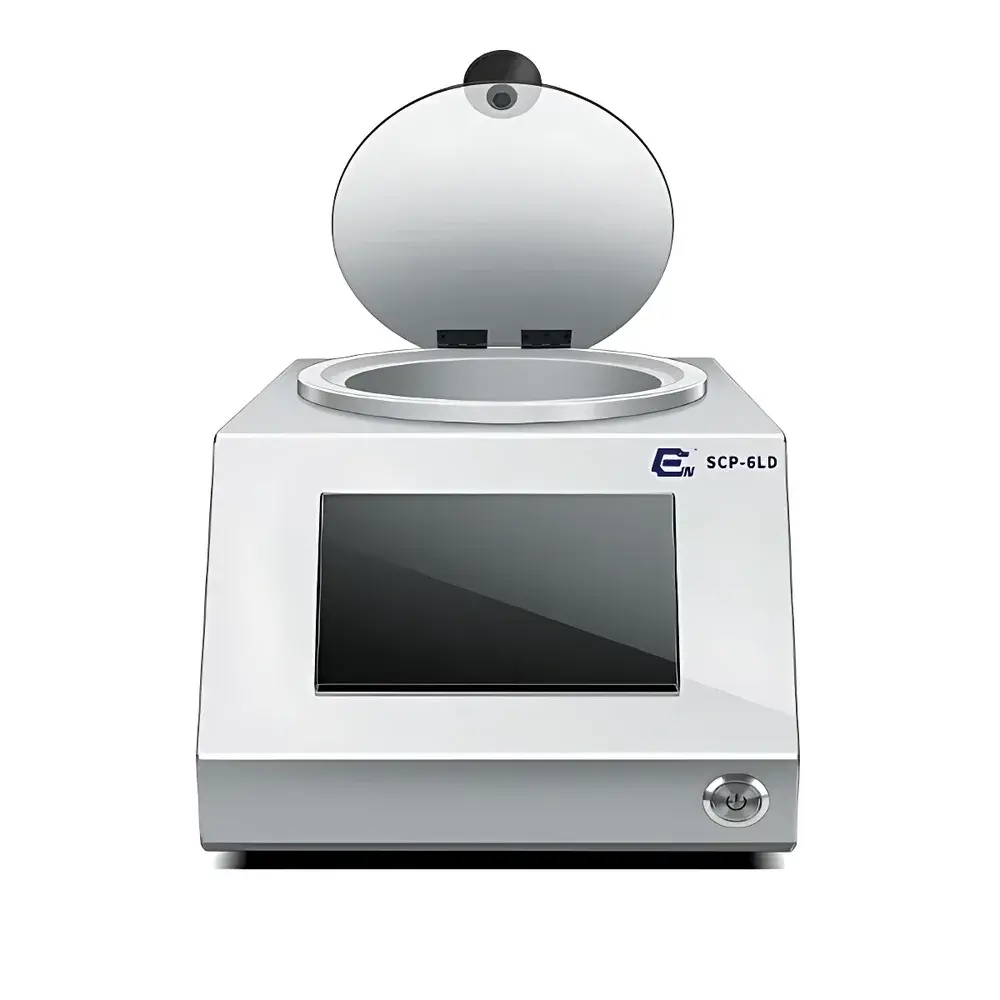
The ADT WCS-977 Wafer Cleaning System is a precision-engineered wet process tool designed for high-reliability cleaning of silicon, compound semiconductor, and MEMS wafers in front-end semiconductor fabrication environments. It operates on the principle of controlled rotational spin processing combined with programmable multi-nozzle fluid delivery and nitrogen-assisted drying. The system employs a vacuum ceramic chuck to secure wafers (6-inch or 8-inch diameter) during sequential rinse, chemical dispense, megasonic-enhanced (optional), and high-speed spin-dry stages. Its core architecture integrates dual-fluid nozzles driven by stepper motors for precise angular positioning, enabling targeted delivery of deionized (DI) water, SC1/SC2 solutions, HF-based etchants, or CO₂-saturated DI water—critical for low-surface-tension drying and particle removal without watermark formation. Unlike batch immersion tools, the WCS-977 executes single-wafer processing under laminar airflow conditions, minimizing cross-contamination risk and supporting inline integration within 300-mm-compatible fab automation frameworks.
Key Features
- Single-wafer spin-processing platform with vacuum ceramic chuck compatible with both 6-inch and 8-inch substrates, including notched and flat-edge configurations.
- Programmable PLC-based control system with non-volatile recipe storage (≥100 user-defined processes), real-time parameter logging, and graphical HMI interface for operator feedback.
- Dual-axis stepper-controlled nozzle arm enabling reproducible radial and azimuthal positioning of DI water, chemical, and N₂ purge streams—optimized for edge-bead removal and backside rinse coverage.
- Integrated membrane contactor module for on-demand dissolution of ultra-high-purity CO₂ into DI water, reducing surface tension to <68 mN/m and eliminating drying marks on hydrophobic surfaces.
- Full stainless-steel (316L) wetted path construction with electropolished internal surfaces, meeting SEMI F57 requirements for metallic contamination control (<1E10 atoms/cm² for Fe, Cr, Ni).
- Safety-certified interlock system compliant with ISO 13857 and SEMI S2-0218, featuring light-curtain monitored access doors, redundant emergency stop circuits, and color-coded status indicators (green/yellow/red).
Sample Compatibility & Compliance
The WCS-977 accommodates standard silicon wafers (bare, oxide, nitride, poly-Si), SOI, GaAs, SiC, and sapphire substrates ranging from 150 mm to 200 mm in diameter. It supports process chemistries aligned with industry-standard cleaning protocols—including RCA Standard Clean (SC1 and SC2), dilute HF, ozone-DI water, and CO₂-enhanced final rinse. All fluidic pathways are constructed from perfluoroalkoxy (PFA)-lined stainless steel or quartz components to prevent leaching. The system meets SEMI S2-0218 electrical safety and chemical exposure requirements, and its data logging architecture supports audit-ready traceability per FDA 21 CFR Part 11 when paired with optional electronic signature modules. It is suitable for use in ISO Class 5 (Class 100) cleanrooms and conforms to SEMI E10 specifications for equipment reliability and maintainability.
Software & Data Management
The embedded control software provides full recipe management with versioned parameter sets, timestamped execution logs, and configurable alarm thresholds for pressure, flow, rotation speed, and vacuum level. Process data—including motor current draw, CDA pressure stability, DI water resistivity (via optional inline sensor), and cycle time—is exported in CSV format via Ethernet or USB. Optional OPC UA server integration enables seamless connection to MES platforms such as Applied Materials EnduraConnect or Tokyo Electron TELiS. Audit trails record all operator actions, recipe modifications, and system faults with immutable timestamps, satisfying GLP/GMP documentation requirements for qualification and release testing.
Applications
The WCS-977 serves critical pre- and post-lithography cleaning steps: pre-gate oxide cleaning to remove native oxide and organic residues; post-etch residue removal after plasma etch of metal or dielectric layers; pre-diffusion cleaning to eliminate particles prior to thermal processing; and post-CMP cleaning to remove slurry remnants and metal ions. Its edge- and backside-rinse capability ensures uniformity across wafer topography—particularly essential for advanced nodes (≤28 nm) where particle-induced defects at device edges directly impact yield. The CO₂-infused rinse mode is routinely deployed before metrology steps (e.g., AFM, ellipsometry) where surface hydration artifacts must be eliminated.
FAQ
What wafer sizes does the WCS-977 support?
The system is configured for 6-inch (150 mm) and 8-inch (200 mm) wafers using interchangeable vacuum chucks. Custom chucks for 12-inch wafers are available under OEM agreement.
Is megasonic assistance integrated or optional?
Megasonic transducers (1 MHz, 50–100 W) are available as a factory-installed option, mounted beneath the chuck to enhance particle dislodgement during chemical rinse stages.
Can the system be integrated into an automated material handling system (AMHS)?
Yes—the WCS-977 includes SECS/GEM-compliant communication ports (RS-232 and Ethernet/IP) and mechanical interfaces compatible with standard FOUP load ports per SEMI E47.1.
How is CO₂ purity maintained in the dissolution module?
The membrane contactor uses certified 99.999% (5N) CO₂ gas supplied through dedicated stainless-steel lines with point-of-use filtration (0.003 µm PTFE); dissolved CO₂ concentration is verified daily using in-line conductivity compensation.
What maintenance intervals are recommended for critical subsystems?
Nozzle alignment verification every 250 cycles; vacuum pump oil change every 2,000 operating hours; DI water filter replacement every 500 hours or per resistivity drop below 18.2 MΩ·cm.