
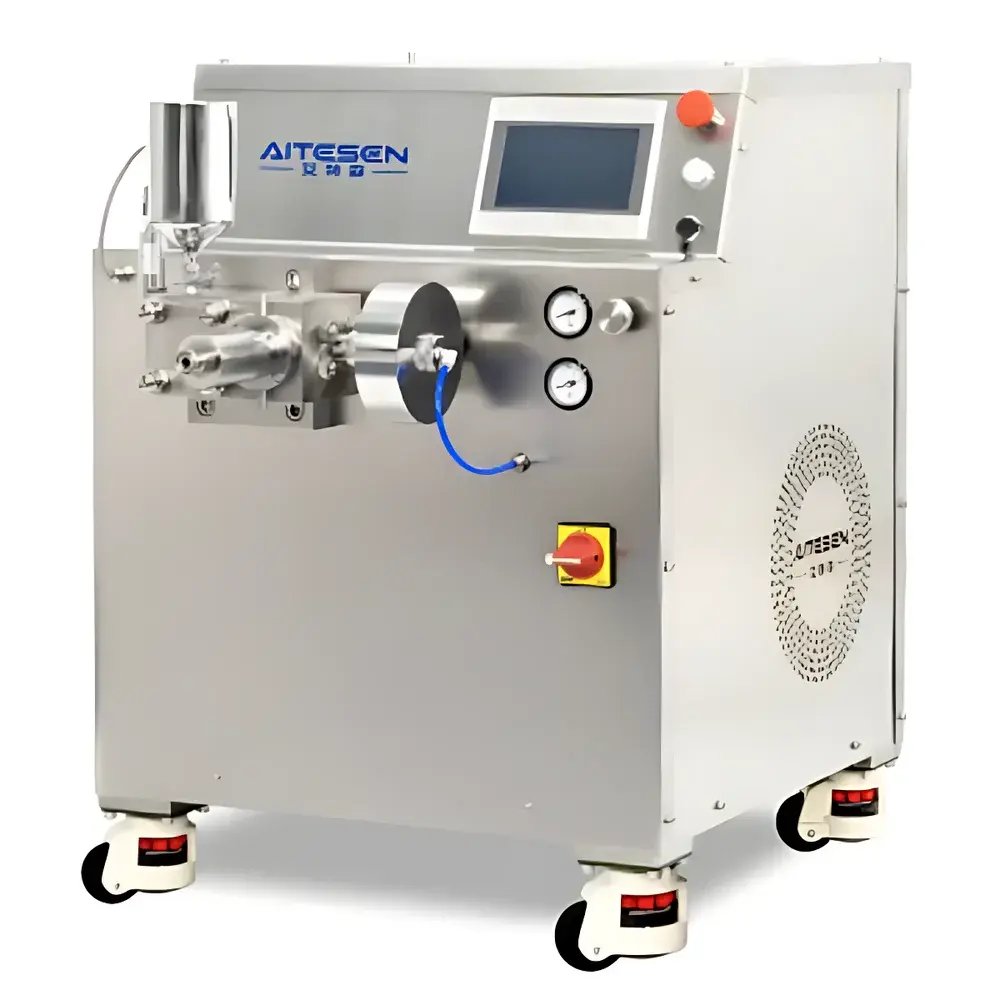
Aitesen HPH-L3 High-Pressure Homogenizer for Cell Disruption and Nanoscale Emulsification
| Brand | Aitesen |
|---|---|
| Origin | Jiangsu, China |
| Manufacturer Type | Authorized Distributor |
| Product Category | Domestic |
| Model | HPH-L3 |
| Instrument Type | High-Pressure Cell Disruptor |
| Max. Inlet Particle Size | 500 µm |
| Flow Rate | 10–40 L/h |
| Max. Operating Pressure | 1800 bar |
| Minimum Sample Volume | 30 mL |
| Noise Level | 65 dB(A) |
| Power Rating | 5.5 kW |
| Cleaning & Sterilization | Yes |
| Dimensions (W×D×H) | 658 × 868 × 920 mm |
| Weight | 280 kg |
Overview
The Aitesen HPH-L3 is a high-pressure homogenizer engineered for reproducible, scalable cell disruption and nanoscale emulsification in regulated life science and pharmaceutical development environments. It operates on the principle of controlled fluid shear, cavitation, and impact forces generated when a pressurized sample stream is forced through a precisely engineered homogenizing valve at pressures up to 1800 bar. This mechanical energy transfer enables efficient lysis of robust microbial cells—including Escherichia coli, Saccharomyces cerevisiae, and filamentous fungi—as well as the formation of sub-200 nm lipid nanoparticles (LNPs), liposomes, fat emulsions, and stable suspensions. Designed with a modular, split-head pump architecture fabricated from SAF2507 super duplex stainless steel, the HPH-L3 ensures corrosion resistance, long-term dimensional stability under cyclic pressure loading, and compatibility with aqueous, organic, and low-pH formulations.
Key Features
- Robust SAF2507 homogenizing valve assembly with precision-machined seat geometry for consistent shear profile and extended service life
- Touchscreen HMI interface supporting real-time pressure monitoring, manual or pneumatic pressure adjustment, and user-defined safety pressure limits with audible/visual alarms
- Integrated pressure data logging with timestamped export capability (CSV format) for audit-ready process documentation
- Modular design accommodating optional configurations: variable-frequency flow control, automated pressure ramping, PLC-based sequence logic, jacketed temperature-controlled inlet, multi-stage homogenization, closed-loop recirculation, and pre-homogenization filtration
- Compliance with European Machinery Directive 2006/42/EC (successor to 98/37/EC), CE-marked for safe operation in ISO Class 5–8 cleanrooms and GMP-compliant laboratories
Sample Compatibility & Compliance
The HPH-L3 accommodates a broad range of biological and formulation matrices—from bacterial lysates and yeast homogenates to viscous lipid dispersions and nanoparticle suspensions—with inlet particle tolerance up to 500 µm. Its wetted path materials (SAF2507, PTFE seals, 316L stainless steel tubing) meet USP Class VI biocompatibility requirements and are compatible with CIP/SIP protocols using steam, hydrogen peroxide vapor, or alkaline detergents. The system supports process validation per ICH Q5A(R2) for host-cell protein clearance and ICH Q5C for product consistency across batches. When integrated with validated accessories—such as sterile-grade 0.22 µm filters, heat-exchange modules, or tangential flow filtration units—the HPH-L3 serves as a core unit operation in end-to-end LNP and liposome manufacturing workflows compliant with FDA 21 CFR Part 11 data integrity expectations.
Software & Data Management
The embedded control firmware records pressure, flow rate (via calibrated turbine sensor), cycle count, and runtime per batch. All parameters are stored locally with configurable retention policies and exportable via USB or Ethernet. Optional OPC UA integration enables bidirectional communication with MES or SCADA platforms for electronic batch record (EBR) generation. Audit trails include operator ID, timestamp, parameter changes, and alarm events—fully traceable for GLP/GMP audits. No cloud dependency or proprietary software licenses are required; raw data files are human-readable and interoperable with common statistical analysis tools (e.g., JMP, Minitab).
Applications
- Biopharmaceutical: Gram-scale bacterial and yeast cell disruption for recombinant protein recovery; LNP encapsulation of mRNA, siRNA, and CRISPR-Cas ribonucleoproteins
- Parenteral Drug Development: Production of nutritionally complete and drug-loaded fat emulsions (e.g., propofol analogs), sterility-assured liposomal doxorubicin intermediates, and nanostructured crystalline suspensions
- Vaccine Manufacturing: Adjuvant emulsification (e.g., MF59-type squalene-in-water systems), viral vector purification support, and whole-pathogen inactivation via mechanical stress
- Advanced Materials: Exfoliation of graphene oxide, dispersion of carbon nanotubes in biocompatible media, and production of nanocellulose hydrogels
- Cosmeceuticals: Stabilized phospholipid vesicles for topical delivery, uniform oil-in-water emulsions for sustained-release actives
FAQ
What is the minimum viable sample volume for method development studies?
The HPH-L3 supports repeatable processing down to 30 mL with full pressure control and data capture—ideal for early-stage formulation screening.
Can the system be qualified for GMP manufacturing use?
Yes. IQ/OQ documentation templates are provided, and the hardware meets mechanical and electrical safety requirements for qualification under ASTM E2500 and Annex 15 guidelines.
Is temperature control integrated or optional?
Jacketed inlet and heat-exchange modules are available as factory-installed options to maintain samples between 4 °C and 40 °C during homogenization.
How is cleaning validation supported?
The fully drainable flow path, absence of dead legs, and CIP-compatible surface finish (Ra ≤ 0.4 µm) enable residue testing per PDE-based acceptance criteria per ICH Q5C.
Does the HPH-L3 support multi-pass homogenization without sample transfer?
Yes—when configured with the closed-loop recirculation option, the system enables precise control over pass number, total residence time, and cumulative energy input.




