
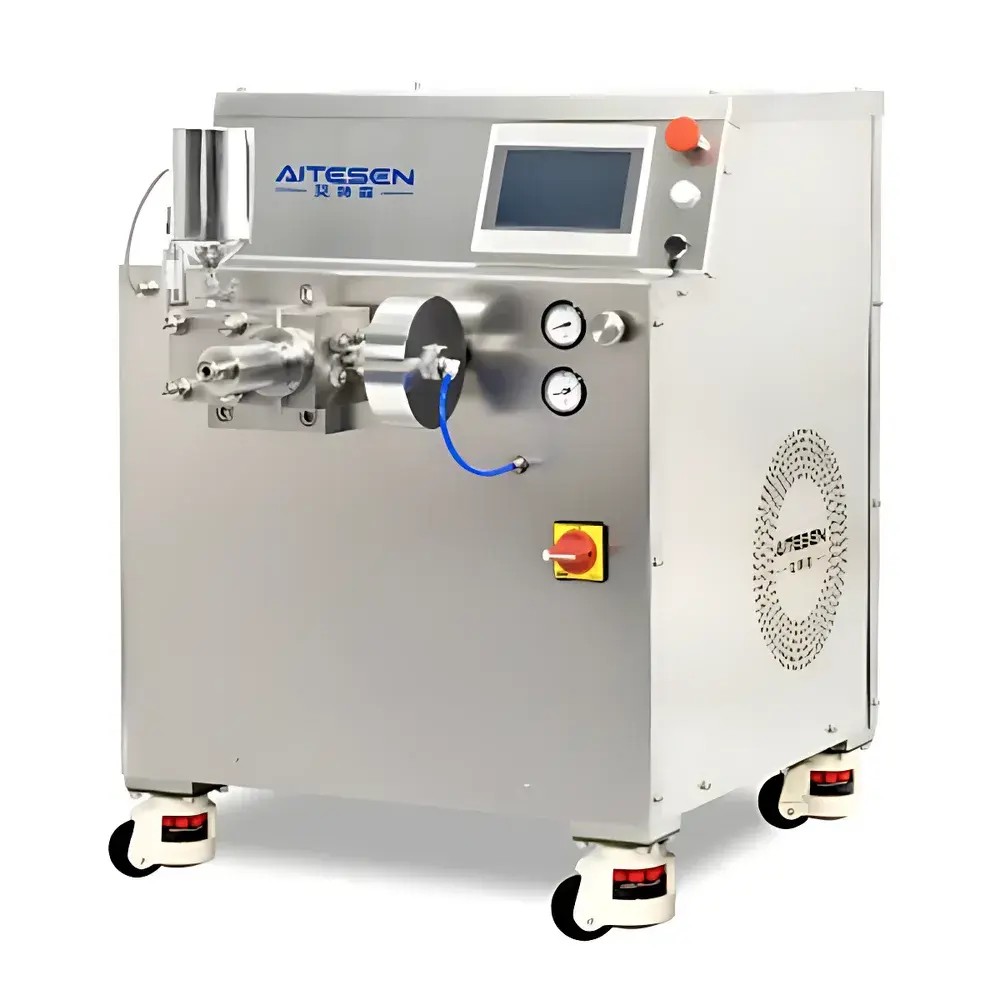
AITSEN HPH-L3 Pilot-Scale High-Pressure Homogenizer
| Brand | AITSEN |
|---|---|
| Model | HPH-L3 |
| Type | High-Pressure Piston-Type Homogenizer |
| Construction | Modular Pump Head Design |
| Wetted Materials | SAF2507 Super Duplex Stainless Steel |
| Maximum Operating Pressure | 1800 bar |
| Flow Rate Range | 10–40 L/h |
| Minimum Sample Volume | 30 mL |
| Dimensions (W×D×H) | 658 × 868 × 920 mm |
| Weight | 280 kg |
| Noise Level | ≤65 dB(A) |
| Power Supply | 5.5 kW |
| Compliance | Manufactured per EU Machinery Directive 98/37/EC (MD) |
| Sterilization & Cleaning | CIP-Compatible, Autoclavable Components |
| Control Interface | Touchscreen HMI with Real-Time Pressure Monitoring, Data Logging, and Export (CSV/Excel) |
| Optional Systems | Frequency-Controlled Flow Regulation, Pneumatic/Automatic Pressure Actuation, PLC-Based Process Logic Control, Jacketed Temperature Control, Multi-Stage Homogenization, Closed-Loop Recirculation, Pre-Conditioning Module |
Overview
The AITSEN HPH-L3 is a pilot-scale high-pressure homogenizer engineered for reproducible, scalable processing of sensitive biopharmaceutical and nanomaterial suspensions under controlled mechanical stress. It operates on the principle of turbulent shear, cavitation, and particle collision induced by rapid pressure drop across a precisely engineered homogenizing valve—enabling consistent sub-micron and nano-scale dispersion, cell disruption, and emulsification. Designed for transition from lab-scale feasibility studies to clinical batch production, the HPH-L3 bridges the gap between R&D instrumentation and GMP-compliant manufacturing equipment. Its robust architecture integrates a high-strength SAF2507 pump head, thermally stable hydraulic drive system, and fail-safe pressure regulation—ensuring operational stability at sustained pressures up to 1800 bar. The unit meets essential mechanical safety requirements per EU Machinery Directive 98/37/EC and supports integration into validated workflows aligned with ISO 13485, FDA 21 CFR Part 11 (when paired with compliant software), and ICH Q5A/Q5D process validation frameworks.
Key Features
- Modular pump head assembly with quick-access service design—minimizing downtime during routine maintenance or valve replacement.
- SAF2507 super duplex stainless steel wetted surfaces—providing exceptional resistance to chloride-induced pitting and erosion in aggressive biological or acidic media.
- Adjustable homogenizing valve with dual-stage geometry—optimized for both high-shear lysis (e.g., E. coli, yeast) and gentle nano-emulsification (e.g., lipid nanoparticles, liposomes).
- Real-time digital pressure monitoring and logging via touchscreen HMI—with configurable alarm thresholds and automatic pressure hold functionality.
- Integrated data export capability (CSV/Excel format) for audit-ready traceability; compatible with external SCADA or MES systems via RS485/Modbus RTU.
- CIP-compatible fluid path and autoclavable sample inlet/outlet manifolds—supporting cleaning validation per ASTM E3106 and ASME BPE standards.
Sample Compatibility & Compliance
The HPH-L3 accommodates a broad spectrum of viscous and particulate-laden feed streams—including bacterial lysates, lipid dispersions, polymer suspensions, and ceramic nanoparticle slurries—with maximum inlet particle size ≤500 µm. Its closed-loop recirculation option enables multi-pass processing without air exposure—critical for oxygen-sensitive mRNA-LNP formulations or sterile drug product intermediates. All pressure-bearing components conform to PED 2014/68/EU design criteria. Electrical safety complies with EN 61000-6-2/6-4 EMC standards. For regulated environments, optional PLC control modules support 21 CFR Part 11-compliant electronic signatures, audit trails, and user role-based access control.
Software & Data Management
The embedded HMI firmware provides intuitive operation via graphical interface: pressure ramping profiles, cycle counting, run-time logging, and fault diagnostics are all accessible without external software. Logged parameters include inlet/outlet pressure, temperature (with optional sensor), total runtime, and cumulative energy input (kWh). Data export supports CSV formatting for statistical process control (SPC) analysis in JMP or Minitab. When integrated with third-party LIMS or MES platforms, the HPH-L3 can transmit real-time status signals (e.g., “valve open”, “pressure stable”, “cycle complete”) via discrete I/O or Modbus TCP—facilitating automated batch record generation and deviation tracking per ALCOA+ principles.
Applications
- Biopharmaceutical development: Gram-negative and gram-positive microbial cell disruption; inclusion body solubilization; viral vector purification support.
- Lipid nanoparticle (LNP) formulation: Scalable preparation of ionizable lipid–nucleic acid complexes for mRNA vaccine candidates and gene therapies.
- Nanomedicine: Production of sterically stabilized liposomes, nanoemulsions for parenteral nutrition, and polymeric micelles with narrow PDI (<0.15).
- Advanced materials: Exfoliation of graphene oxide, dispersion of carbon nanotubes in aqueous/organic matrices, and deagglomeration of cellulose nanocrystals.
- Food & cosmetic science: Cold homogenization of heat-labile bioactives; stabilization of oil-in-water emulsions without thermal degradation.
FAQ
What is the minimum viable sample volume for process development runs?
The HPH-L3 supports repeatable processing down to 30 mL with full pressure control—ideal for early-stage formulation screening where material conservation is critical.
Can the system be validated for GMP manufacturing?
Yes—when equipped with optional PLC control, calibrated pressure transducers, and audit-trail-enabled firmware, the HPH-L3 supports IQ/OQ/PQ execution per Annex 15 and ISPE GAMP 5 guidelines.
Is temperature control available during homogenization?
An optional jacketed homogenization chamber and external chiller interface enable precise thermal management (±0.5°C) across 4–40°C range—essential for thermolabile biologics.
How does the HPH-L3 compare to microfluidizer-based platforms?
Unlike fixed-geometry microchannels, the HPH-L3’s adjustable valve permits dynamic optimization of shear intensity and residence time—offering greater flexibility for diverse material rheologies and scalability pathways.
Does the unit support sterile processing?
With steam-in-place (SIP)-compatible wetted parts and validated CIP protocols, the HPH-L3 is routinely deployed in aseptic API intermediate processing—subject to site-specific sterilization cycle qualification.



