
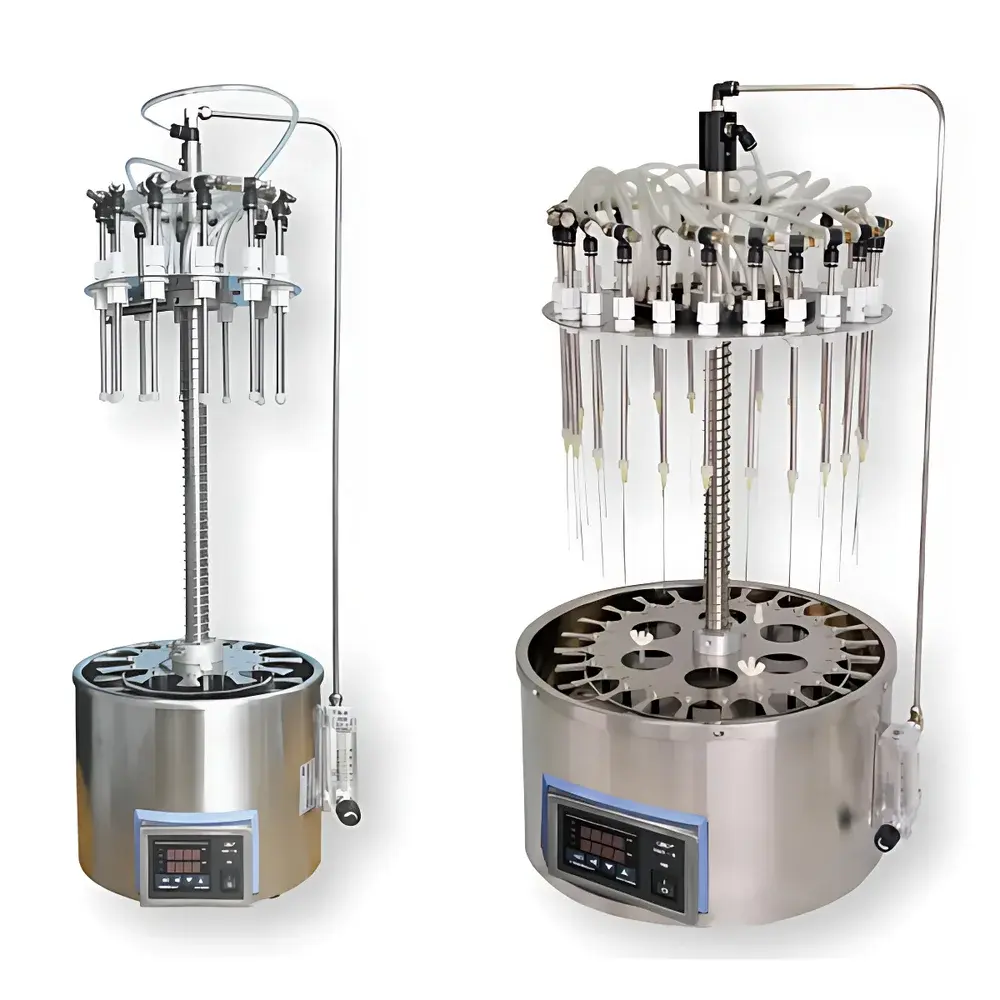
HengAo HSC-12B / HSC-24B Water-Bath Nitrogen Evaporator
| Brand | Tianjin HengAo |
|---|---|
| Origin | Tianjin, China |
| Manufacturer Type | Direct Manufacturer |
| Heating Method | Water Bath |
| Temperature Range | Ambient to 100 °C |
| Temperature Uniformity | ±1 °C |
| Sample Capacity | 12 or 24 positions |
| Tube Diameter Compatibility | 10–25 mm |
| Nitrogen Flow Rate | 0–5 L/min |
| Rated Power | 400 W |
| Dimensions (HSC-12B) | Ø250 × 820 mm |
| Weight | 7 kg |
| Control | 4-digit LED display with PID temperature regulation, overheat protection, PTC heating element |
| Power Supply | 220 V, 50 Hz |
| Gas Inlet Pressure | 0–200 kPa |
| Material Contacting Solvents | 316 stainless steel, anodized aluminum, or epoxy-coated surfaces |
Overview
The HengAo HSC-12B and HSC-24B Water-Bath Nitrogen Evaporators are precision-engineered instruments designed for gentle, reproducible concentration of volatile solvents from multiple liquid samples under inert gas atmosphere. Based on the principle of controlled nitrogen gas sweep across sample surfaces in a thermostatically regulated water bath, these systems facilitate efficient solvent removal while minimizing analyte degradation, oxidation, or thermal decomposition—critical for thermally labile compounds encountered in pharmaceutical, environmental, and clinical laboratories. Unlike dry-block evaporators, the water-bath configuration ensures uniform heat distribution and superior temperature stability across all sample positions, directly supporting compliance with method validation requirements for quantitative residue analysis.
Key Features
- Stable water-bath heating system with PID-controlled temperature regulation (ambient to 100 °C) and ±1 °C uniformity across the bath surface
- Dual configuration options: fixed 12-position (HSC-12B) or 24-position (HSC-24B) modular sample blocks with adjustable-height nitrogen needle manifold
- Individual gas flow control per channel via precision metering valves; total flow range 0–5 L/min with calibrated rotameter
- Corrosion-resistant construction: all solvent-contacting components fabricated from 316 stainless steel, anodized aluminum, or epoxy-coated steel to withstand repeated exposure to organic solvents including acetonitrile, ethyl acetate, and dichloromethane
- Intuitive 4-digit LED digital display with real-time setpoint/actual temperature readout, overheat cut-off protection, and PTC self-regulating heating elements
- Modular design supports rapid cleaning and maintenance; removable water bath tray and vertically adjustable gas manifold accommodate tubes ranging from 10 mm to 25 mm outer diameter
Sample Compatibility & Compliance
The HSC series accommodates standard 10–25 mm OD test tubes, culture tubes, and conical vials without adapter modification. Its open-bath geometry allows direct visual monitoring of evaporation endpoints and facilitates manual intervention when required—essential for method development and non-standard sample matrices. The instrument meets general laboratory safety standards for electrical insulation (IEC 61010-1) and is routinely deployed in workflows aligned with ISO/IEC 17025-accredited testing laboratories. While not certified for GMP production environments, its stable thermal performance, traceable temperature control, and mechanical reproducibility support GLP-compliant documentation when integrated into validated SOPs for pesticide residue analysis (e.g., AOAC 2007.01), pharmaceutical impurity profiling (ICH Q2(R2)), and clinical toxicology screening (CLIA-waived protocols).
Software & Data Management
The HSC-12B and HSC-24B operate as standalone benchtop instruments with no embedded software or data logging capability. All operational parameters—including set temperature, actual bath temperature, and gas flow—are monitored via analog/digital front-panel indicators. For laboratories requiring audit trails, integration with external data acquisition systems is supported through optional PT100 probe outputs (available upon request). When used within regulated environments, users implement manual logbooks or LIMS-integrated electronic notebooks to record batch-specific parameters, operator ID, date/time stamps, and final volume verification—consistent with FDA 21 CFR Part 11 principles for attributable, legible, contemporaneous, original, and accurate (ALCOA+) data handling.
Applications
- Agricultural residue analysis: Concentration of extracts from QuEChERS-prepared fruits, vegetables, cereals, and plant tissues prior to GC-MS or LC-MS/MS detection
- Environmental monitoring: Pre-concentration of trace-level PAHs, PCBs, and organochlorine pesticides from aqueous environmental samples (drinking water, wastewater, sediment eluates)
- Pharmaceutical quality control: Solvent removal following extraction of herbal formulations, dissolution media, or stability study samples under inert atmosphere
- Clinical and forensic toxicology: Preparation of biological matrices (plasma, serum, urine, whole blood) for target analyte quantification by tandem mass spectrometry
- Food safety testing: Final concentration step in multi-residue methods for veterinary drug residues, mycotoxins, and process contaminants (e.g., furan, acrylamide)
FAQ
What is the maximum recommended operating temperature for the HSC series?
The HSC-12B and HSC-24B are rated for continuous operation up to 100 °C. Exceeding this limit may compromise seal integrity, accelerate bath fluid evaporation, and affect long-term temperature stability.
Can the instrument be used with gases other than nitrogen?
Yes—argon or other inert, dry, oil-free gases compatible with stainless steel and elastomer seals may be substituted; however, nitrogen remains the default choice due to cost-effectiveness and established safety profiles in analytical labs.
Is calibration documentation provided with the unit?
Factory calibration certificates for temperature sensors and flow meters are available upon request at time of order; users are responsible for periodic in-house verification using NIST-traceable reference standards per their quality management system requirements.
How often should the water bath fluid be replaced?
Distilled or deionized water should be refreshed daily in high-throughput labs; weekly replacement is sufficient for low-frequency use. Addition of algaecide or biocide is discouraged unless validated for compatibility with downstream analytical methods.
Does the system support unattended overnight operation?
While equipped with overheat protection, the HSC series lacks automated endpoint detection or timed shutdown. Unattended use requires risk assessment per institutional safety policy and implementation of external timer controls or supervisory monitoring protocols.



