
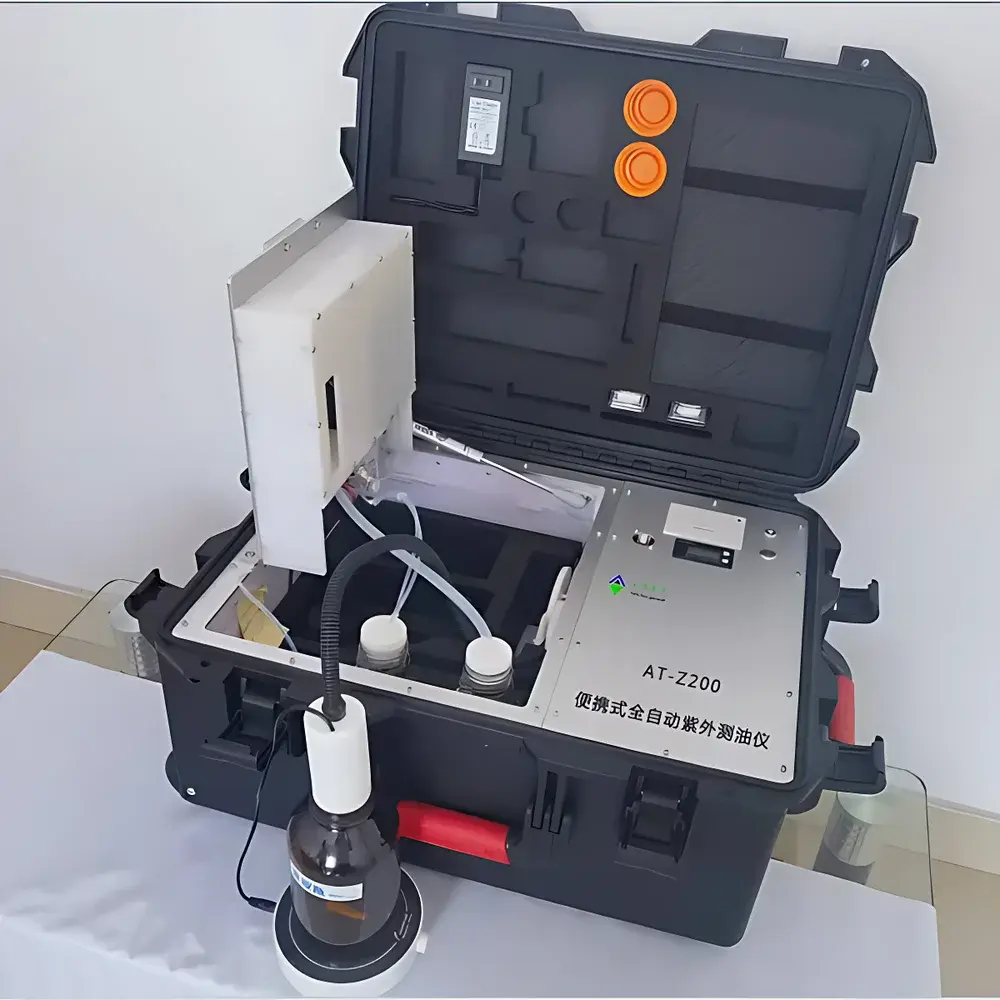
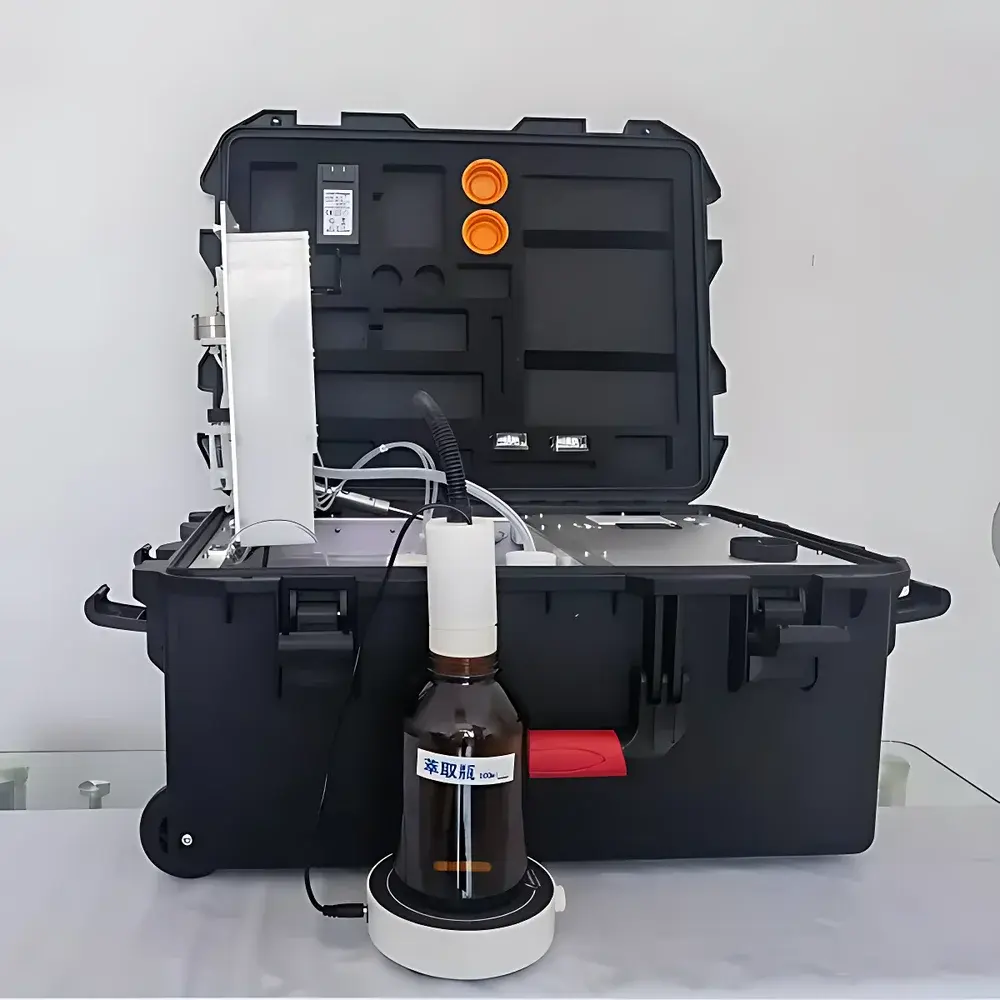
Agilent General AT-Z200 Portable Fully Automated UV Oil-in-Water Analyzer
| Brand | Agilent General |
|---|---|
| Origin | Beijing, China |
| Manufacturer Type | Direct Manufacturer |
| Product Category | Domestic |
| Model | AT-Z200 |
| Instrument Type | Portable |
| Measurement Principle | Ultraviolet Spectrophotometry (UV-Vis) |
| Measurement Range | 0.002–60 mg/L |
| Detection Limit | < 0.01 mg/L |
| Accuracy | ±2% (relative error) |
| Resolution | 0.001 mg/L |
| Analysis Cycle Time | 7 minutes per sample |
Overview
The Agilent General AT-Z200 Portable Fully Automated UV Oil-in-Water Analyzer is an engineered solution for field-deployable, regulatory-compliant quantification of petroleum hydrocarbons in aqueous matrices. It operates on the principle of ultraviolet absorption spectroscopy at 225 nm, as specified in the Chinese national environmental standard HJ 970–2018, “Determination of Petroleum Hydrocarbons in Water—Ultraviolet Spectrophotometric Method (Trial).” The instrument integrates a compact optical path with a narrow spectral bandwidth (< 2 nm), high-stability deuterium lamp source, and thermoelectrically stabilized photodiode detector to ensure measurement repeatability and long-term baseline stability. Its fully automated workflow eliminates manual solvent handling and operator-dependent steps, reducing analytical variability and enabling unattended operation in remote or resource-constrained environments—including mobile laboratories, emergency response vehicles, and on-site monitoring stations.
Key Features
- Fully integrated automation: precise water sample volumetric dispensing, automatic liquid–liquid extraction using n-hexane (or alternative UV-transparent solvents), phase separation, water removal via anhydrous sodium sulfate column, and spectrophotometric analysis—all within a single sealed system.
- Hermetic process architecture: all solvent-based operations occur under closed-loop conditions; waste organic phase and aqueous residuals are automatically segregated into dedicated containment vessels; volatile organic compound (VOC) emissions are captured and vented through an activated carbon filter module.
- Dual-operation mode: supports standalone operation via embedded industrial-grade ARM-based controller with 7-inch capacitive touchscreen, or networked control and data logging via external Windows PC using USB or Ethernet interface.
- Robust field design: housed in a custom-molded ABS impact-resistant carry case (IP65-rated enclosure), equipped with internal shock-absorbing mounts, rechargeable Li-ion battery (≥4 hours continuous operation), and integrated solvent reservoirs with level sensors.
- Regulatory alignment: designed and validated in accordance with JJF 1833–2020, “Verification Regulation for Oil-in-Water Analyzers,” a national metrological verification standard for which Agilent General served as a core drafting participant.
Sample Compatibility & Compliance
The AT-Z200 is validated for direct analysis of surface water, groundwater, seawater, and wastewater effluents without pre-filtration (for non-turbid samples) or dilution (within linear dynamic range). It complies with method-defined matrix tolerances for salinity (≤35 g/L NaCl), suspended solids (< 20 mg/L), and common interferents including humic substances (up to 10 mg/L as DOC) and surfactants (≤5 mg/L SDS). All calibration and verification procedures follow traceable protocols aligned with ISO/IEC 17025 requirements for testing laboratories. Instrument performance verification includes daily system suitability checks (SSC) per HJ 970–2018 Annex B, covering wavelength accuracy, photometric linearity, and extraction recovery (target: 85–115% for spiked mineral oil standards).
Software & Data Management
The embedded software (v3.2+) provides GLP-compliant audit trails, user-access-level management (admin/operator/observer), electronic signature support, and automatic generation of compliant test reports (PDF/CSV). Data files include raw absorbance spectra, extraction efficiency logs, solvent consumption metrics, and QC flagging for out-of-spec results. When connected to a laboratory information management system (LIMS), the analyzer supports ASTM E1384-compliant data exchange via HL7 or direct SQL database push. All analytical records retain full metadata: timestamp, operator ID, calibration status, environmental temperature/humidity, and instrument firmware version—meeting FDA 21 CFR Part 11 requirements for electronic records and signatures when deployed in regulated environmental testing labs.
Applications
- Regulatory compliance monitoring of petroleum hydrocarbon discharge limits under China’s GB 3838–2002 and GB 8978–1996 standards.
- Emergency spill assessment and real-time tracking of oil migration plumes in rivers, lakes, and coastal zones.
- Baseline and post-remediation surveys at petrochemical facilities, offshore platforms, and storage tank farms.
- Research applications requiring high-frequency, low-variability oil-in-water time-series data—e.g., biodegradation kinetics studies, sorption isotherm modeling, and membrane filtration efficiency validation.
- Mobile QA/QC support for third-party environmental testing agencies conducting multi-site field campaigns.
FAQ
What solvent is required for extraction, and is it compatible with HJ 970–2018?
n-Hexane is the primary extraction solvent specified in HJ 970–2018; the AT-Z200 is pre-configured for n-hexane use and includes solvent purity verification routines. Alternative UV-transparent solvents (e.g., cyclohexane) may be selected via method setup, subject to user validation.
Can the instrument measure both total petroleum hydrocarbons (TPH) and separately quantify aliphatic vs. aromatic fractions?
The AT-Z200 measures total UV-absorbing petroleum hydrocarbons as defined by HJ 970–2018. It does not perform spectral deconvolution or GC-based speciation; for compound-class differentiation, complementary analysis using GC-FID or GC-MS is recommended.
Is routine maintenance required between samples?
No manual intervention is needed between analyses. System cleaning cycles (including tubing purge, cuvette rinse, and solvent line flush) are executed automatically after each run. Scheduled maintenance intervals are 200 runs or 6 months—whichever occurs first—and include optical window inspection and extraction column replacement.
How is calibration performed, and what standards are traceable to?
Calibration uses certified mineral oil standard solutions (CRM, NIST-traceable or CNAS-accredited), prepared gravimetrically in n-hexane. Calibration curves are generated using 5-point linear regression (0.002–60 mg/L), with r² ≥ 0.9995 required for acceptance.
Does the system support remote diagnostics or firmware updates?
Yes—via secure HTTPS-based web interface or dedicated diagnostic port. Firmware updates are digitally signed and validated prior to installation; rollback capability is retained for critical operational continuity.
Related Products







