
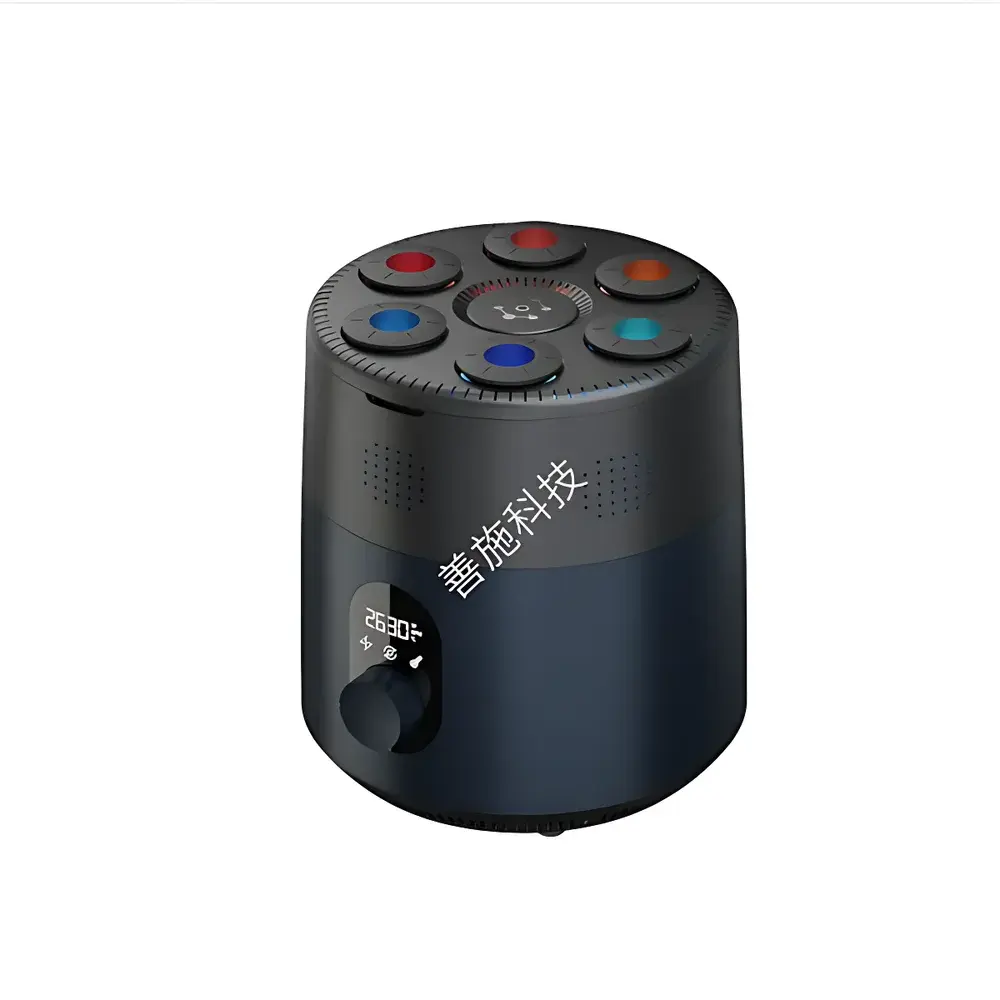
Shanghai 3S AL(7) Air-Cooled Photocatalytic Reactor
| Brand | Shanghai 3S Technology Co., Ltd |
|---|---|
| Origin | Shanghai, China |
| Manufacturer Type | Direct Manufacturer |
| Product Origin | Domestic (China) |
| Model | AL(7) |
| Pricing | Available Upon Request |
| Wavelength Range | 365–975 nm |
| Light Intensity | Up to 700 mW/cm² (≈2,000,000 lux) |
| Light Degradation Rate | <5% per year |
| Temperature Control | Ambient to 40 °C via Intelligent Air Cooling |
| Stirring Speed | 300–1500 rpm |
| Sample Vessel Compatibility | NMR tubes |
Overview
The Shanghai 3S AL(7) Air-Cooled Photocatalytic Reactor is an engineered platform for controlled photochemical synthesis under ambient or thermally regulated conditions. It operates on the principle of heterogeneous and homogeneous photocatalysis—where incident photons excite semiconductor catalysts (e.g., TiO₂, g-C₃N₄) or molecular photosensitizers (e.g., Ru(bpy)₃²⁺, Ir(ppy)₃), generating reactive species such as electrons, holes, singlet oxygen, or radical intermediates. Unlike water-cooled or jacketed reactors, the AL(7) employs a precisely modulated forced-air thermal management system, enabling stable temperature maintenance between ambient and 40 °C without solvent contamination, condensation risk, or external chiller dependency. Its integrated magnetic stirrer eliminates shaft seals and drive-through penetrations, ensuring absolute sample integrity—critical for air-sensitive, high-purity, or trace-level catalytic studies in pharmaceutical and materials development.
Key Features
- Multi-Wavelength Photonic Flexibility: Broad-spectrum LED or mercury/xenon lamp source options spanning 365–975 nm, with over 100 discrete wavelength configurations available. Modular lamp cartridges allow rapid interchange without realignment or recalibration.
- High-Flux Illumination: Delivers up to 700 mW/cm² irradiance at sample plane (measured per ISO 17025-accredited radiometric protocol), with photometric stability maintained within ±2% over 10,000 hours. Optical path design minimizes reflection loss and ensures uniform beam profile across standard vessel geometries.
- Intelligent Air Thermal Regulation: Closed-loop fan control with PID algorithm maintains setpoint temperature within ±0.5 °C across variable ambient conditions. Airflow rate and direction are optimized to avoid vortex formation or localized cooling that could disrupt reaction homogeneity.
- Seal-Free Magnetic Agitation: High-torque internal stir motor (rated for continuous operation at 1500 rpm) couples with PTFE-coated stir bars, supporting viscosity ranges from 0.3 to 500 cP. No lubricants, O-rings, or dynamic seals contact the reaction zone—eliminating leachables and cross-contamination.
- Modular Reaction Vessel Integration: Standardized mounting interface accommodates 5–100 mL cylindrical vessels—including ASTM E2877-compliant NMR tubes, Schlenk-type vials, and borosilicate glass reaction tubes. Custom adapters support non-standard geometries per user specification.
Sample Compatibility & Compliance
The AL(7) is compatible with organic solvents (acetonitrile, DMF, THF, DCM), aqueous buffers, and biphasic systems. All wetted parts comply with USP Class VI and ISO 10993-5 cytotoxicity standards. The reactor’s open architecture supports inert-atmosphere operation when paired with standard glovebox ports or Schlenk line manifolds. While not certified to IEC 61000-6-3 (EMC) or UL 61010-1 out-of-the-box, its electrical subsystems meet CE marking requirements for laboratory equipment (2014/30/EU, 2014/35/EU). Documentation packages include full traceable calibration records for light output (NIST-traceable spectroradiometer verification) and temperature sensors (PT100 Class B per IEC 60751).
Software & Data Management
The AL(7) operates via embedded microcontroller with local LCD interface and optional RS-485/USB-C digital communication. Real-time logging of irradiance (mW/cm²), stirring speed (rpm), chamber temperature (°C), and runtime (hh:mm:ss) is supported through ASCII-formatted CSV export. When integrated into LIMS or ELN environments (e.g., LabVantage, Benchling), data streams comply with ASTM E1578-20 metadata schema. Audit trail functionality satisfies GLP/GMP-aligned record-keeping requirements, including user ID stamping, parameter change history, and tamper-evident log file hashing. No cloud connectivity or proprietary software installation is required—ensuring full data sovereignty and IT security compliance.
Applications
This reactor serves as a primary tool in academic and industrial laboratories conducting method development for C–H functionalization, asymmetric photocatalysis, polymer photo-initiation, metal-free oxidation/reduction, and photocrosslinking of hydrogels. It accelerates reaction condition screening—particularly in DOE (Design of Experiments) workflows where wavelength, intensity, temperature, and mixing rate are orthogonal variables. Validated use cases include late-stage functionalization of API intermediates (per ICH Q5A/Q5B), synthesis of MOF precursors under UV–Vis irradiation, and mechanistic studies involving transient absorption spectroscopy coupling. Its reproducibility enables direct scale-up correlation from 5 mL discovery vials to 100 mL process-optimization batches.
FAQ
Does the AL(7) support simultaneous multi-wavelength irradiation?
Yes—dual-lamp configurations (e.g., 365 nm + 450 nm) can be installed using optional dual-channel power supplies and independent intensity controls.
Can the reactor be operated under nitrogen or argon atmosphere?
Yes—standard vessels feature septum-sealed caps or QuickFit® ground-glass joints compatible with standard inert gas purging protocols.
Is spectral irradiance data provided for each lamp option?
Yes—each lamp module ships with a calibrated spectral power distribution (SPD) report, measured using a cosine-corrected fiber-optic spectroradiometer traceable to NIST SRM 2035.
What is the maximum allowable solvent volume for thermal stability at 40 °C?
For optimal air-cooling efficiency, recommended upper limits are 20 mL (in 25 mL tube), 50 mL (in 100 mL tube); larger volumes require extended stabilization time but remain within operational envelope.
Are replacement lamps and stir bars supplied as consumables?
Yes—original equipment manufacturer (OEM) lamp cartridges, PTFE-coated stir bars, and quartz light guides are stocked and shipped with full compatibility certification.



