
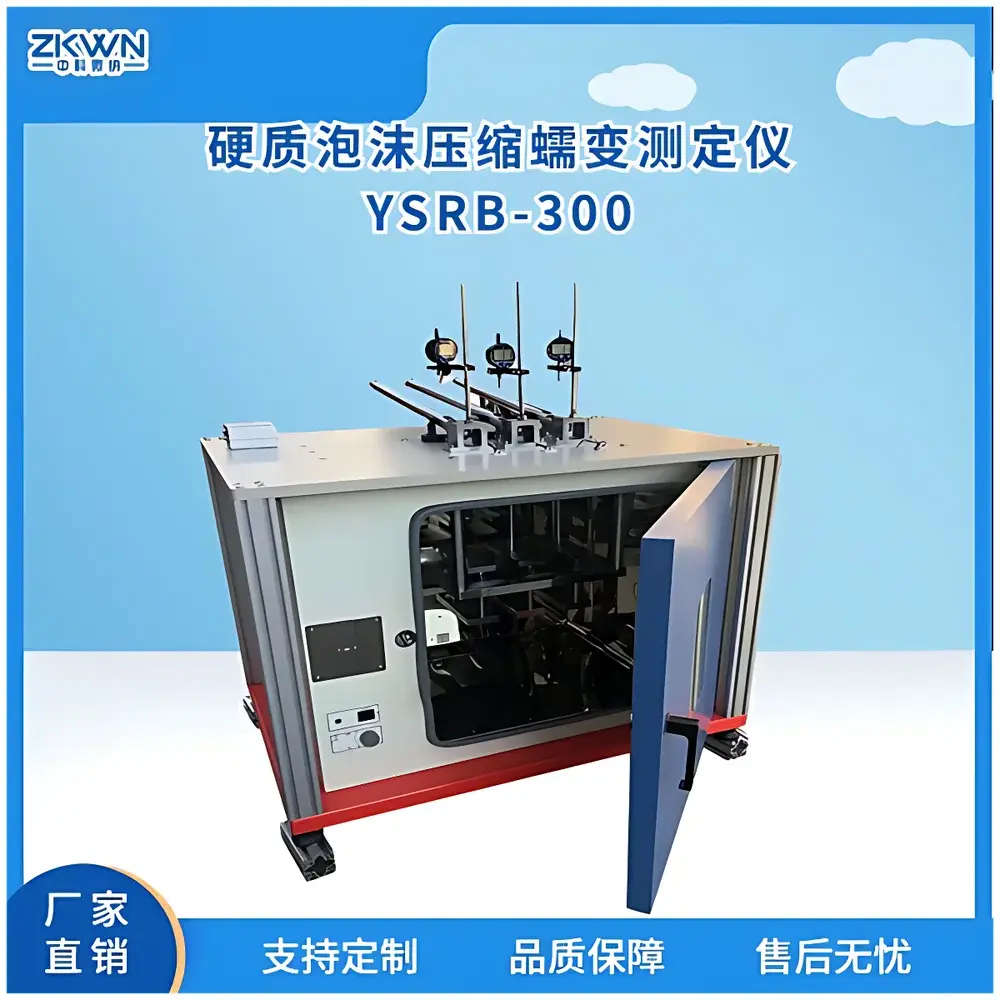
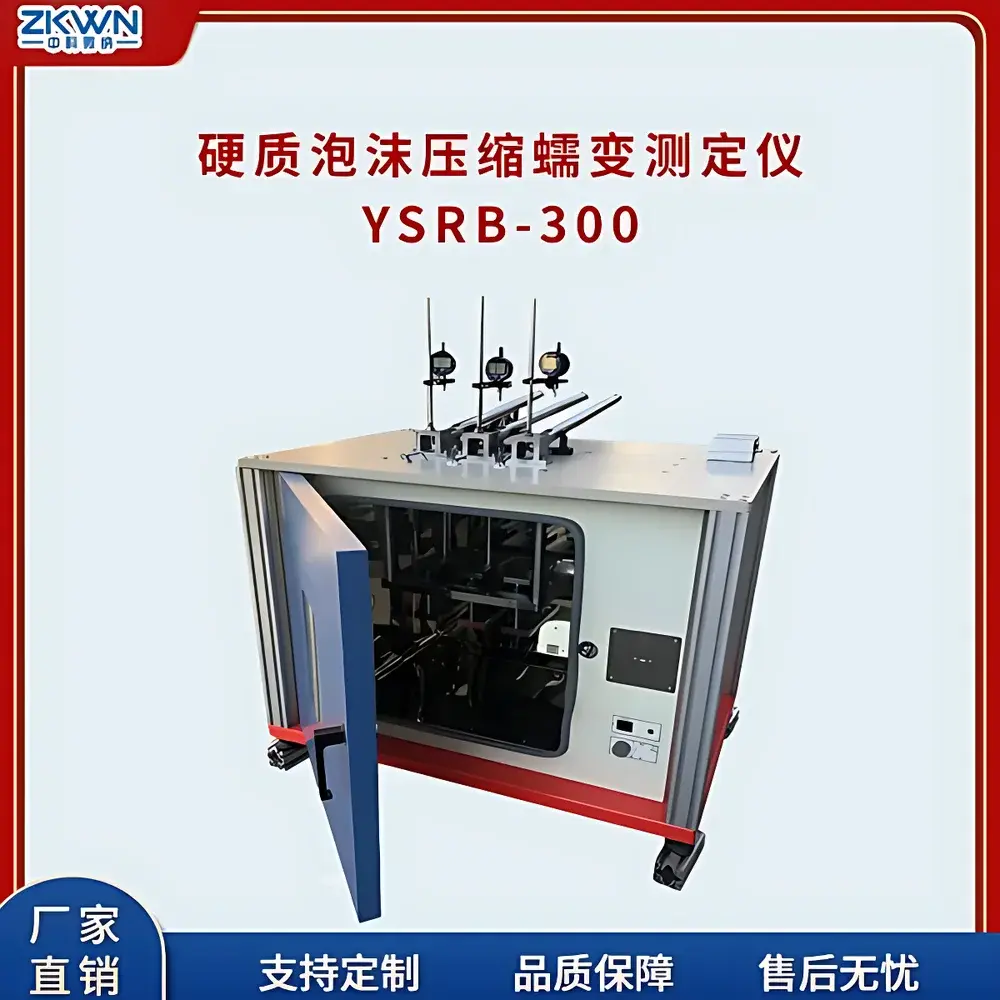
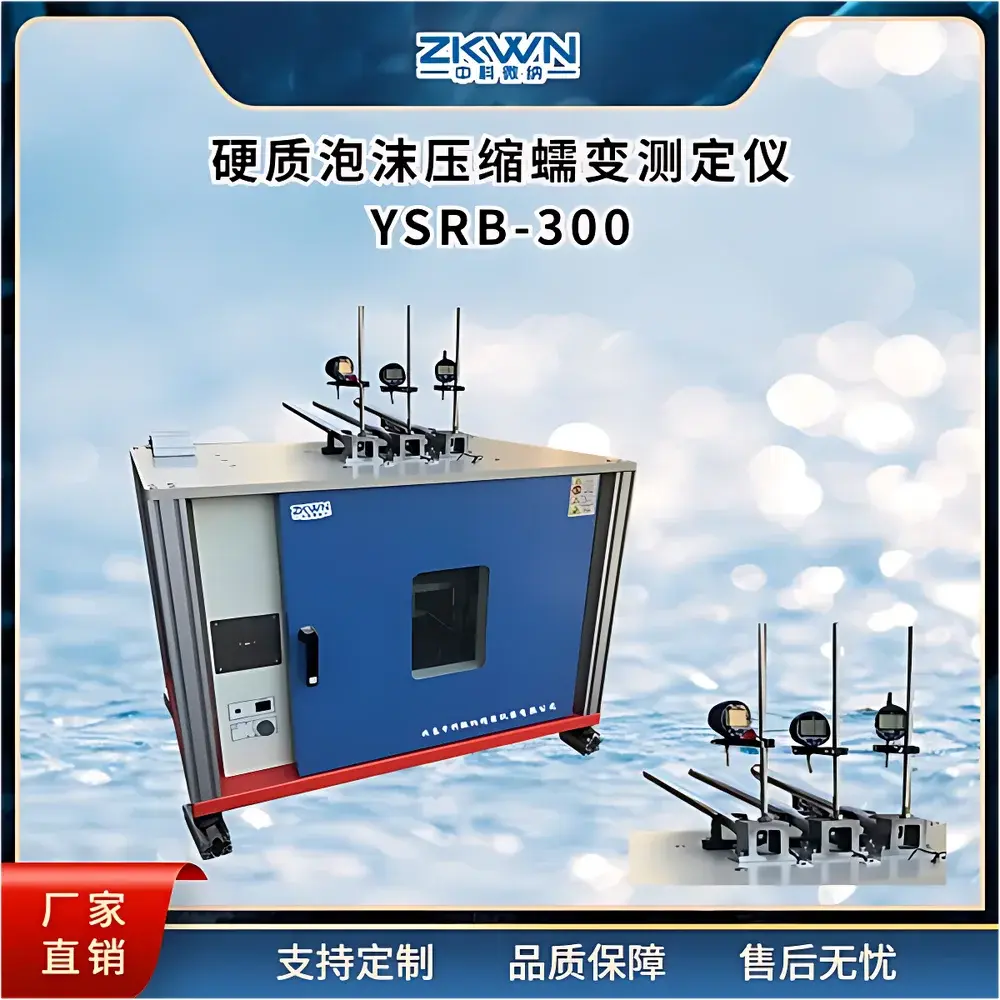
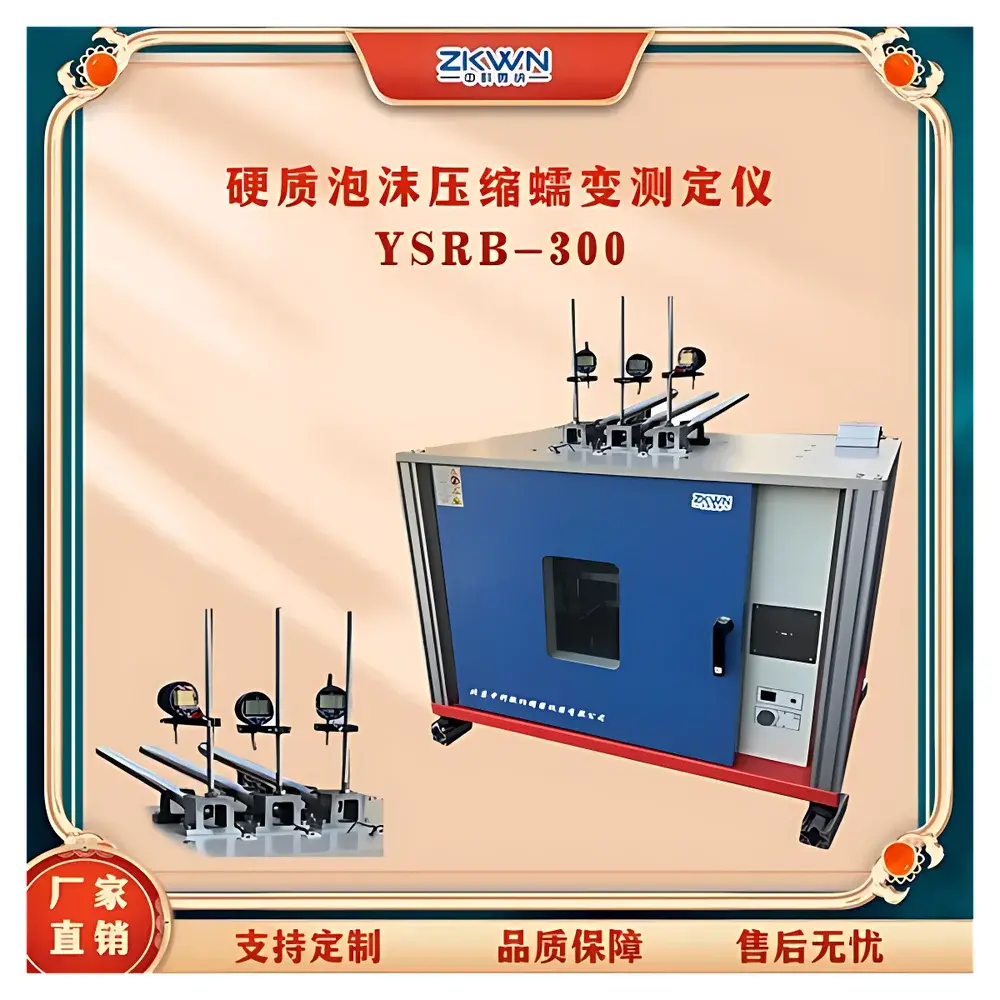
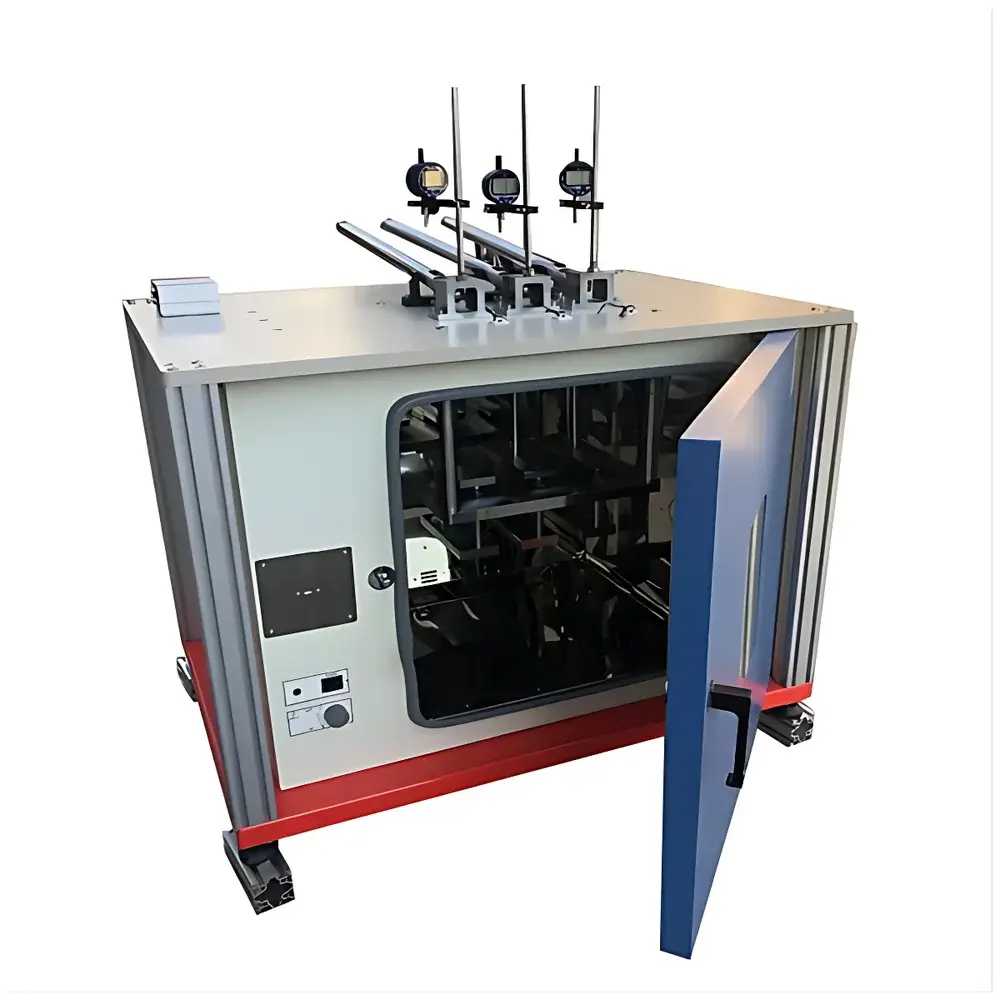
ZKWN YSRB-300* Hard Foam Creep and Stress Rupture Testing Machine
| Brand | ZKWN |
|---|---|
| Origin | Beijing, China |
| Model | YSRB-300* |
| Instrument Type | Electromechanical |
| Max Test Load | 10 kN |
| Max Plunger Travel | 180 mm |
| Specimen Dimensions | 50×50×50 mm or 40×40×20 mm |
| Overall Dimensions | 500×500×500 mm (H×W×D) / 400×400×200 mm (H×W×D) |
| Net Weight | 50 kg |
| Heating Method | Forced-air oven |
| Temperature Range | Ambient to 300 °C |
| Temp. Stability | ±2 °C |
| Temp. Ramp Rates | 50±3 °C/h or 10±2 °C/12 min |
| Temp. Resolution | 0.1 °C |
| Deformation Resolution | 0.002 mm |
| Loading Configuration | Three independent test stations (compression via lever-arm mechanical amplification 1:32 |
| Recommended Load Range | 0–1 MPa |
| Heating Chamber Volume | 350×400×400 mm (L×W×H) |
| Compliance | GB/T 20672–2006, DIN 53424 |
Overview
The ZKWN YSRB-300* Hard Foam Creep and Stress Rupture Testing Machine is a precision electromechanical system engineered for long-term dimensional stability evaluation of rigid polymeric foams under sustained compressive or flexural loading at elevated temperatures. It operates on the fundamental principle of time-dependent viscoelastic deformation measurement—specifically, compression creep under constant load and controlled thermal environment—enabling quantification of strain evolution over hours or days in accordance with standardized protocols. Designed for laboratories engaged in polymer material development, quality assurance, and regulatory compliance testing, the instrument delivers high reproducibility in creep compliance (ε/t), creep modulus (σ/ε), and time-to-failure under stress rupture conditions. Its architecture integrates air-bath thermal conditioning with mechanical load application via calibrated dead-weight systems and lever-amplified force transmission, ensuring minimal thermal drift interference with mechanical signal integrity.
Key Features
- Triple-station configuration supporting simultaneous creep testing across three independent specimens—two compression and one bending—or fully customizable allocation per test requirement.
- Forced-air heating chamber (350 × 400 × 400 mm) with programmable ramp profiles (50 ± 3 °C/h or 10 ± 2 °C/12 min) and stable temperature control (±2 °C deviation) across the full range from ambient to 300 °C.
- High-resolution displacement measurement using optical grating-based digital micrometers (0.002 mm resolution), mounted directly on each loading axis to eliminate thermal expansion artifacts from structural frames.
- Mechanically amplified compression loading (1:32 lever ratio) enabling precise application of low-stress loads (0–1 MPa) using standard stainless-steel calibration weights; bending tests utilize direct dead-weight loading for ASTM D790-comparable boundary conditions.
- Integrated electronic control unit with real-time color curve visualization, automatic data logging, and timestamped event marking for load application, temperature stabilization, and deformation threshold detection.
- Full audit trail capability: all temperature setpoints, load values, displacement readings, and system status flags are logged with millisecond timestamps, supporting GLP/GMP documentation requirements and FDA 21 CFR Part 11-compliant data archiving when paired with validated software.
Sample Compatibility & Compliance
The YSRB-300* accommodates standard specimen geometries defined in international foam testing standards: cuboidal samples of 50 × 50 × 50 mm or 40 × 40 × 20 mm, suitable for both compression and three-point bending configurations. Its design strictly adheres to the procedural and metrological requirements of GB/T 20672–2006 (“Rigid cellular plastics — Determination of compression creep under specified load and temperature”) and DIN 53424 (“Testing of plastics — Dimensional stability under heat and stress”). The system’s temperature uniformity, load accuracy, and deformation resolution meet the minimum performance thresholds required for ISO 844 and ASTM D1621 verification workflows. All mechanical components—including load train elements, platen surfaces (50 × 50 mm flat compression platens), and bending support rollers—are manufactured from low-thermal-expansion stainless steel to minimize parasitic drift during extended-duration tests (>100 h).
Software & Data Management
The embedded controller firmware provides native support for automated test sequencing, including multi-step temperature ramps, load hold periods, and conditional termination triggers (e.g., strain rate exceeding 0.1 %/h). Raw sensor data—including thermocouple voltage, encoder counts, and relay status—is streamed continuously at 10 Hz and stored in binary format with CRC-32 checksum validation. Export options include CSV (with SI-unit headers), PDF report generation (including annotated creep curves, derivative plots, and summary tables), and XML schema-compliant files compatible with LIMS integration. Optional software modules enable statistical process control (SPC) charting, Weibull failure analysis for stress rupture datasets, and comparative overlay of master curves generated via time–temperature superposition (TTS) methods per ISO 6721-1.
Applications
- Quantitative assessment of long-term compressive set in rigid polyurethane (PUR), phenolic, and melamine-formaldehyde foams used in building insulation and aerospace sandwich cores.
- Evaluation of thermal-mechanical stability for flame-retardant foams subjected to fire-resistance certification protocols (e.g., EN 13501-1, UL 94).
- Material screening for automotive interior components requiring dimensional retention under dashboard temperature cycling (e.g., 85 °C/95 % RH for 1000 h).
- Supporting ISO 11357-6 and ASTM D696 coefficient-of-thermal-expansion (CTE) correlation studies through synchronized thermal expansion and creep onset detection.
- Validation of finite element models simulating viscoelastic response of cellular polymers under service-relevant thermo-mechanical boundary conditions.
FAQ
What standards does the YSRB-300* comply with for creep testing?
It conforms to GB/T 20672–2006 and DIN 53424, with hardware specifications aligned to the metrological requirements of ISO 844 and ASTM D1621 for rigid foam characterization.
Can the system perform both compression and bending creep tests simultaneously?
Yes—three independent test stations allow concurrent execution of two compression and one bending test, or any other combination enabled by the modular load train configuration.
Is the deformation measurement traceable to national metrology institutes?
The optical grating sensors are factory-calibrated against NIST-traceable length standards; calibration certificates with uncertainty budgets (k=2) are provided with each instrument shipment.
What is the maximum allowable test duration?
No intrinsic time limit exists; the system has been validated for continuous operation up to 3000 hours (≈125 days) with uninterrupted data acquisition and thermal stability monitoring.
Does the software support 21 CFR Part 11 compliance?
Yes—the optional GxP Edition includes role-based access control, electronic signatures, audit trail export, and data integrity validation tools certified for use in regulated pharmaceutical and medical device environments.



