
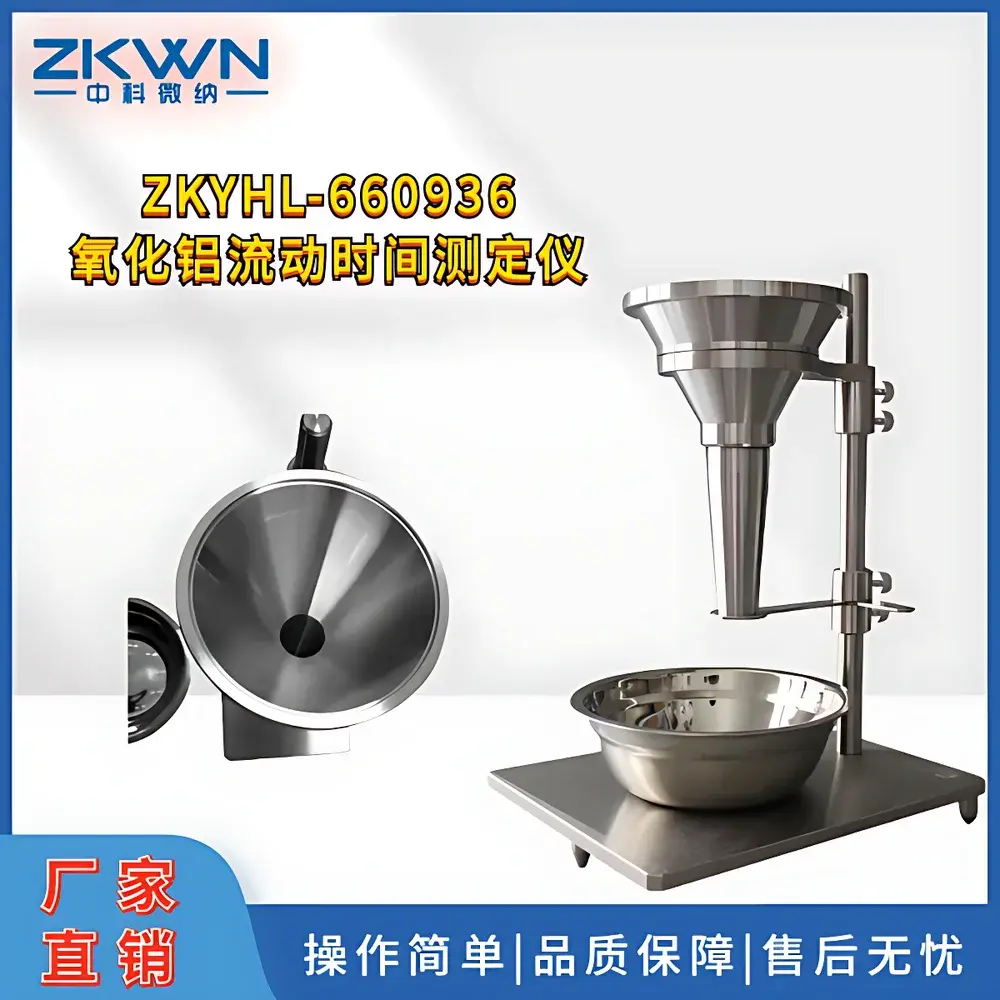
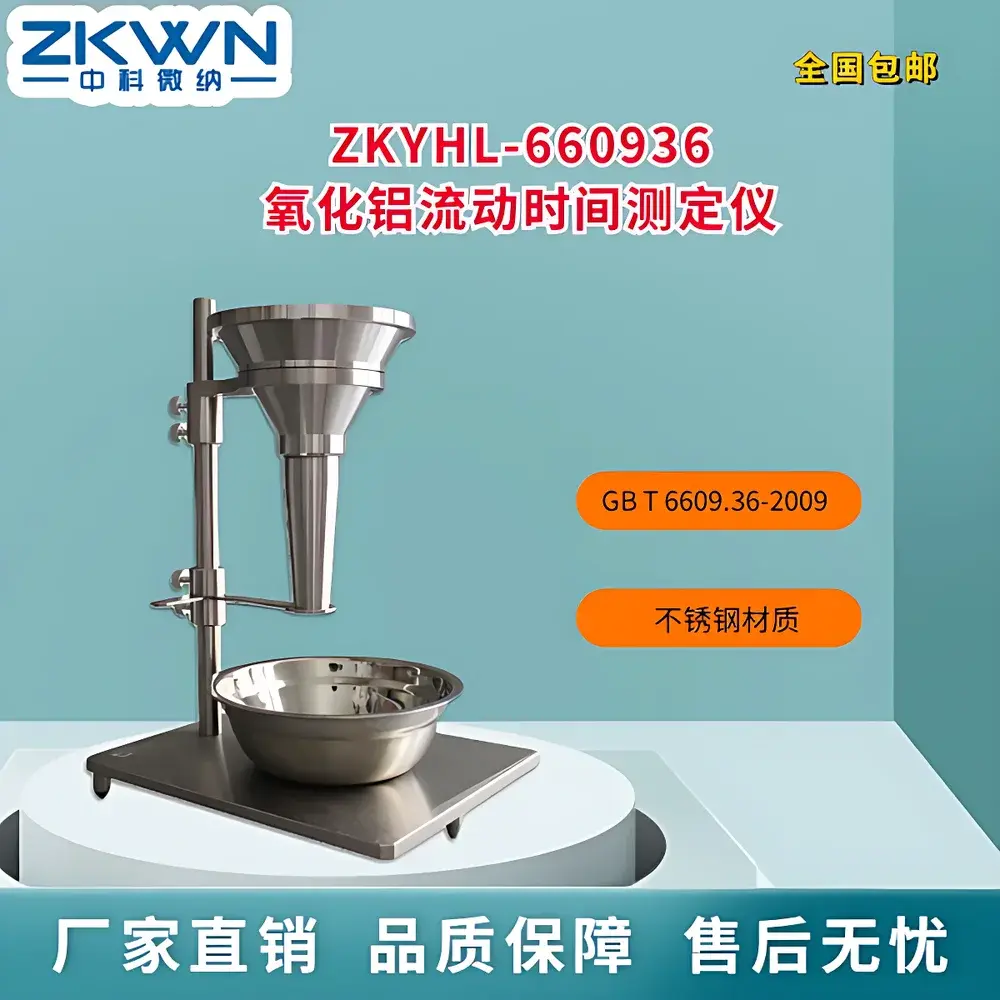
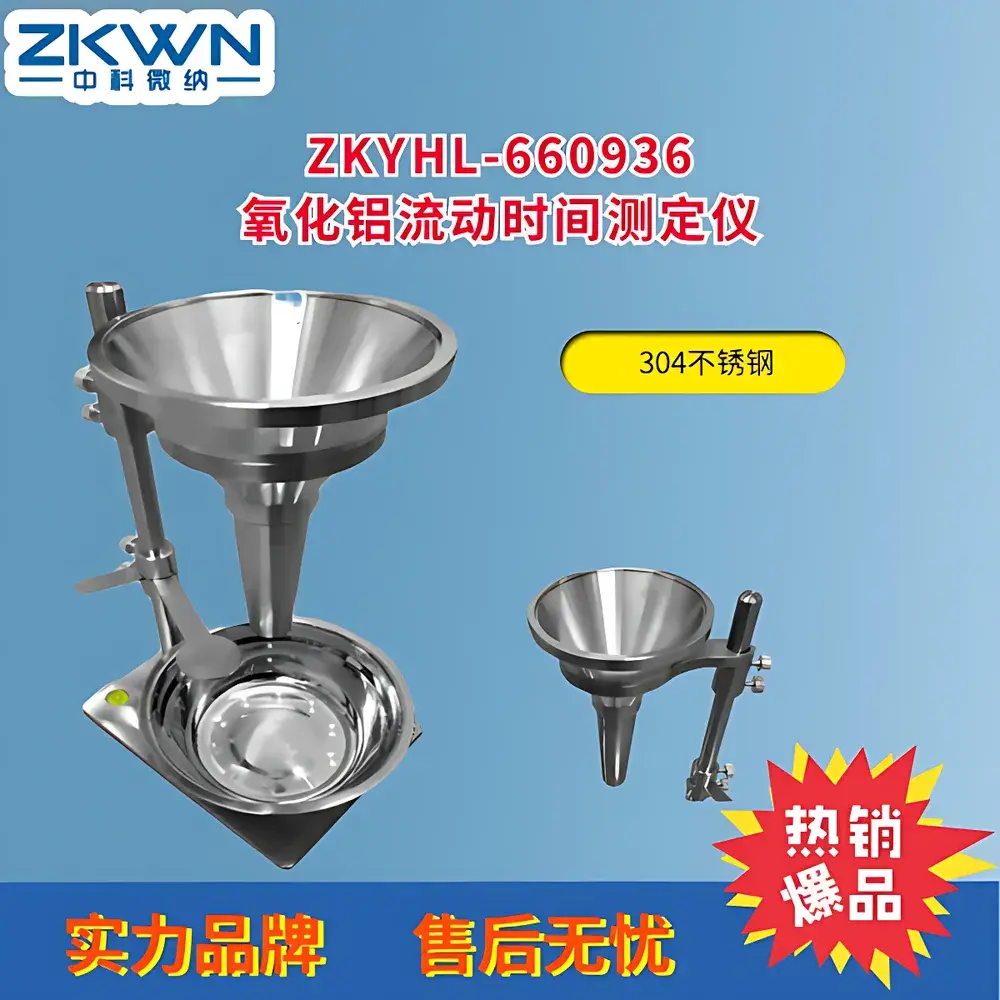
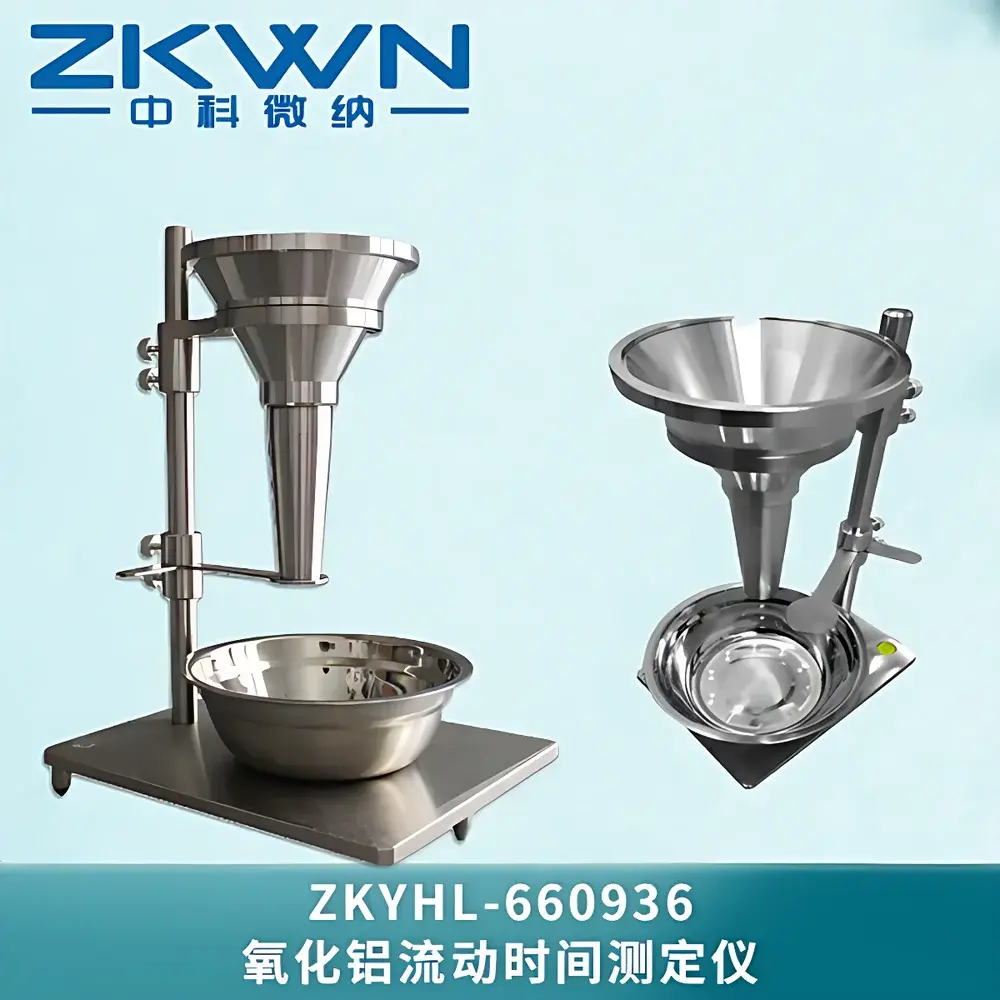
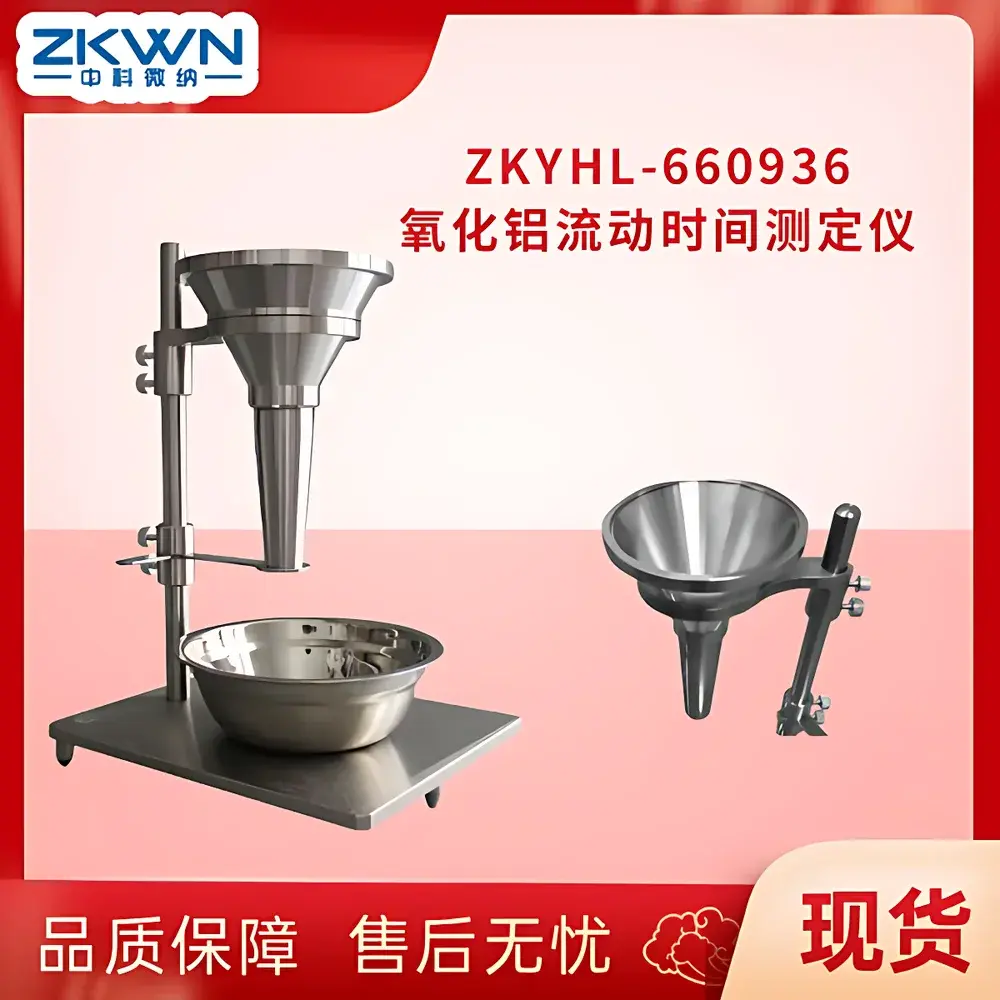
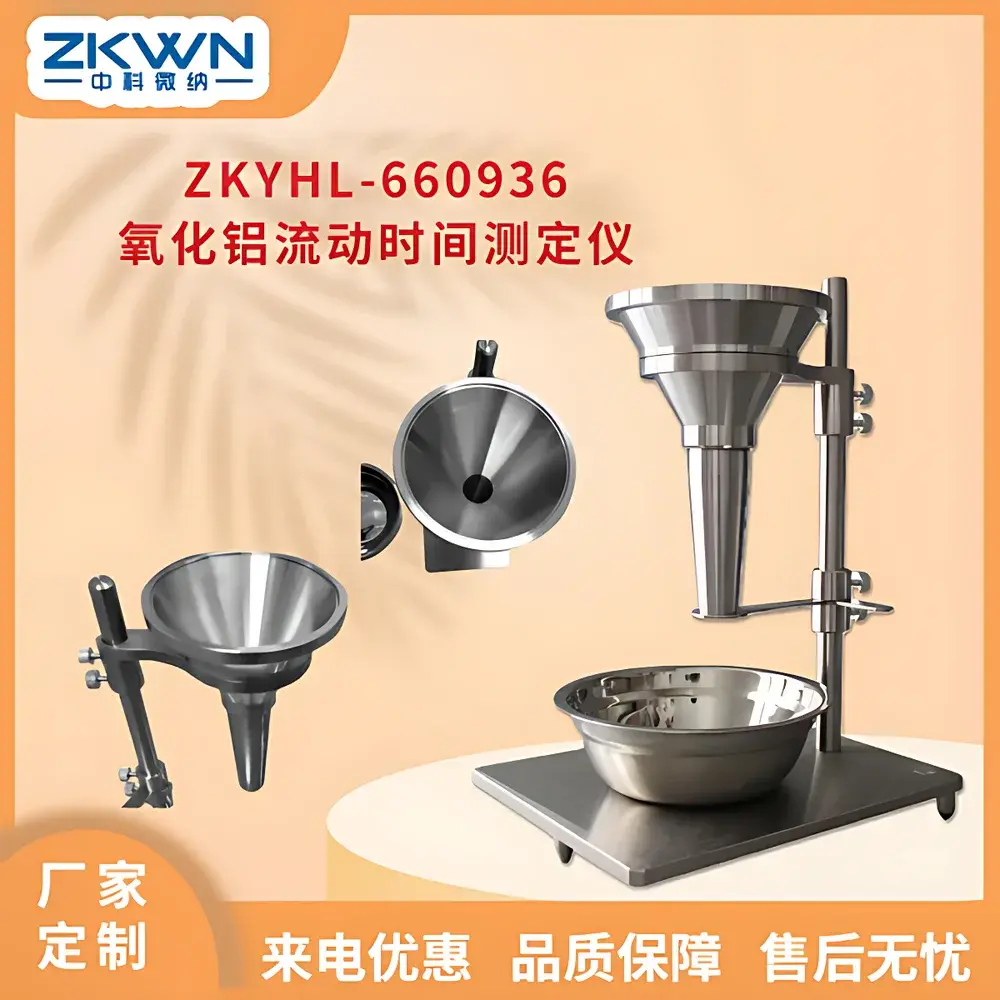
ZKWN ZKYHL-660936 Aluminum Oxide Powder Flow Time Tester
| Brand | ZKWN |
|---|---|
| Origin | Beijing, China |
| Model | ZKYHL-660936 |
| Instrument Type | Multi-functional Powder Flowability Tester |
| Measurable Parameter | Flow Time (s) |
| Funnel Outlet Diameter | 3.95–4.0 mm |
| Funnel Upper Inner Diameter | 123 mm |
| Funnel Upper Outer Diameter | 138.5 mm |
| Total Funnel Height | 190.5 mm |
| Upper Cone Angle | 60° |
| Lower Discharge Cone Angle | 15° |
| Maximum Sample Cup Capacity | 40 mL |
| Minimum Sample Mass | 10 g |
| Compliance Standard | GB/T 6609.36–2009 |
Overview
The ZKWN ZKYHL-660936 Aluminum Oxide Powder Flow Time Tester is a precision-engineered instrument designed specifically for the standardized measurement of flow time — a critical physical parameter reflecting the dynamic flow behavior of free-flowing granular materials under gravity. Based on the principle of gravitational discharge through a calibrated stainless-steel funnel, this tester implements the methodology defined in GB/T 6609.36–2009, which is aligned with internationally recognized powder flow characterization practices such as those referenced in ASTM D1895 (Method A) and ISO 4490. The device operates without mechanical agitation or vibration, ensuring that measured flow time reflects intrinsic interparticle friction, particle size distribution, surface morphology, and bulk density — all key determinants of processability in alumina powder handling, pneumatic conveying, die filling, and ceramic green body formation.
Key Features
- Stainless-steel conical funnel conforming precisely to GB/T 6609.36–2009 dimensional specifications: upper inner diameter 123 mm, outer diameter 138.5 mm, total height 190.5 mm, upper cone angle 60°, lower discharge cone angle 15°, and outlet orifice diameter tightly controlled between 3.95 mm and 4.0 mm.
- Gravity-driven flow measurement system requiring no external power, motorized actuation, or sensor calibration — eliminating sources of electronic drift and enabling long-term operational stability.
- Dedicated design for aluminum oxide (Al₂O₃) powders used in refractory, catalyst support, and advanced ceramic applications; optimized geometry minimizes wall adhesion and channeling effects common in fine, cohesive oxides.
- Integrated sample preparation protocol guidance compliant with GB/T 6609.36–2009: includes ambient equilibration (≥2 h at laboratory conditions), sieve pre-treatment (to remove oversized agglomerates), and precise mass dosing (100.0 ± 0.1 g per test).
- Robust benchtop architecture suitable for QC laboratories operating under ISO/IEC 17025 or GMP-aligned environments where procedural consistency and operator-independent repeatability are essential.
Sample Compatibility & Compliance
This instrument is validated for use with calcined and hydrated aluminum oxide powders meeting the particle size and moisture specifications outlined in GB/T 6609.1–2009. While primarily intended for Al₂O₃, its geometric configuration permits comparative flow time assessment of other free-flowing, non-fibrous, non-sticky powders with median particle sizes between 1 µm and 100 µm — including fused silica, magnesium oxide, and certain metal oxide pigments. All test procedures comply with national standard GB/T 6609.36–2009, which is technically harmonized with ISO 4490:2017 (Metallic powders — Determination of flow rate using a calibrated funnel). The device supports traceable testing within GLP and internal quality assurance frameworks, though it does not incorporate electronic audit trails or 21 CFR Part 11-compliant software.
Software & Data Management
The ZKYHL-660936 is a manually operated, analog-digital hybrid instrument: flow initiation and termination are recorded using a high-resolution digital stopwatch (not included), and raw time data are entered into laboratory notebooks or LIMS-compatible spreadsheets. No embedded firmware, touchscreen interface, or proprietary software is integrated. This design prioritizes method transparency, reduces validation burden, and ensures full alignment with paper-based SOPs required in regulated manufacturing environments. Users may integrate timing data with statistical process control (SPC) tools or Excel-based trend analysis for batch release documentation. Calibration verification is performed annually via certified reference funnels or dimensional metrology reports (e.g., CMM traceable to NIM, China).
Applications
- Quality control of alumina feedstock in sintered ceramic and refractory production lines.
- Batch-to-batch consistency verification during alumina powder synthesis (e.g., Bayer process intermediates, spray-dried precursors).
- Pre-screening of powder modifications — such as surface silanization or calcination temperature variation — for impact on gravitational flow performance.
- Supporting DOE studies on granulation efficiency, where flow time serves as a surrogate for die-fill uniformity in uniaxial pressing.
- Educational use in materials science laboratories to demonstrate the empirical relationship between particle cohesion, interstitial air entrapment, and macroscopic flow kinetics.
FAQ
What standards does the ZKYHL-660936 comply with?
It is fully configured to meet the dimensional and procedural requirements of GB/T 6609.36–2009, the Chinese national standard for aluminum oxide flow time determination.
Can this instrument be used for non-alumina powders?
Yes — provided the powder exhibits free-flowing behavior and falls within the applicable particle size and density range; however, results must be interpreted with reference to the specific material’s cohesivity and are not directly comparable across chemistries without method adaptation.
Is the funnel supplied with calibration certification?
The funnel is manufactured to nominal GB/T 6609.36–2009 tolerances; users are advised to perform incoming dimensional verification using calibrated calipers or coordinate measuring machines.
What is the recommended sample mass and conditioning protocol?
Per standard procedure: 100.0 ± 0.1 g of sieved material, equilibrated for ≥2 hours at ambient lab temperature and humidity, with layer thickness <5 mm during drying.
Does the instrument require electrical power or compressed air?
No — it is entirely passive and gravity-dependent, requiring only a stable horizontal work surface and a synchronized timing device.



