
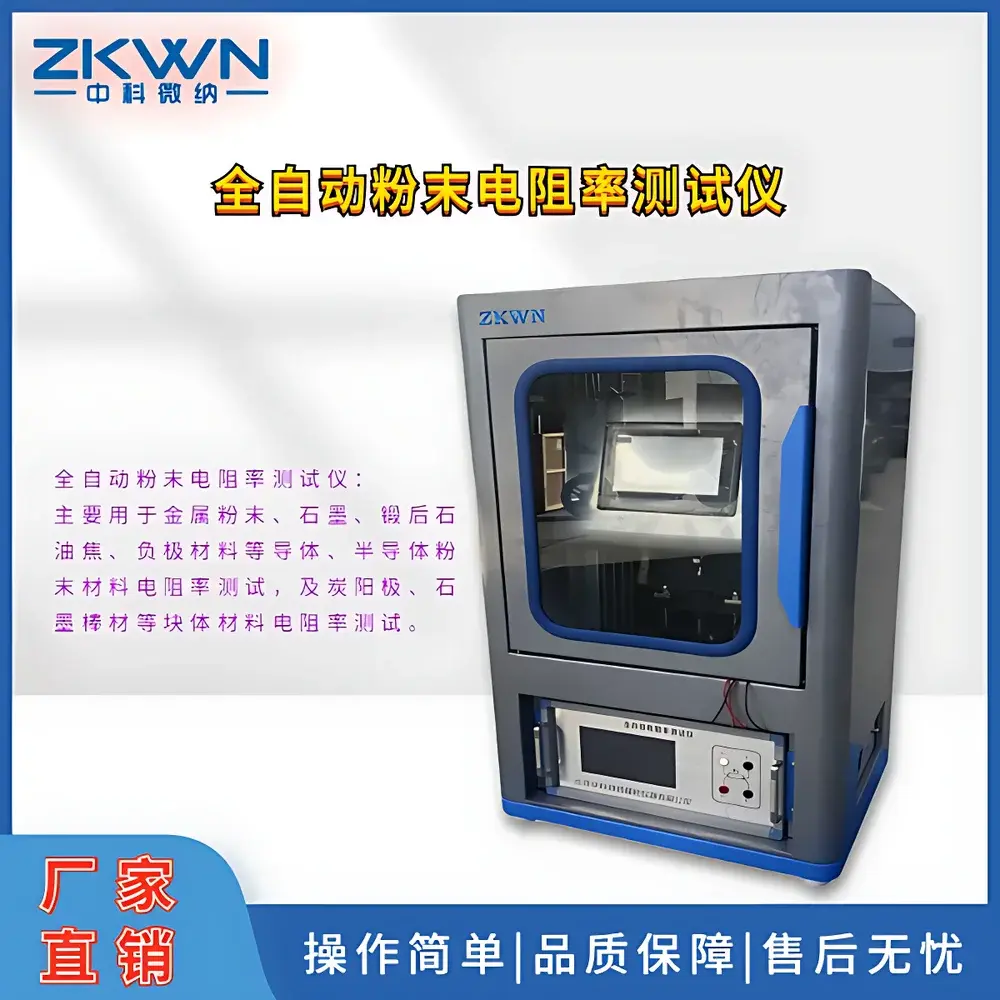
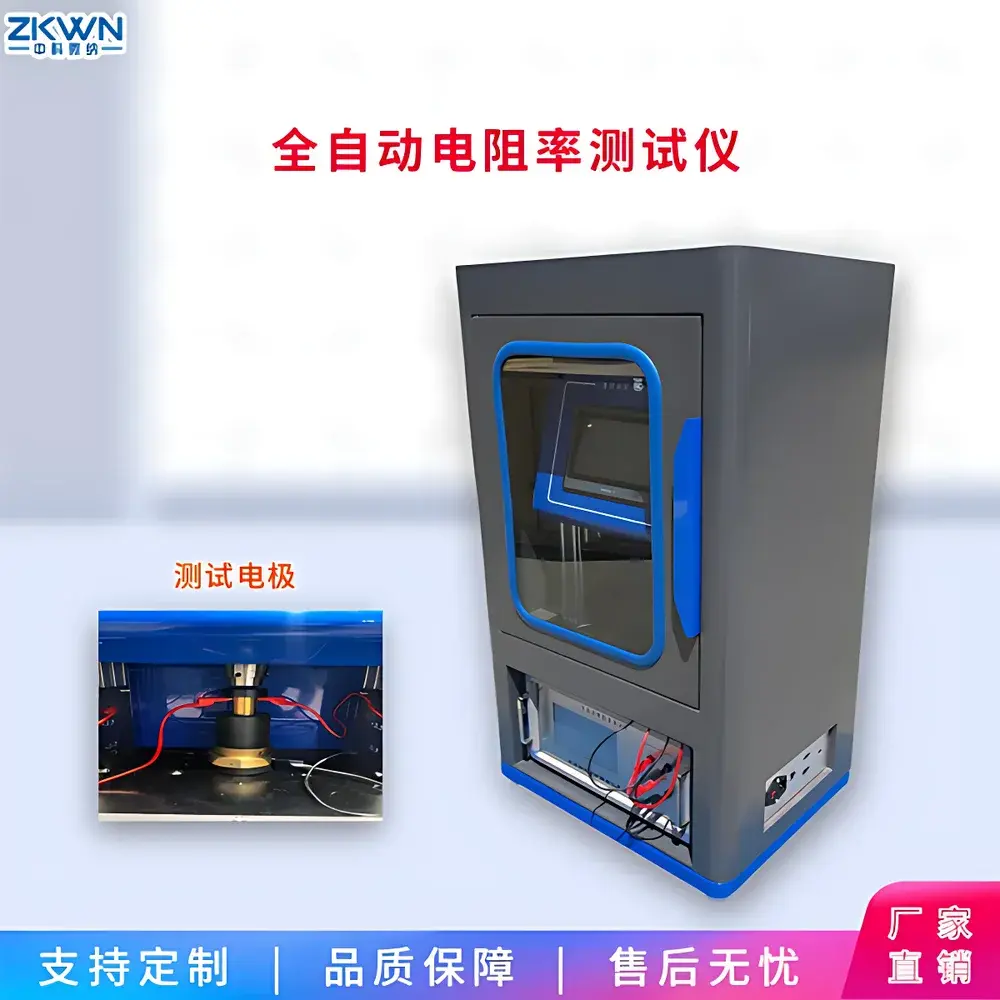
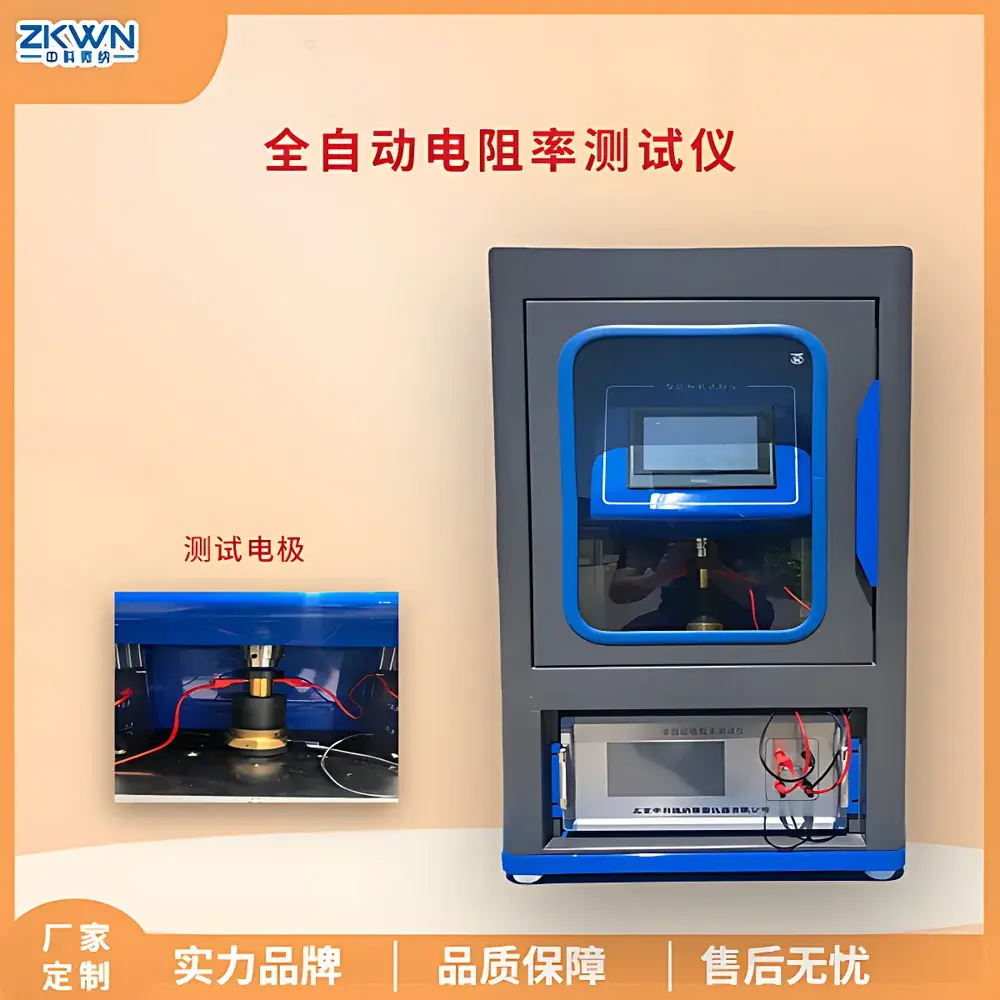
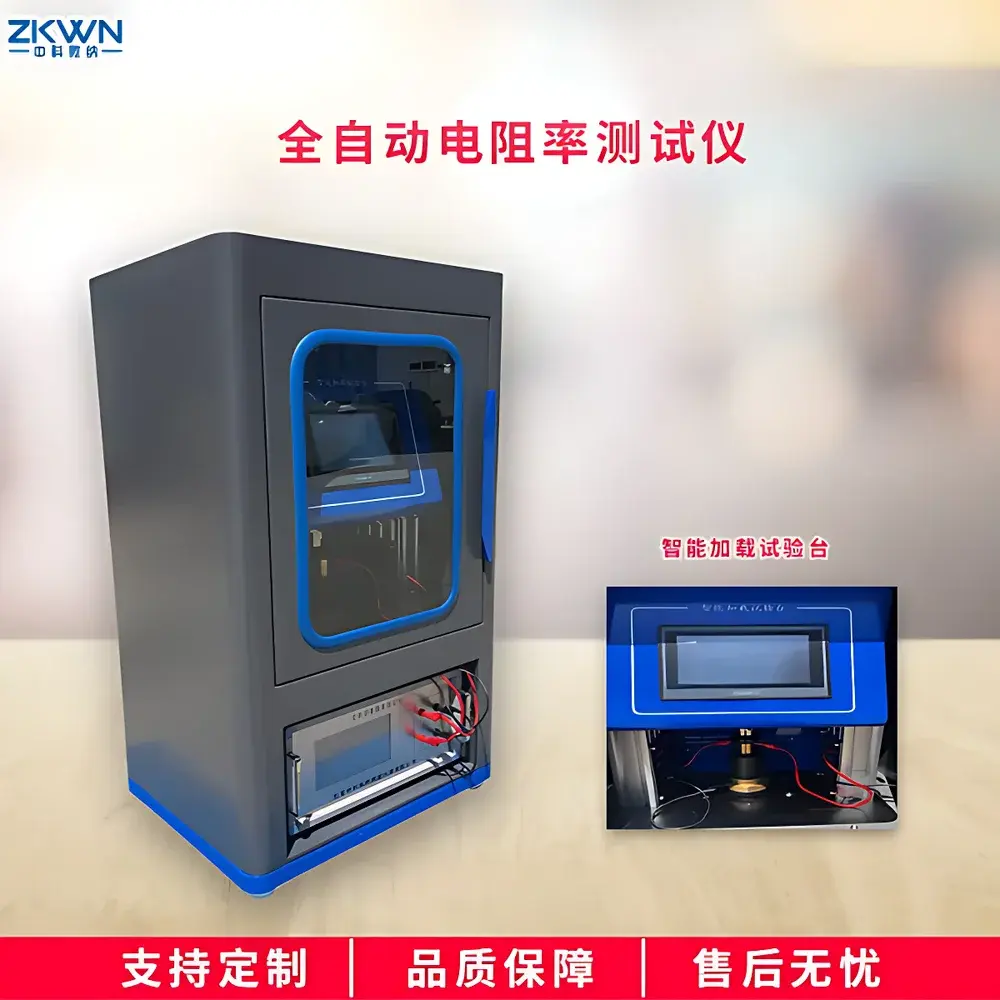
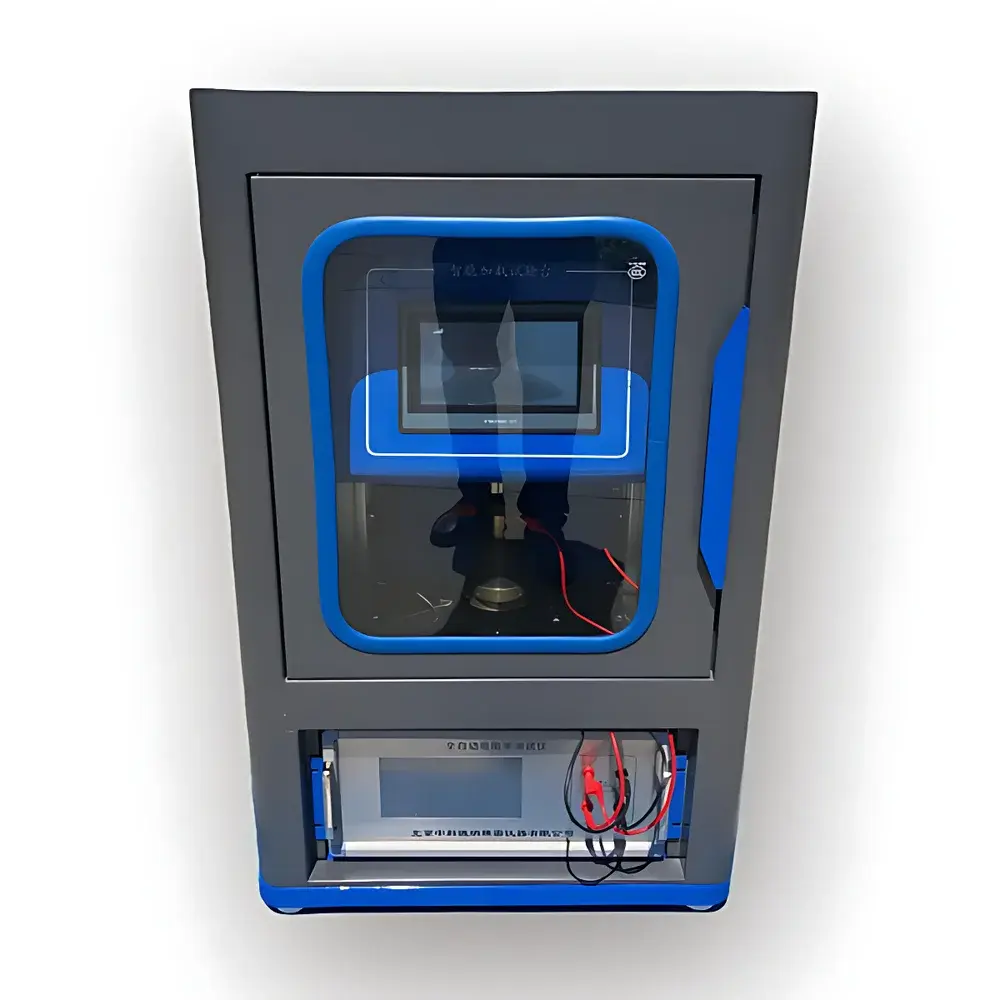
ZKWN GEST-126 Automated Powder Resistivity Tester
| Brand | ZKWN |
|---|---|
| Origin | Beijing, China |
| Manufacturer Type | Authorized Distributor |
| Product Origin | Domestic (China) |
| Model | GEST-126 |
| Measurement Principle | Four-Probe DC Resistivity Method with Controlled Compaction |
| Compliance Standards | YS/T 587.6–2006, GB/T 24525–2009, GB/T 24521–2009, GB/T 3782–2016 |
| Resistivity Range | 10⁻⁶ – 10⁵ Ω·cm |
| Resolution | 10⁻⁸ Ω·cm |
| Voltage Ranges | 2 mV / 20 mV / 200 mV / 2 V |
| Current Output | 10 μA – 10 A (8 ranges) |
| Electrode Material | High-Purity Copper |
| Inter-Electrode Spacing | 10 mm |
| Powder Compaction Cylinder ID | 16 mm (optional 30 mm) |
| Stroke | 50 mm |
| Loading Capacity | 10 kN |
| Loading Control | Stepper-Motor-Driven Automatic Constant-Load Application |
| Force & Pressure Display | Real-Time Digital Readout |
| Sample Height Measurement | Integrated Linear Encoder |
| Data Output | Volume Resistivity (Ω·cm), Resistance (Ω), Applied Pressure (MPa), Compaction Time (s) |
| Interface | 7-inch Capacitive Touchscreen HMI |
| Data Export | USB Storage |
| Thermal Drift Stability | <0.05% per hour |
| Measurement Repeatability | ±0.3% at fixed density and temperature |
Overview
The ZKWN GEST-126 Automated Powder Resistivity Tester is an engineered solution for precise, repeatable volumetric resistivity characterization of conductive and semiconductive powders under controlled compaction conditions. It implements the four-probe direct-current (DC) method—per ASTM D257 and IEC 60093 principles—as adapted for granular media, where interparticle contact resistance, particle morphology, and bulk density critically influence measured resistivity. Unlike conventional two-terminal measurements, the GEST-126 eliminates lead and contact resistance errors by separating current injection and voltage sensing electrodes, ensuring traceable accuracy across six decades of resistivity (10⁻⁶ to 10⁵ Ω·cm). Its integrated electromechanical compaction system applies programmable axial loads (up to 10 kN) to standard cylindrical powder beds (16 mm or 30 mm ID), enabling compliance with industry-specific density protocols defined in YS/T 587.6–2006 (calcined petroleum coke), GB/T 24525–2009 (carbon materials), and GB/T 24521–2009 (coke). The instrument operates within a thermally stabilized environment and delivers high-resolution data (10⁻⁸ Ω·cm) with <0.3% measurement repeatability when density and temperature are held constant.
Key Features
- Four-probe DC resistivity measurement architecture with isolated current source and high-input-impedance voltmeter (4½-digit resolution, auto-ranging)
- Automated, stepper-motor-driven compaction system with real-time force feedback and pressure-controlled hold functionality
- Dual-column vertical electrode assembly ensuring coaxial alignment and uniform stress distribution across the powder bed
- High-stability constant-current source (eight selectable ranges: 10 μA to 10 A) with ±(0.5% rdg + 2 digits) accuracy
- Integrated linear encoder for precise displacement monitoring and sample height calculation during loading/unloading cycles
- 7-inch capacitive touchscreen HMI with intuitive workflow navigation, parameter preset storage, and on-device result review
- USB-based data export supporting CSV format for post-processing in Excel, MATLAB, or LIMS environments
- Copper probe electrodes (99.99% purity) with 10 mm fixed inter-electrode spacing and low-contact-resistance plating
- Thermally compensated analog front-end minimizing drift (<0.05% per hour) during extended measurement sequences
Sample Compatibility & Compliance
The GEST-126 is validated for use with carbonaceous and metallic powders including calcined petroleum coke, graphite powders, acetylene black, lithium iron phosphate (LiFePO₄), silicon carbide, metal alloy powders (e.g., Ni, Cu, Al), and conductive polymer composites. It supports both loose-fill and vibration-compacted density states, with optional custom die sets (16 mm and 30 mm internal diameters) accommodating varying sample mass requirements (typically 1–5 g). All operational parameters—including applied load, dwell time, current range, and voltage range—are fully configurable to meet test method requirements outlined in YS/T 587.6–2006, GB/T 24525–2009, GB/T 24521–2009, and GB/T 3782–2016. While not certified to ISO/IEC 17025, the system’s metrological traceability aligns with GLP-aligned laboratory practices; calibration certificates for voltage, current, and load sensors are available upon request. No hazardous chemicals or vacuum systems are required—operation is ambient-air compatible.
Software & Data Management
The embedded firmware provides full local control without external PC dependency. Test methods can be saved as named profiles—including target load (kN), hold duration (s), current level (A), and auto-zero delay—enabling rapid re-execution of standardized protocols. Each measurement record stores timestamped values for volume resistivity (Ω·cm), electrical resistance (Ω), applied pressure (MPa), compacted height (mm), and elapsed test time. Results are displayed numerically and graphically (resistivity vs. pressure curve overlay). Data export via USB flash drive includes raw and processed values with metadata (operator ID, date/time, profile name, environmental notes). For integration into regulated environments, optional firmware upgrade supports audit-trail logging (user actions, parameter changes, result modifications) compliant with FDA 21 CFR Part 11 Annex 11 principles—though electronic signatures require third-party validation.
Applications
- Quality control of anode-grade calcined coke in aluminum smelting operations
- Batch-to-batch consistency verification of conductive additives (e.g., carbon black, graphene nanoplatelets) in battery electrode slurries
- Development and optimization of cold-compacted metal powder components for additive manufacturing feedstock qualification
- Resistivity-density correlation modeling for predictive sintering behavior in ceramic and metallurgical powders
- R&D screening of doped semiconductor powders (e.g., SnO₂, ZnO) for gas sensor material selection
- Process validation of surface oxidation or coating uniformity on metal powders via resistivity deviation analysis
FAQ
What standards does the GEST-126 directly support?
It is configured and validated for YS/T 587.6–2006, GB/T 24525–2009, GB/T 24521–2009, and GB/T 3782–2016.
Can the instrument measure resistivity at variable densities?
Yes—programmable load control enables discrete or stepped pressure application, generating resistivity vs. density curves.
Is calibration traceable to national standards?
Voltage, current, and load channels are factory-calibrated using NIST-traceable references; full calibration reports are available as an add-on service.
What is the minimum sample mass required for reliable measurement?
With the 16 mm cylinder, typical mass is 1.5–2.5 g; for lower-density powders, 30 mm tooling allows ≥4 g to ensure stable electrode contact.
Does the system support automated reporting for ISO/IEC 17025 labs?
Basic reporting is built-in; for accredited lab workflows, CSV export integrates with LIMS or custom report generators—full 17025 compliance requires lab-specific procedural documentation.
Related Products



