
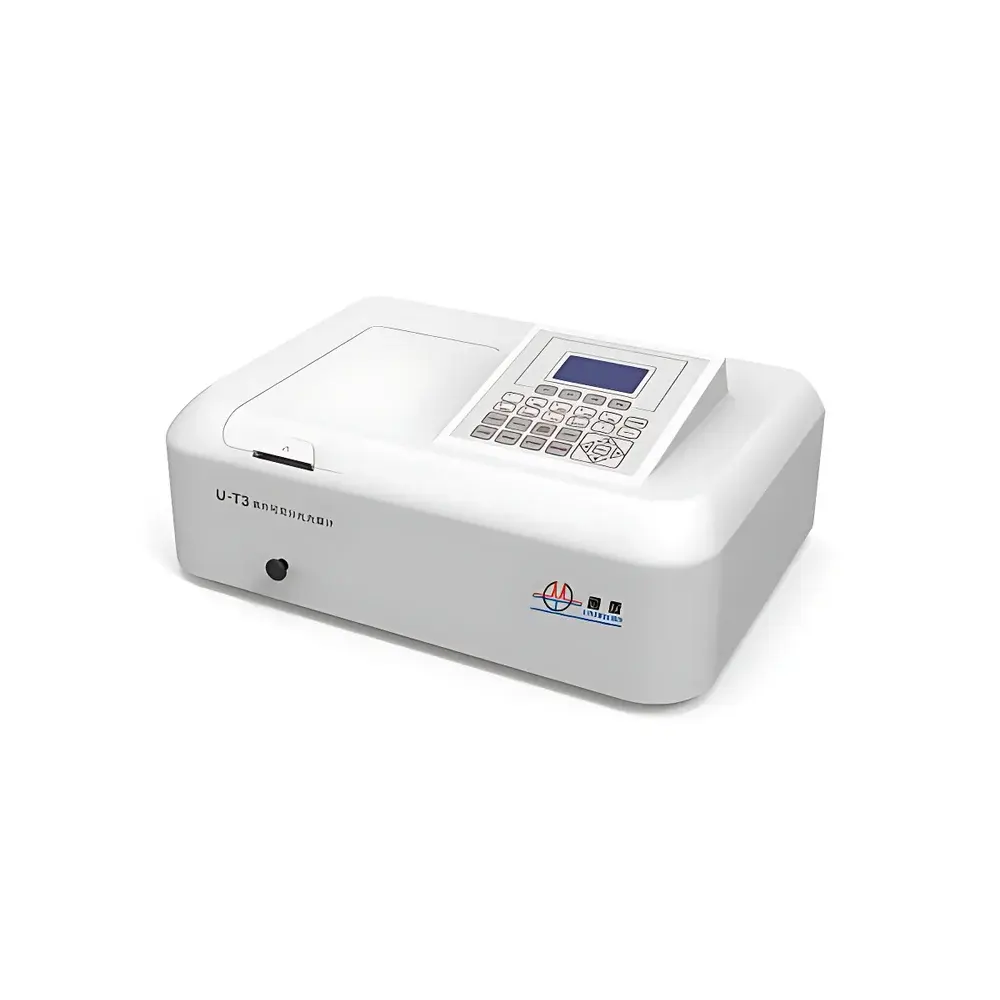
Unimicro Technologies V-3000/UV-3000 Ultraviolet-Visible Spectrophotometer
| Brand | Unimicro Technologies |
|---|---|
| Origin | Shanghai, China |
| Manufacturer Type | Original Equipment Manufacturer (OEM) |
| Instrument Architecture | Single-beam |
| Detector Type | CCD Array Detector |
| Wavelength Range | 190–1100 nm |
| Wavelength Accuracy | ±1 nm |
| Wavelength Repeatability | ±0.5 nm |
| Spectral Bandwidth | 2 nm |
| Stray Light | ≤0.1% T at 220 nm and 360 nm |
| Wavelength Scanning Mode | Motorized Auto-Scanning |
| Data Storage Capacity | 1000 measurement sets |
| Interface | USB port for U-disk data export |
| Language Support | Switchable English/Chinese UI |
| Software Option | PC-based remote control and advanced data analysis software (optional) |
Overview
The Unimicro Technologies V-3000/UV-3000 is a precision single-beam ultraviolet-visible (UV-Vis) spectrophotometer engineered for routine quantitative and qualitative analysis in academic laboratories, quality control environments, and industrial R&D settings. Based on the principle of Beer-Lambert absorption spectroscopy, it measures sample absorbance across a broad spectral range (190–1100 nm), enabling reliable characterization of organic compounds, transition metal complexes, nucleic acids, proteins, and aqueous pollutants. Its optical architecture integrates a high-stability tungsten-halogen lamp (for visible/NIR) and a deuterium lamp (for UV), coupled with a fixed-grating monochromator and a linear CCD array detector — eliminating mechanical slit adjustments and ensuring consistent spectral resolution and photometric linearity over time. The instrument’s rigid, thermally stable optical bench and minimized optical path length contribute to long-term baseline stability and low drift (<0.001 A/h at 500 nm), meeting essential performance criteria for GLP-compliant workflows.
Key Features
- Single-beam optical design with dual-lamp source (deuterium + tungsten-halogen), automatically selected based on wavelength region
- CCD-based detection system providing simultaneous multi-wavelength acquisition capability and enhanced signal-to-noise ratio
- Precise motorized wavelength drive with ±1 nm accuracy and ±0.5 nm repeatability, certified per ISO 9001 manufacturing protocols
- Narrow 2 nm spectral bandwidth optimized for resolving adjacent absorption peaks in complex mixtures
- Stray light performance ≤0.1% T at critical validation wavelengths (220 nm and 360 nm), supporting compliance with USP and ASTM E275
- Onboard data management: internal storage for up to 1000 spectra or quantitative results; direct export via USB flash drive without external PC
- Intuitive touchscreen interface with dual-language support (English/Chinese) and context-sensitive help menus
- Embedded calibration routines including auto-zero, auto-blank, lamp energy check, and wavelength verification using holmium oxide or didymium filters
Sample Compatibility & Compliance
The V-3000/UV-3000 accommodates standard 10 mm pathlength cuvettes as well as specialized accessories to broaden analytical flexibility: an 8-position automated sample changer for high-throughput screening; a micro-volume adapter supporting down to 50 µL sample volume; extended-pathlength cells (50 mm and 100 mm) for low-absorbance water quality testing (e.g., COD, nitrate, phosphate); and thermostatted cuvette holders (single- or triple-position) compatible with external recirculating chillers for temperature-controlled kinetics studies. All hardware configurations maintain optical alignment integrity and comply with ISO/IEC 17025 traceability requirements when used with NIST-traceable reference standards. The instrument supports audit trail generation when paired with optional PC software compliant with FDA 21 CFR Part 11 for electronic records and signatures.
Software & Data Management
Optional PC-based control software enables full remote operation, method development, spectral subtraction, derivative spectroscopy, and kinetic time-scan analysis. It provides customizable report templates aligned with ISO 17025 documentation standards, including operator ID, timestamp, instrument serial number, calibration history, and raw spectral metadata. Data files are saved in ASCII-compatible .csv and vendor-neutral .jdx formats for interoperability with third-party chemometrics platforms (e.g., MATLAB, OriginLab, Unscrambler). The software includes built-in validation tools for linearity assessment (per ICH Q2(R2)), limit of detection (LOD) calculation, and robustness testing under variable slit width or integration time.
Applications
This spectrophotometer is routinely deployed in pharmaceutical QC labs for assay validation and dissolution testing; in environmental monitoring for quantification of heavy metals (via colorimetric chelation), nutrients, and disinfection byproducts; in food safety for pigment analysis (e.g., anthocyanins, carotenoids) and preservative concentration; and in academic teaching labs for fundamental spectroscopy experiments including molar absorptivity determination, equilibrium constant estimation, and enzyme kinetics (e.g., NADH oxidation at 340 nm). Its reliability in low-concentration UV measurements makes it suitable for oligonucleotide purity assessment (A260/A280 ratios) and protein quantification via Bradford or BCA assays.
FAQ
What wavelength calibration standards are recommended for routine verification?
Holmium oxide solution (NIST SRM 2034) is recommended for wavelength accuracy verification at 241.1, 279.4, 287.5, 333.7, 360.9, 418.5, 460.0, 485.8, 536.2, and 637.5 nm.
Is the instrument compliant with pharmacopeial methods such as USP <857>?
Yes — when operated within specified environmental conditions (20–25°C, <60% RH) and validated using documented procedures, its stray light, photometric accuracy, and wavelength accuracy meet USP requirements for UV-Vis spectrophotometers.
Can the V-3000/UV-3000 be integrated into a LIMS environment?
Yes — the optional PC software supports ODBC-compliant database connectivity and HL7 message formatting for seamless integration with laboratory information management systems.
What maintenance is required to sustain optimal performance?
Biannual cleaning of optical windows and lamp housings; annual lamp replacement (deuterium lamp life ≈ 1000 h, tungsten-halogen ≈ 2000 h); quarterly verification of wavelength and photometric accuracy using certified reference materials.
Does the instrument support kinetic measurements?
Yes — both onboard and PC software support time-scan mode with user-defined interval (0.1–60 s), duration, and trigger options (manual, external TTL, or auto-start post-blank).
Related Products




