
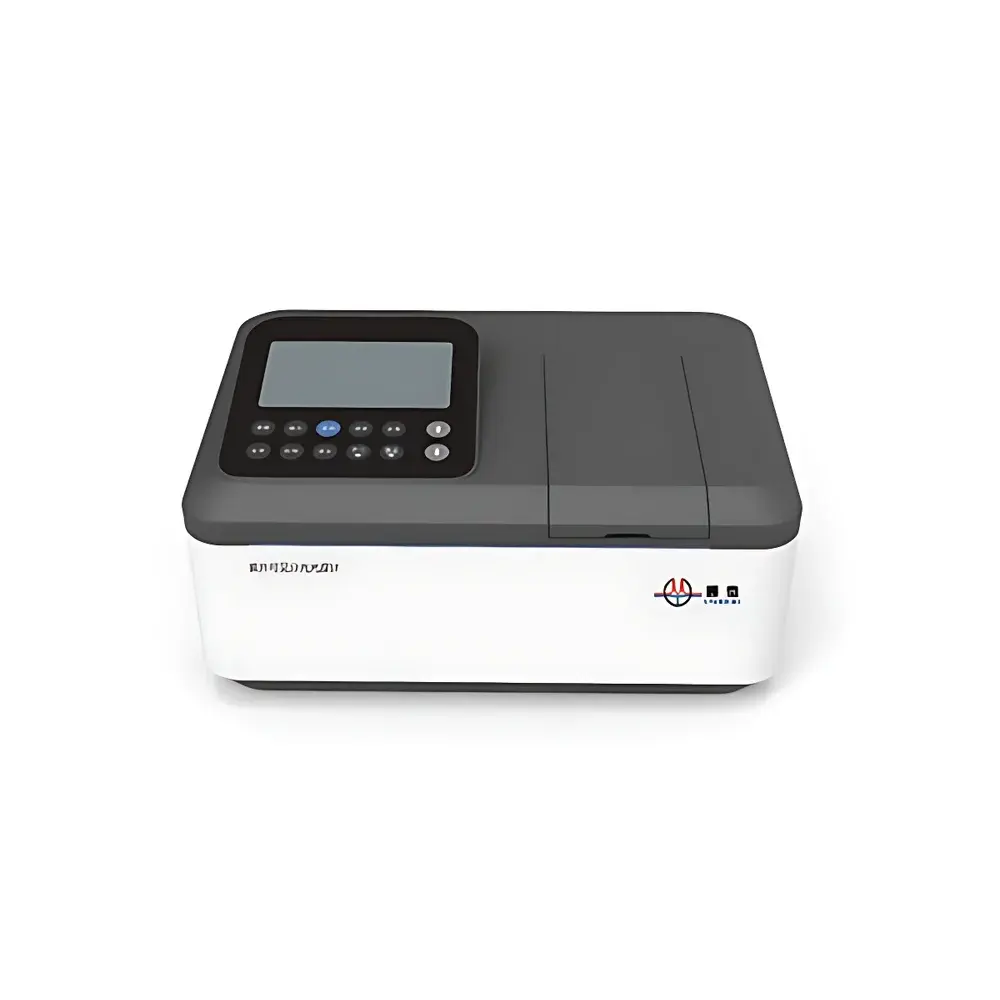
UV-6000/8000/9000 Series UV-Vis Spectrophotometer by Unimicro Technologies
| Brand | Unimicro Technologies |
|---|---|
| Origin | Shanghai, China |
| Manufacturer Type | Original Equipment Manufacturer (OEM) |
| Model | UV-6000 / UV-8000 / UV-9000 |
| Optical Design | Czerny-Turner monochromator with high-resolution grating |
| Wavelength Range | 190–1100 nm |
| Photometric Range | –4.0 to 4.0 A |
| Display | 7-inch color TFT touchscreen |
| Sample Handling | 4-position manual cuvette holder (10–50 mm pathlength compatible) |
| Data Storage | Internal memory + USB flash drive export |
| Connectivity | Bluetooth 4.2 (printer support), USB host/device, RS-232 optional |
| Control Interface | Touchscreen + physical keypad dual-mode operation |
| Lamp System | Replaceable D₂ and W lamp modules with front-access flange-mount design |
| Software | PC-based remote control suite with GLP-compliant audit trail, method storage, and report generation |
Overview
The UV-6000/8000/9000 Series UV-Vis Spectrophotometers are benchtop double-beam (UV-8000/9000) or single-beam (UV-6000) instruments engineered for routine and research-grade absorbance, transmittance, and reflectance measurements across the ultraviolet, visible, and near-infrared spectral range (190–1100 nm). Based on a high-fidelity Czerny-Turner optical architecture with precision blazed gratings and thermally stabilized optics, these spectrophotometers deliver consistent photometric accuracy and long-term baseline stability—critical for QC laboratories performing pharmaceutical assay validation, environmental water analysis, biochemical quantification, and materials characterization. The modular lamp system—featuring independently serviceable deuterium and tungsten-halogen sources—ensures minimal downtime during routine maintenance, while the optomechanical design minimizes stray light (<0.05% at 220 nm) and supports high signal-to-noise ratio across the full wavelength span.
Key Features
- High-resolution Czerny-Turner monochromator with automated wavelength calibration and real-time slit width optimization for improved spectral fidelity.
- Dual operational interface: responsive 7-inch capacitive touchscreen paired with tactile membrane keys—enabling glove-compatible use in controlled environments and reducing misoperation risk via context-sensitive menu navigation.
- Robust mechanical construction using aerospace-grade aluminum alloy chassis and vibration-damped optical bench, ensuring thermal and mechanical stability over extended measurement cycles (±0.002 A/h drift at 500 nm).
- Front-access lamp module design with flanged alignment fixtures—allowing rapid, tool-free replacement of D₂ and W lamps without optical realignment or recalibration.
- Four-position manual cuvette holder accommodating standard 10 mm, semi-micro (5 mm), macro (20–50 mm), and custom pathlength cells—compatible with quartz, fused silica, and high-transmission glass cuvettes.
- Integrated ARM-based microcontroller with 256 MB RAM and 2 GB flash storage—supporting >10,000 spectra per session, automatic timestamping, and user-defined metadata tagging.
Sample Compatibility & Compliance
The series accommodates liquid, suspension, and thin-film samples via standardized cuvettes (10–50 mm pathlength), flow cells (optional), and solid-sample reflectance accessories. All models comply with ISO 9001 manufacturing protocols and meet key performance criteria outlined in ASTM E275 (Standard Practices for Description of Ultraviolet, Visible, and Near-Infrared Spectrophotometers) and ISO/IEC 17025 requirements for testing laboratories. The PC control software includes full 21 CFR Part 11 compliance features—including electronic signatures, role-based access control, immutable audit trails, and secure method locking—making it suitable for regulated environments under GMP/GLP frameworks. Instrument calibration is traceable to NIST-certified reference standards (e.g., SRM 930e for photometric accuracy, SRM 2034 for wavelength verification).
Software & Data Management
The bundled Unimicro UV-Spec Suite provides comprehensive instrument control, spectral acquisition, kinetic monitoring, multi-wavelength analysis, and quantitative modeling (including single/multi-point calibration, Beer-Lambert fitting, and DNA/protein concentration algorithms per Edelhoch and Bradford methods). Data export supports CSV, TXT, XML, and JCAMP-DX formats; reports are generated in PDF with embedded instrument metadata, operator ID, and calibration status. USB mass storage mode enables direct transfer of spectral datasets and method files to external drives. Firmware updates are performed via one-click OTA (over-the-air) download through the embedded web server interface or local USB installation—eliminating dependency on third-party drivers.
Applications
- Pharmaceutical QC: Dissolution testing, excipient compatibility screening, and active pharmaceutical ingredient (API) assay per USP and EP 2.2.25.
- Biochemistry labs: Quantitative analysis of nucleic acids (A260/A280 ratios), proteins (BCA/Lowry assays), and enzyme kinetics (NADH/NADPH monitoring at 340 nm).
- Environmental testing: Nitrate/nitrite detection in wastewater (EPA Method 353.2), COD analysis, and heavy metal complexation studies.
- Materials science: Thin-film thickness estimation via interference fringe analysis, bandgap determination of semiconductors, and pigment dispersion characterization.
- Academic teaching: Spectral library development, Beer’s law validation experiments, and comparative analysis of chromophore behavior across solvent systems.
FAQ
What is the wavelength accuracy specification for the UV-6000/8000/9000 series?
Wavelength accuracy is ±0.5 nm (typical) across 190–1100 nm, verified using holmium oxide and didymium glass reference filters per ISO 6326-1.
Can the instrument perform kinetic measurements with time-resolved data logging?
Yes—time-scan mode supports user-defined interval acquisition from 0.1 s to 9999 s per point, with up to 10,000 data points per run and automatic CSV export.
Is the PC software validated for use in FDA-regulated laboratories?
The UV-Spec Suite includes configurable 21 CFR Part 11 compliance modules (audit trail, e-signature, electronic records retention) and is deployable in validated environments when installed on IQ/OQ-qualified workstations.
How often does the deuterium lamp require replacement under normal usage?
Typical D₂ lamp lifetime is 1,000–1,500 hours; the instrument monitors cumulative lamp-on time and triggers a service alert at 90% end-of-life threshold.
Are there options for automated sample handling or integration with LIMS?
While the base configuration uses manual cuvette positioning, optional 8-position autosamplers and RS-232/Modbus TCP interfaces enable integration with laboratory automation systems and LIMS via ASCII command protocol.



