
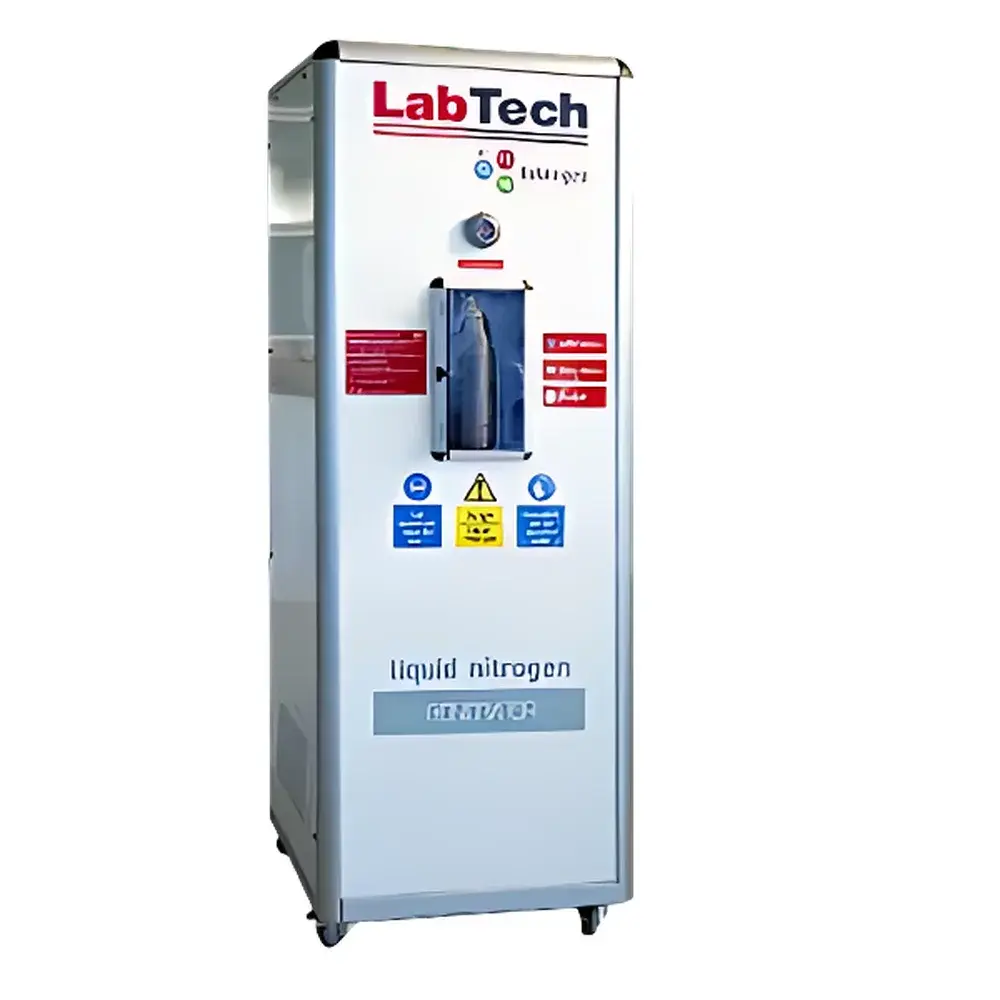
LNG Series Small-Scale Liquid Nitrogen Generator by LabTech
| Brand | LabTech |
|---|---|
| Model | LNG |
| Origin | Beijing, China |
| Manufacturer | LabTech (OEM/ODM Producer) |
| Type | Domestic Benchtop Cryogenic Generator |
| Cooling Options | Air-Cooled or Water-Cooled (45°C Ambient Tolerance) |
| Output Capacity | 10–80 L/day Liquid Nitrogen |
| Purity | ≥99.5% N₂ (v/v) |
| Storage Vessel | Stainless Steel Dewar (20–210 L Options) |
| Core Technology | Integrated PSA Nitrogen Generation + Closed-Cycle Helium Refrigeration |
| Control Interface | Color Touchscreen HMI |
| Filtration | Sterile Membrane Filter on Nitrogen Supply Line |
| Cold Head Integration | Direct-Mounted to Dewar for Minimized Thermal Loss |
| Footprint | Compact Benchtop Design |
| Acoustic Emission | <65 dB(A) at 1 m |
Overview
The LabTech LNG Series Small-Scale Liquid Nitrogen Generator is an engineered cryogenic system designed for on-site, continuous production of high-purity liquid nitrogen from ambient air. Unlike traditional bulk delivery logistics, the LNG system employs a fully integrated process combining pressure swing adsorption (PSA) for high-efficiency nitrogen separation, followed by a closed-cycle helium refrigeration loop with an integrated cold head directly mounted to the stainless steel Dewar vessel. This architecture eliminates intermediate transfer lines and thermal bridging, maximizing liquefaction efficiency and minimizing boil-off. The system operates autonomously after initial setup—requiring only standard electrical supply (220–240 V AC, 50/60 Hz) and, for water-cooled variants, chilled water at ≤30°C inlet temperature. It is certified for continuous unattended operation in laboratory, QC, and pilot-scale bioprocessing environments where stable, traceable, and contamination-controlled cryogen supply is critical.
Key Features
- Integrated PSA nitrogen generation module with carbon molecular sieve beds, delivering >99.5% nitrogen purity prior to liquefaction
- Closed-cycle helium refrigeration system with oil-free helium compressor and high-efficiency cold head thermally coupled to the Dewar neck
- Direct-mounted cold head design reduces conductive and convective heat ingress, achieving typical daily net yield retention >92% of theoretical output
- Industrial-grade stainless steel Dewar vessels (ASME BPVC Section VIII compliant), available in 20 L, 50 L, 100 L, and 210 L configurations with vacuum-jacketed insulation and integrated level monitoring
- Full-color touchscreen HMI with real-time visualization of nitrogen flow rate, Dewar fill level, compressor discharge temperature, PSA cycle timing, and system fault logs
- Sterile-grade 0.2 µm hydrophobic membrane filter installed inline on the gaseous nitrogen feed line upstream of the liquefier—validated per ISO 13408-1 for aseptic processing applications
- Low-noise engineering: acoustic emission maintained below 65 dB(A) at 1 meter distance under full-load operation
- Flexible cooling architecture: air-cooled configuration for ambient temperatures ≤35°C; water-cooled variant rated for sustained operation at up to 45°C ambient with chiller water supply ≤30°C
Sample Compatibility & Compliance
The LNG generator produces liquid nitrogen suitable for direct use in cryopreservation of biological samples (e.g., cell lines, primary tissues, semen, embryos), superconducting magnet cooling, cryo-SEM specimen preparation, and low-temperature reaction quenching. All wetted components contacting nitrogen gas or liquid—including PSA beds, heat exchangers, cold head surfaces, and Dewar interiors—are electropolished 316L stainless steel, passivated per ASTM A967, and certified free of leachable heavy metals. The system complies with IEC 61000-6-2 (immunity) and IEC 61000-6-4 (emissions), carries CE marking under the Machinery Directive 2006/42/EC and Low Voltage Directive 2014/35/EU, and meets essential requirements of ISO 8573-1:2010 Class 2 for compressed air quality feeding the PSA unit. Optional IQ/OQ documentation packages support GLP and GMP validation per FDA 21 CFR Part 11 and EU Annex 11.
Software & Data Management
The embedded control firmware supports local data logging of all operational parameters at user-configurable intervals (1 s to 10 min resolution), with storage capacity for ≥30 days of continuous timestamped records. Data export is available via USB flash drive in CSV format. Remote monitoring and alarm notification are enabled through optional Ethernet or RS-485 Modbus TCP interface, compatible with LabVantage, Thermo Fisher SampleManager, and Siemens Desigo CCMS platforms. Audit trail functionality records all operator actions—including mode changes, setpoint adjustments, and manual purge initiations—with user ID, timestamp, and reason code. Electronic signatures and role-based access control (admin/operator/observer) are configurable to meet ALCOA+ data integrity principles.
Applications
- Cryopreservation of mammalian cell cultures, stem cells, and clinical biobank specimens requiring consistent LN₂ availability and documented purity
- In-process cooling in pharmaceutical lyophilization cycles where dew point stability and nitrogen sterility impact product residual moisture and reconstitution profile
- Continuous feed for cryo-milling of temperature-sensitive APIs and excipients in R&D and formulation development labs
- On-demand liquid nitrogen supply for FTIR, Raman, and XRD instrumentation requiring stable cryostat temperatures below −196°C
- Support of ISO/IEC 17025-accredited testing laboratories needing auditable, metrologically traceable cryogen sourcing without third-party delivery dependencies
FAQ
What is the minimum ambient temperature required for stable operation of the air-cooled LNG model?
The air-cooled variant requires ambient temperatures between 15°C and 35°C, with relative humidity ≤70% non-condensing.
Can the LNG system be validated for GMP manufacturing environments?
Yes—LabTech provides optional qualification protocols (DQ/IQ/OQ) aligned with ISPE Baseline Guide Vol. 5 and ASTM E2500-13, including calibration certificates for all embedded sensors traceable to NIST standards.
Is helium consumption required during normal operation?
No—the system uses a sealed, recirculating helium loop; no periodic helium top-up is needed under normal maintenance schedules.
How frequently must the PSA carbon molecular sieve beds be replaced?
Under typical lab usage (12 h/day, 5 days/week), bed replacement is recommended every 24–36 months, with performance monitored via real-time oxygen analyzer output integrated into the HMI.
Does the system support integration with building management systems (BMS)?
Yes—via Modbus TCP or optional BACnet/IP gateway, enabling status reporting, alarm forwarding, and remote start/stop commands within enterprise-wide infrastructure networks.



