
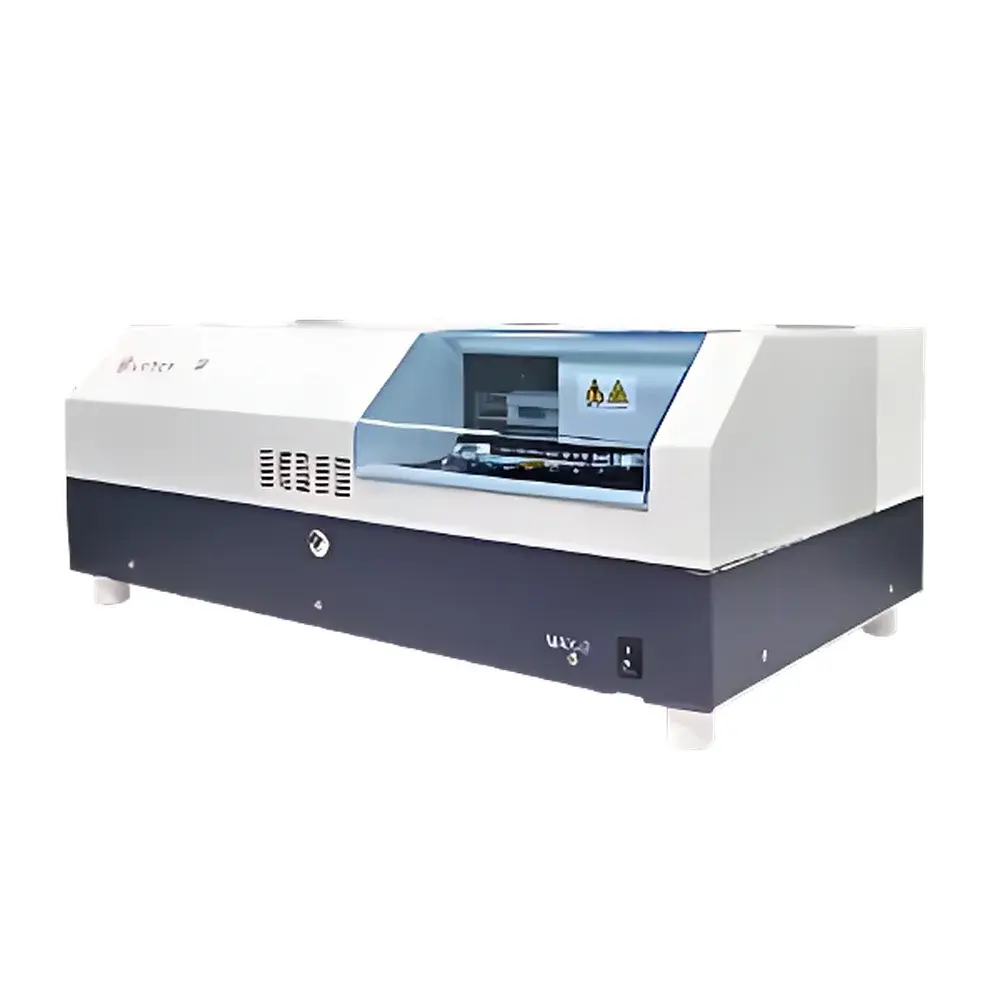
MAX-S Direct Mercury Analyzer by LabTech
| Brand | LabTech |
|---|---|
| Model | MAX-S |
| Principle | Catalytic Thermal Decomposition–Gold Amalgamation–Cold Vapor Atomic Absorption Spectrometry (CV-AAS) |
| Detection Limit | 0.0005 ng Hg |
| Linear Range | 0–30,000 ng Hg (7 orders of magnitude) |
| Analysis Time | 2–5 min per sample |
| Sample Forms | Solid, liquid, and gas matrices without pretreatment |
| Repeatability | RSD < 3% (n = 10 at 10 ng level) |
| Calibration Stability | 3–6 months between standard curve verification |
| Compliance | Designed for GLP/GMP environments |
Overview
The MAX-S Direct Mercury Analyzer by LabTech is a fully automated, benchtop mercury quantification system engineered for precision, speed, and operational simplicity in regulated laboratory environments. It employs the well-established analytical sequence of catalytic thermal decomposition followed by gold amalgamation and cold vapor atomic absorption spectrometry (CV-AAS). This integrated physical–optical methodology enables direct, reagent-free quantification of total elemental mercury (Hg⁰) across heterogeneous sample matrices—including solids (e.g., soils, sediments, tissues, coal), liquids (e.g., water, biological fluids, extracts), and gases (e.g., ambient air, stack emissions)—without acid digestion, distillation, or chemical oxidation. By eliminating wet-chemistry sample preparation, the MAX-S mitigates two primary sources of error in mercury analysis: volatilization loss during digestion and memory effects caused by mercury adsorption on glassware or tubing surfaces. Its design conforms to the fundamental metrological requirements of trace mercury measurement as defined in ASTM D6722, ISO 17892-10, and EPA Method 7473—making it suitable for environmental monitoring, clinical toxicology, food safety, and industrial hygiene applications.
Key Features
- True direct analysis: No sample digestion, no oxidants, no reducing agents—only physical thermal release and selective capture.
- Integrated catalytic quartz tube furnace operating up to 950 °C, enabling complete mercury liberation from refractory matrices including sulfides and organomercurials.
- High-efficiency gold-coated quartz trap with real-time thermal desorption, minimizing carryover and ensuring <0.1% residual memory effect between samples.
- Dual-beam UV absorption cell (253.7 nm) with stabilized low-pressure mercury lamp and photomultiplier detection, delivering high signal-to-noise ratio and long-term photometric stability.
- Automated calibration verification using internal Hg⁰ vapor standard generator; optional external permeation tube integration for continuous drift monitoring.
- Modular gas handling system with mass flow controllers, particulate filters, and moisture traps—fully configurable for solid, liquid, or gas introduction protocols.
Sample Compatibility & Compliance
The MAX-S accepts samples ranging from 0.01 g to 1.0 g (solids), 0.1–2.0 mL (liquids), or 0.1–5.0 L (gaseous streams), all introduced via standardized autosampler trays or direct gas-line coupling. Its hardware architecture and firmware support full audit trail generation, electronic signature capability, and user-access-level permissions—meeting core data integrity expectations under FDA 21 CFR Part 11, EU Annex 11, and ISO/IEC 17025:2017. Instrument qualification documentation (IQ/OQ/PQ templates) and method validation packages are provided to facilitate GxP-compliant implementation in pharmaceutical, clinical, and environmental testing laboratories.
Software & Data Management
Controlled via LabTech MercurySuite™ v4.x, the MAX-S software provides intuitive workflow-driven operation—from method setup and calibration to report generation and raw-data archiving. All measurements are timestamped, user-logged, and stored in an encrypted SQLite database with automatic backup and export to CSV, PDF, or LIMS-compatible XML formats. The software includes built-in compliance tools: electronic signatures with dual authentication, change history tracking, and forced revalidation prompts upon parameter modification. Raw absorbance spectra, peak integration logs, and trap desorption profiles are retained for forensic review during regulatory audits.
Applications
- Environmental: Total mercury in soils, sediments, fly ash, wastewater, and ambient air particulates (PM₂.₅/PM₁₀).
- Clinical & Forensic: Quantification of mercury in hair, blood, urine, and autopsy tissues per CLIA and CAP guidelines.
- Food & Feed: Screening of fish, rice, infant formula, and animal feed per FDA Action Levels and EU Commission Regulation (EU) No 1881/2006.
- Industrial: Monitoring mercury in natural gas streams, catalysts, fluorescent lamps, and chlor-alkali process brines.
- Research: Speciation support via coupling with pyrolysis interfaces or pre-separation modules (e.g., HPLC-CV-AFS).
FAQ
Does the MAX-S require carrier gas or consumable reagents?
No—only ultra-high-purity argon or nitrogen is required as purge gas. No acids, oxidants, stannous chloride, or sodium borohydride are used at any stage.
Can the instrument be validated for ISO/IEC 17025 accreditation?
Yes—LabTech provides comprehensive validation documentation, including uncertainty budgets calculated per EURACHEM/CITAC Guide, and supports third-party IQ/OQ/PQ execution.
How is carryover managed between high- and low-concentration samples?
The gold trap undergoes programmable thermal desorption after each analysis, and system blank checks are automatically inserted every 10th sample or upon user-defined triggers.
Is remote monitoring or LIMS integration supported?
Yes—the MercurySuite software includes OPC UA server functionality and RESTful API endpoints for bidirectional LIMS communication and centralized fleet management.
What maintenance intervals are recommended?
Quartz furnace tubes and gold traps are rated for ≥5,000 analyses; optical alignment verification is recommended annually; full performance verification every 6 months or per internal SOP.




