
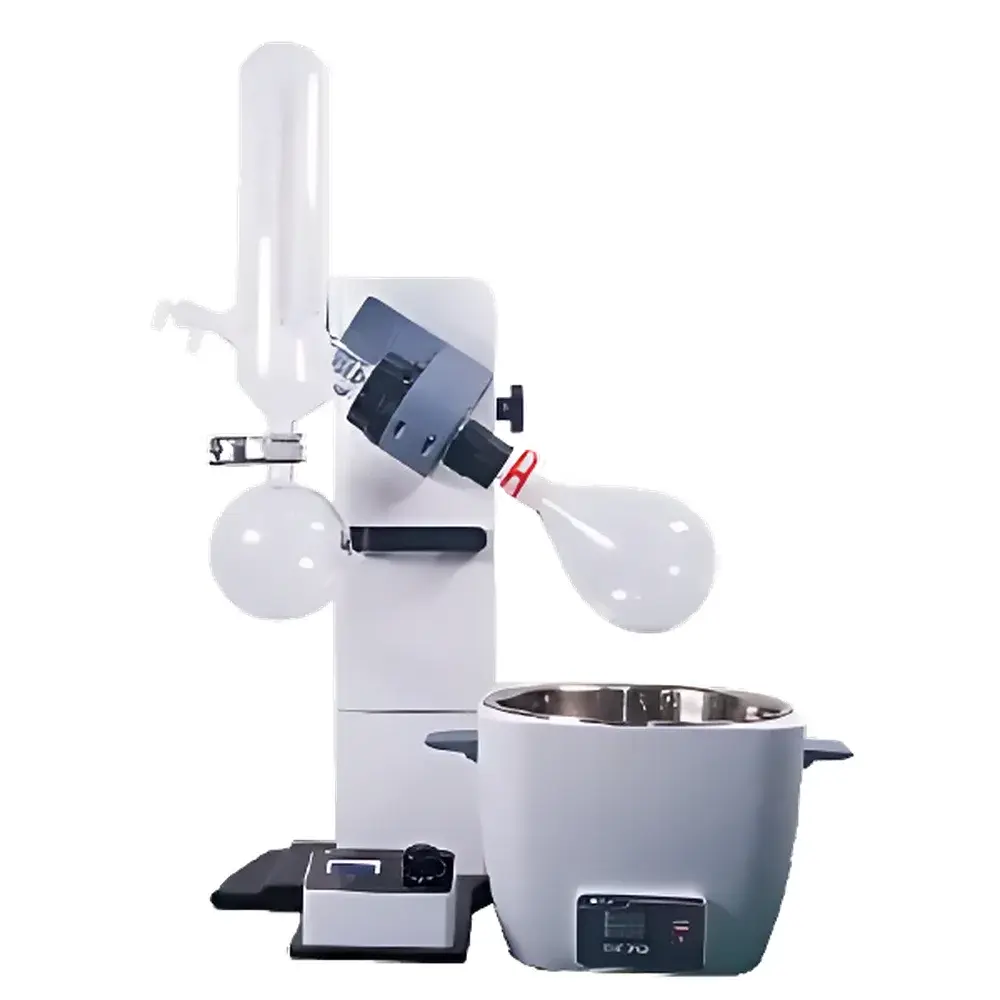
LabTech EV400H Rotary Evaporator
| Brand | LabTech |
|---|---|
| Origin | Beijing, China |
| Manufacturer Type | Original Equipment Manufacturer (OEM) |
| Country of Origin | China |
| Model | EV400H |
| Pricing | Available Upon Request |
| Heating Bath Mode | Water or Oil Bath |
| Temperature Display | LCD Digital |
| Safety Features | Dry-run Auto-Off, Overtemperature Audible Alarm |
| Condenser Design | Dual-stage Vertical Condenser |
| Sealing Material | Modified PTFE + FKM Elastomer |
| Lift Mechanism | Manual with Micro-switch Lock/Release |
| Rotation Control | Single-knob Flywheel with LCD RPM Display |
| Optional Accessory | VC1000 Digital Vacuum Controller |
Overview
The LabTech EV400H Rotary Evaporator is an engineered solution for controlled solvent removal and sample concentration in research, quality control, and synthetic chemistry laboratories. Based on the fundamental principle of reduced-pressure distillation—where lowering the system pressure decreases the boiling point of solvents—the EV400H enables gentle, efficient evaporation of heat-sensitive compounds without thermal degradation. Its robust mechanical architecture integrates precision rotational dynamics, thermally stable bath heating, and chemically inert sealing to support reproducible batch processing under GLP-compliant workflows. Designed for daily high-throughput operation, the system meets essential functional requirements for ISO/IEC 17025-accredited labs and aligns with common operational expectations outlined in ASTM E2655 (Standard Guide for Laboratory Evaporation Procedures) and USP (Analytical Method Validation).
Key Features
- Manual Lift with Positive-Action Micro-Switch Locking: A simplified, maintenance-free elevation mechanism allows precise vertical positioning of the evaporation flask. The tactile micro-switch interface provides unambiguous mechanical engagement—no pneumatic or motorized components to calibrate or service.
- Dual-Mode Heating Bath: Compatible with both water and oil media, the bath delivers uniform thermal distribution across temperature ranges from ambient to 180 °C (oil) or 99 °C (water), with digital LCD readout and programmable timer function for process repeatability.
- Dry-Run and Overtemperature Protection: Integrated thermal cutoff prevents heater activation when the bath is empty; a dedicated high-temperature alarm triggers audible notification if setpoint exceeds user-defined safety threshold—reducing risk of sample charring or glassware failure.
- Chemically Resilient Sealing System: Seals utilize a composite elastomer blend of modified polytetrafluoroethylene (PTFE) and fluoroelastomer (FKM), rated for continuous use up to 200 °C and resistant to aggressive solvents including chlorinated hydrocarbons, esters, and strong acids.
- “Through-Shaft” Evaporation Tube Design: The central rotating axis passes uninterrupted through the condenser housing, eliminating intermediate couplings. This simplifies disassembly, minimizes dead volume, and facilitates rapid cleaning between runs—critical for trace-level analytical applications.
- Dual-Stage Vertical Condenser: Comprising primary and secondary cooling zones, this configuration enhances condensate capture efficiency and mitigates backflow during rapid vapor generation or vacuum fluctuations—particularly beneficial during multi-solvent fractionation.
Sample Compatibility & Compliance
The EV400H accommodates standard ground-glass jointed glassware (ISO 29771 compliant), including 50 mL to 4 L round-bottom flasks. Its sealed vacuum path supports operation down to ≤1 mbar (with optional VC1000 controller), enabling low-boiling-point solvent recovery (e.g., diethyl ether, pentane) and high-boiling-point residue isolation (e.g., DMF, DMSO). All wetted materials conform to USP Class VI biocompatibility standards. The system’s electrical design complies with IEC 61010-1 for laboratory equipment safety, and its documentation structure supports audit readiness for FDA 21 CFR Part 11–governed environments when paired with validated software modules.
Software & Data Management
While the base EV400H operates via standalone hardware controls, integration with the optional VC1000 Digital Vacuum Controller introduces programmable vacuum ramping, real-time pressure logging, and event-triggered alarms. The VC1000 records timestamped vacuum profiles to internal memory (≥10,000 data points), exportable via USB to CSV for traceability. When deployed in regulated settings, the controller’s audit trail functionality—including user ID tagging and modification history—supports alignment with ALCOA+ data integrity principles and GMP Annex 11 requirements.
Applications
- Concentration of natural product extracts prior to HPLC analysis
- Removal of reaction solvents in pharmaceutical intermediate synthesis
- Purification of polymer solutions via sequential solvent exchange
- Preparative-scale solvent recovery in green chemistry workflows
- Drying of hygroscopic samples under inert atmosphere (with optional N₂ purge kit)
- Multi-step fractional distillation using programmable vacuum gradients
FAQ
What is the maximum recommended flask size for the EV400H?
The system is mechanically optimized for flasks ranging from 50 mL to 2 L; use of 4 L flasks requires verification of rotational balance and bath immersion depth.
Can the EV400H be used under inert gas conditions?
Yes—when equipped with a three-way valve and gas inlet adapter, the system supports nitrogen or argon blanketing during evaporation to prevent oxidation of air-sensitive compounds.
Is the VC1000 vacuum controller compatible with third-party data acquisition systems?
The VC1000 features RS-232 and analog 0–10 V output interfaces, enabling integration with LabVIEW, SCADA platforms, or custom LIMS via standard protocol mapping.
Does the bath temperature sensor require periodic calibration?
The PT100 sensor is factory-calibrated; users should perform annual verification against a NIST-traceable reference thermometer per ISO/IEC 17025 Clause 6.5.2.
What maintenance intervals are recommended for the PTFE/FKM seals?
Under normal use with non-oxidizing solvents, seals exhibit service life exceeding 12 months; visual inspection for cracking or compression set is advised before each high-temperature run.



