
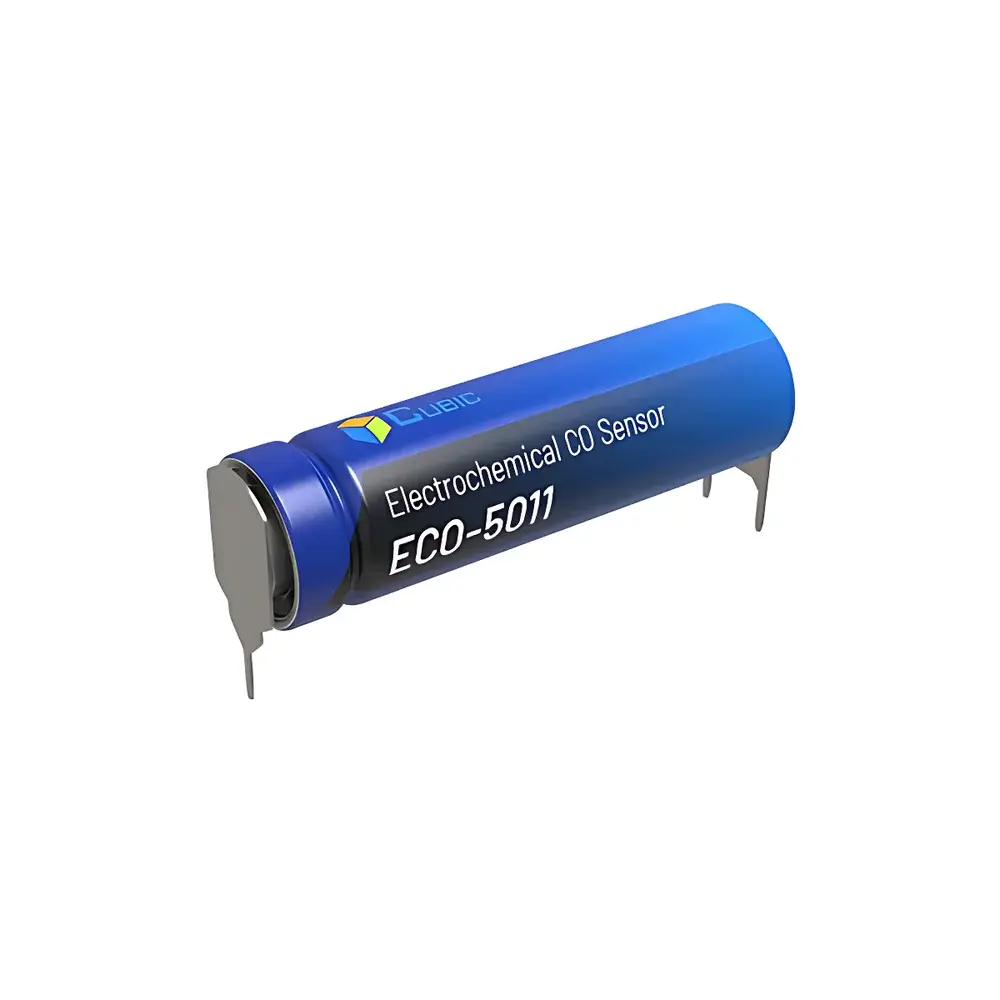
Cubic ECO-5011 Electrochemical Carbon Monoxide Sensor
| Brand | Cubic |
|---|---|
| Origin | Hubei, China |
| Model | ECO-5011 |
| Detection Principle | Electrochemical |
| Target Gas | Carbon Monoxide (CO) |
| Measurement Range | 0–10,000 ppm |
| Output Signal | 1.5–3 nA/ppm |
| Repeatability | ±2% |
| Resolution | 0.5 ppm |
| Response Time (T90) | <60 s |
| Long-Term Output Drift | <2%/month |
| Expected Service Life | 8–10 years |
| Weight | ~12 g |
| Operating Temperature | −20 to +60 °C |
| Storage Temperature | −20 to +60 °C |
| Relative Humidity | 5–99% RH (non-condensing) |
| Operating Pressure | 0.1 MPa ±10% |
| Bias Voltage | Not required |
| Recommended Load Resistance | 1 kΩ |
| Compliance | UL 2075, UL 2034, EN 50291, RoHS |
Overview
The Cubic ECO-5011 is a high-reliability, electrochemical carbon monoxide (CO) sensor engineered for continuous ambient air monitoring in residential, commercial, and light industrial environments. It operates on the principle of amperometric electrochemistry: CO diffuses through a selective membrane into an aqueous electrolyte cell, where it undergoes oxidation at the working electrode, generating a current proportional to gas concentration. This analog current output (1.5–3 nA per ppm) enables precise, low-power integration into battery-operated or mains-powered detection systems—including standalone alarms, HVAC controllers, and building management systems (BMS). Unlike legacy electrochemical sensors, the ECO-5011 employs a non-leaching, environmentally compliant electrolyte formulation and hermetically sealed packaging, eliminating risks of electrolyte leakage under thermal cycling or mechanical stress. Its wide operating temperature range (−20 to +60 °C) and tolerance to high relative humidity (up to 99% RH, non-condensing) support deployment in diverse climatic conditions without performance degradation.
Key Features
- True battery-compatible operation with zero bias voltage requirement and minimal power draw—ideal for wireless or energy-constrained installations.
- High selectivity for CO with low cross-sensitivity to common interferents: ethanol and acetic acid exhibit negligible response; resistance to silicone poisoning ensures stable operation in kitchens, laboratories, and manufacturing facilities where sealants or lubricants are present.
- Linear current output (1.5–3 nA/ppm) over full 0–10,000 ppm range, enabling straightforward signal conditioning and calibration traceability.
- Robust long-term stability: <2% monthly output drift under continuous operation, validated across accelerated aging tests simulating 8–10 years of field service life.
- Compact form factor (≈12 g) with standardized footprint for drop-in replacement in existing detector housings compliant with UL 2034 and EN 50291.
Sample Compatibility & Compliance
The ECO-5011 is designed for ambient air sampling only and is not intended for direct process stream analysis or high-pressure applications (operating pressure limited to 0.1 MPa ±10%). It meets internationally recognized safety and environmental standards for residential and commercial CO detection devices, including UL 2075 (Standard for Gas and Vapor Detectors and Sensors), UL 2034 (Single- and Multiple-Station Carbon Monoxide Alarms), EN 50291-1:2019 (Household CO alarms), and RoHS Directive 2011/65/EU. Its construction excludes restricted substances and incorporates lead-free soldering and halogen-free PCB substrates. The sensor does not require recalibration during its service life when used within specified environmental limits and paired with appropriate signal conditioning circuitry meeting IEC 61000-4 immunity requirements.
Software & Data Management
As an analog transducer, the ECO-5011 outputs a raw current signal requiring external signal conditioning—typically a transimpedance amplifier followed by analog-to-digital conversion. For system integrators, Cubic provides reference schematics and calibration protocols supporting NIST-traceable two-point (zero/span) calibration. When embedded in networked detectors, the sensor’s stable baseline and linear response facilitate implementation of diagnostic algorithms such as end-of-life prediction (based on drift trend analysis) and self-test verification (via periodic pulsed excitation). While the sensor itself contains no firmware, its electrical behavior is fully compatible with data acquisition platforms compliant with FDA 21 CFR Part 11 (for regulated facility monitoring) and ISO/IEC 17025 (for accredited calibration labs), provided the host system implements audit-trail logging and electronic signature controls.
Applications
- Residential and multi-family CO alarm systems meeting UL 2034 and EN 50291 certification requirements.
- Integration into HVAC air quality modules for demand-controlled ventilation (DCV) based on real-time CO levels.
- Portable personal safety monitors used by maintenance technicians in garages, boiler rooms, and confined spaces.
- Smart home gateways and IoT-enabled environmental dashboards requiring low-power, long-life gas sensing nodes.
- Public infrastructure deployments—including schools, hotels, and elderly care facilities—where regulatory compliance, reliability, and maintenance intervals are critical operational parameters.
FAQ
Does the ECO-5011 require a bias voltage to operate?
No. It is a passive, three-electrode electrochemical cell with no external bias requirement—simplifying circuit design and reducing power consumption.
What is the recommended load resistance for signal conditioning?
A 1 kΩ transimpedance resistor is specified to convert the nominal 1.5–3 nA/ppm current output into a measurable voltage range (e.g., 0–30 mV at 10,000 ppm).
Can the sensor be exposed to condensing humidity?
No. Operation is rated for 5–99% RH under non-condensing conditions only. Prolonged exposure to dew formation may compromise membrane integrity and electrolyte stability.
Is factory calibration provided with each unit?
Cubic supplies batch-level calibration certificates traceable to national standards. End-user system-level calibration remains the responsibility of the OEM or installer per applicable regulatory guidelines (e.g., NFPA 72, EN 50291-1 Annex D).
How is end-of-life determined in practice?
Field lifetime is assessed via periodic functional testing and trending of zero-point drift and span response. A sustained drift exceeding 20% of full-scale output—or failure to respond within T90 specification—indicates replacement is required.
Related Products







