
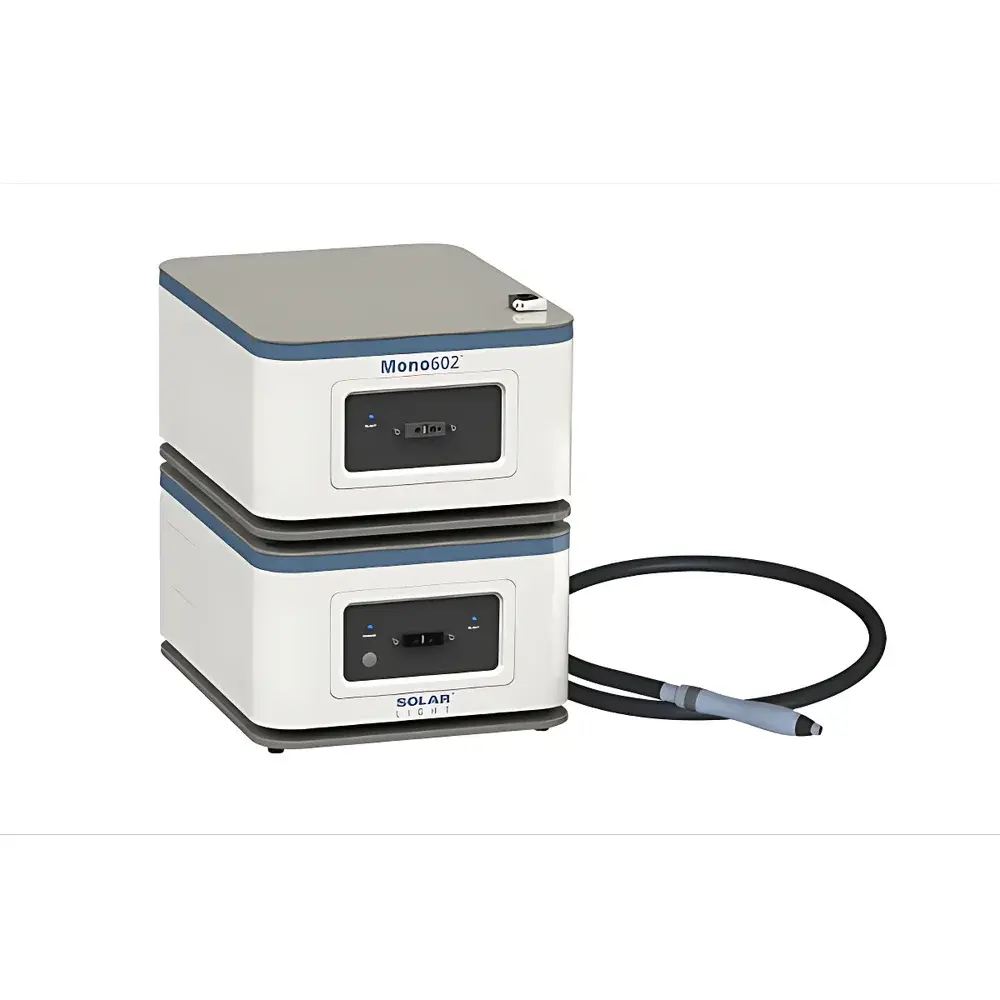
Solar Light Mono602® HDRS Hybrid Diffuse Reflectance Spectrophotometer for Non-Invasive Sunscreen Efficacy Testing
| Brand | Solar Light |
|---|---|
| Origin | USA |
| Model | Mono602® |
| Compliance | ISO 23698:2024, ISO 24442, BS EN 62471:2008 |
| Spectral Range | 290–400 nm |
| Measurement Time per Sample | 3–4 s |
| Operating Temperature | 15–35 °C |
| Relative Humidity | <90% RH (non-condensing) |
| Power Supply | 110–240 VAC, 50/60 Hz, max. 7 A |
| Dimensions (H×W×L) | 52.4 × 40.6 × 50.8 cm |
| Weight | 29 kg |
| Fiber Optic Probe | Bifurcated bundle with integrated contact probe, 1.8 m length |
| UV Exposure Level | Below ACGIH TLV® and occupational exposure limits |
| Footswitch & Keyboard Control | Included |
| Software | HDRSplus™ v5.x (Windows-based, FDA 21 CFR Part 11 ready) |
Overview
The Solar Light Mono602® HDRS is a high-precision, non-invasive hybrid diffuse reflectance spectrophotometer engineered for quantitative, in vitro assessment of sunscreen efficacy in accordance with ISO 23698:2024 — the internationally recognized standard for sunscreen testing via spectral reflectance. Unlike traditional in vivo SPF methodologies reliant on human erythema endpoints, the Mono602® HDRS employs calibrated broadband UV irradiation coupled with real-time spectral acquisition across the biologically relevant 290–400 nm range to determine critical photoprotection parameters including Sun Protection Factor (SPF), Ultraviolet A Protection Factor (UVAPF), Critical Wavelength (λc), UVA1/UV ratio, and spectral absorbance profiles. Its optical architecture integrates a stabilized monochromator-based light source, a bifurcated fiber-optic probe with integrated contact sensor, and a thermoelectrically cooled CCD spectrometer — all synchronized under closed-loop feedback control to ensure repeatability within ±1.5% RSD across replicate measurements. Designed specifically for regulated dermatological research and cosmetic formulation labs, the system eliminates ethical constraints associated with human UV exposure while delivering data traceable to NIST-traceable reference standards.
Key Features
- Compliance with ISO 23698:2024 for in vitro SPF and UVAPF determination — validated for regulatory submission in EU, US, and APAC markets
- Sub-second spectral acquisition (3–4 s per measurement) enabling throughput of up to 10 subjects × 8 formulations in ≤10 hours
- Optically optimized diffuse reflectance geometry minimizing specular artifacts and enhancing reproducibility on heterogeneous skin-mimetic substrates
- Integrated HDRSplus™ software suite with automated calculation engines for SPF, UVAPF, λc, and UVA/UV balance — compliant with GLP/GMP documentation requirements
- Low-intensity UV output (<0.1 J/cm² per scan) fully below ICNIRP and ACGIH occupational exposure thresholds — no PPE required for operators or subjects
- Compact benchtop footprint (50.8 × 40.6 × 52.4 cm) with rear-access cooling clearance — suitable for ISO Class 5 cleanroom-adjacent environments
- Full remote operation via USB-connected keyboard, footswitch, and probe-mounted trigger — supports hands-free workflow during multi-subject trials
- Bifurcated 1.8 m fiber optic assembly with integrated contact probe ensuring consistent probe-to-skin distance and pressure control (±0.2 mm)
Sample Compatibility & Compliance
The Mono602® HDRS is validated for use with standardized substrate systems including PMMA plates (ISO 24442-compliant), synthetic stratum corneum membranes, and ex vivo human skin explants prepared per OECD TG 439 guidelines. It accommodates both uniform and gradient application protocols and supports thickness verification via integrated optical coherence profilometry (OCP) mode in HDRSplus™ v5.x. All optical output meets BS EN 62471:2008 Risk Group 1 (Exempt) classification for UV radiation safety. System calibration is traceable to NIST SRM 2065 and certified annually per ISO/IEC 17025-accredited service protocols. The instrument satisfies audit readiness requirements for FDA 21 CFR Part 11 (electronic records/signatures), EU Annex 11, and MHRA GxP data integrity expectations when deployed with enabled audit trail and user access controls.
Software & Data Management
HDRSplus™ is a Windows-based, modular application developed exclusively for clinical and regulatory sunscreen testing laboratories. It features a dual-mode interface: “Assay Mode” for routine batch processing (with SOP-driven workflows, auto-validation checkpoints, and electronic lab notebook integration), and “Research Mode” supporting custom spectral analysis, multivariate regression modeling, and export to MATLAB/Python via HDF5 and CSV. All raw spectra, metadata (operator ID, timestamp, substrate lot, ambient conditions), and derived metrics are stored in an encrypted SQLite database with immutable audit trails. Reports conform to ISO 23698 Annex C templates and include uncertainty budgets calculated per GUM (JCGM 100:2008). Electronic signatures comply with 21 CFR Part 11 Subpart B requirements when paired with LDAP/Active Directory authentication.
Applications
- Regulatory submission support for SPF, UVAPF, and broad-spectrum claims under FDA, Health Canada, TGA, and ASEAN Cosmetic Directive frameworks
- Formulation optimization of organic/inorganic UV filters, encapsulated actives, and photostabilizers via spectral deconvolution and time-resolved reflectance decay analysis
- Clinical trial endpoint validation — correlating HDRS-derived UVAPF with in vivo persistent pigment darkening (PPD) assays
- Quality control of commercial sunscreen batches against release specifications (e.g., ±15% UVAPF tolerance, λc ≥ 370 nm)
- Training platform for dermatology residents and QC technicians in standardized sunscreen application technique assessment using real-time thickness mapping
- Method transfer studies between contract research organizations (CROs) and brand-owned R&D labs under ICH Q5E comparability guidelines
FAQ
Does the Mono602® HDRS require daily recalibration?
No — the system performs automatic wavelength and intensity self-checks at startup and between samples using internal reference LEDs and NIST-traceable quartz standards. Full calibration verification is recommended every 90 days or after transport.
Can HDRSplus™ generate FDA-compliant eCTD-ready reports?
Yes — the software exports XML-based study summaries compliant with eCTD Module 5.3.3.2 structure, including metadata schemas aligned with CDISC SDTM and SEND standards.
Is the instrument compatible with third-party LIMS platforms?
Yes — HDRSplus™ supports ODBC/JDBC connectivity and HL7 v2.5.1 message exchange for bidirectional data synchronization with major LIMS vendors (e.g., LabWare, STARLIMS, Thermo Fisher SampleManager).
What substrate preparation protocols are validated for ISO 23698 compliance?
PMMA plates coated with 2.0 ± 0.2 mg/cm² sunscreen film (applied via automated applicator per ISO 24442), as well as silicone-coated polycarbonate substrates for high-viscosity formulations.
How is subject safety monitored during repeated testing?
The system logs cumulative spectral irradiance per test session and enforces automatic lockout if cumulative exposure exceeds 0.5 J/cm² — well below the 1.0 J/cm² ACGIH TLV® threshold for chronic exposure.




