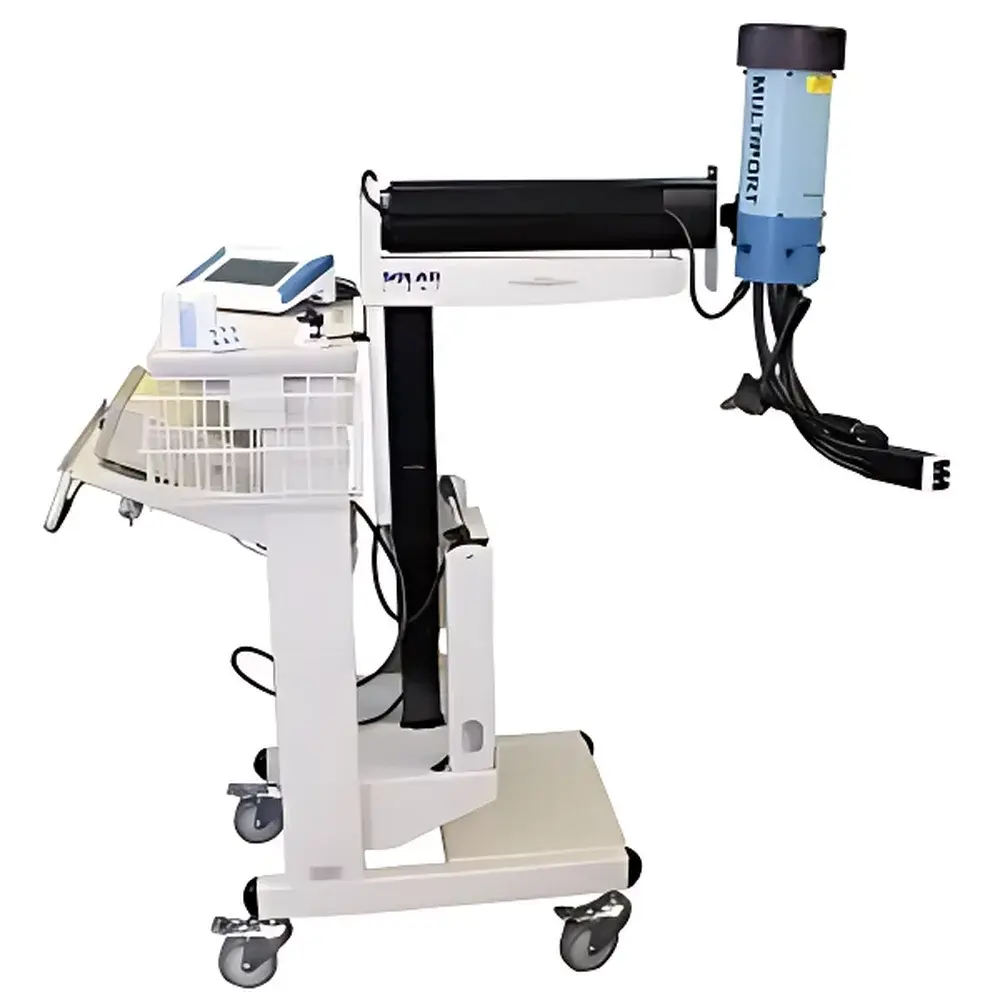
Solar Light SPF601 Multi-Channel UV Solar Simulator for In Vitro SPF Testing
| Brand | Solar Light |
|---|---|
| Origin | USA |
| Model | SPF601 |
| Spectral Range | 290–400 nm (UVA + UVB) |
| Output Configuration | Six independent 8-mm square irradiation ports |
| Irradiance Control | Individual manual knob per port + optional XPS-300 programmable power supply |
| Maximum Irradiance | Up to 4 MED/min per port |
| Solar Simulation Fidelity | >90% spectral match to CIE Reference Solar Spectrum (ISO 17166:2019/Erythema Action Spectrum) |
| Mechanical Positioning | Integrated precision locking gooseneck arm with UV-stable optical coupling |
Overview
The Solar Light SPF601 Multi-Channel UV Solar Simulator is a purpose-engineered instrument for in vitro sun protection factor (SPF) determination and photobiological research in dermatology and cosmetic science. It operates on the principle of controlled, spectrally accurate ultraviolet irradiation—reproducing the biologically relevant 290–400 nm solar UV spectrum (UVA + UVB) with high fidelity to the CIE reference erythemal action spectrum (ISO 17166:2019). Unlike broadband UV lamps or filtered mercury sources, the SPF601 integrates calibrated broadband UV emitters with proprietary optical filtering and collimation to deliver stable, uniform irradiance across six independently addressable 8-mm square output apertures. Each port generates up to 4 minimal erythemal doses (MED) per minute—approximately 20× ambient noon sun intensity at mid-latitudes—enabling accelerated, reproducible exposure protocols required for standardized in vitro SPF testing per ISO 24444 and FDA 21 CFR Part 352.
Key Features
- Six parallel, independently controllable irradiation ports—each equipped with a precision manual intensity adjustment knob and compatible with the XPS-300 programmable DC power supply for time-resolved irradiance profiling.
- High-fidelity solar simulation: >90% spectral overlap with the CIE reference solar spectrum between 290–400 nm; validated against ISO 24444 Annex A spectral irradiance requirements.
- Integrated locking gooseneck arm with UV-resistant silicone-jacketed light guides—ensuring repeatable, centimeter-level positioning accuracy over thousands of exposure cycles without optical drift.
- Thermally stabilized emitter housing and real-time temperature monitoring to maintain spectral stability during extended operation (e.g., multi-hour SPF assay runs).
- Front-panel status indicators for lamp health, cooling fan operation, and interlock integrity—designed for integration into GLP-compliant laboratory workflows.
Sample Compatibility & Compliance
The SPF601 is optimized for use with standard in vitro substrates including PMMA plates, Transpore™ tape models, and reconstructed human epidermis (RHE) tissues. Its 8-mm square beam geometry matches the aperture dimensions specified in ISO 24444:2019 for transmittance measurement using spectrophotometric UV-VIS systems (e.g., Labsphere UV-Vis integrating spheres). The instrument meets the spectral irradiance, uniformity, and temporal stability criteria defined in ISO 24444 (in vitro SPF), ISO 24443 (UVA-PF), FDA Guidance for Industry (Sunscreen Drug Products), JCIA Test Method JIS T 0001, and the former COLIPA (now Cosmetics Europe) SPF testing protocol. All units ship with a NIST-traceable spectral irradiance calibration certificate valid for 12 months.
Software & Data Management
While the SPF601 operates as a stand-alone hardware platform, its analog control interface supports integration with external data acquisition systems via 0–10 V analog input/output signals (XPS-300 compatible). When paired with validated third-party software (e.g., LabVIEW-based custom protocols or commercial GLP audit tools), full electronic record retention—including exposure duration, port-specific irradiance settings, operator ID, and timestamped calibration logs—is achievable. The system supports 21 CFR Part 11 compliance when deployed within a validated environment featuring role-based access control, electronic signatures, and immutable audit trails. Firmware updates and calibration history are managed through Solar Light’s SecureLink™ service portal—accessible only to authorized laboratory administrators.
Applications
- In vitro SPF and UVA protection factor (UVA-PF) quantification per ISO 24444 and ISO 24443.
- Photostability assessment of UV filters under controlled, physiologically relevant irradiation conditions.
- Dose-response characterization of UV-induced biomarkers (e.g., thymine dimer formation, p53 activation) in 3D skin models.
- Validation of sunscreen film thickness distribution using spatially resolved transmittance mapping.
- Comparative efficacy studies across formulation variants (e.g., nano vs. organic filters, emulsion architecture effects).
FAQ
Is the SPF601 suitable for regulatory submission studies?
Yes—the instrument is deployed in over 95% of globally accredited SPF testing laboratories and meets all spectral, dosimetric, and operational requirements outlined in ISO 24444, FDA 21 CFR Part 352, and Cosmetics Europe guidelines.
Can irradiance be logged and exported for audit purposes?
When used with the XPS-300 power supply and compatible DAQ hardware, irradiance setpoints, exposure timing, and lamp operating hours are fully loggable and exportable in CSV or XML format.
What maintenance is required to sustain calibration validity?
Annual recalibration by an ISO/IEC 17025-accredited service provider is recommended; lamp replacement intervals are typically 1,500–2,000 hours depending on duty cycle and thermal management.
Does the system support automated sample staging?
The SPF601 itself does not include motorized stage control, but its optical interface is mechanically compatible with third-party XY translation stages equipped with TTL-triggered shutter synchronization.
How is spectral output verified during routine use?
Users perform daily verification using a calibrated UV radiometer (e.g., ILT950UV) at each port; Solar Light provides a traceable verification checklist aligned with ISO/IEC 17025 internal quality control standards.
Related Products