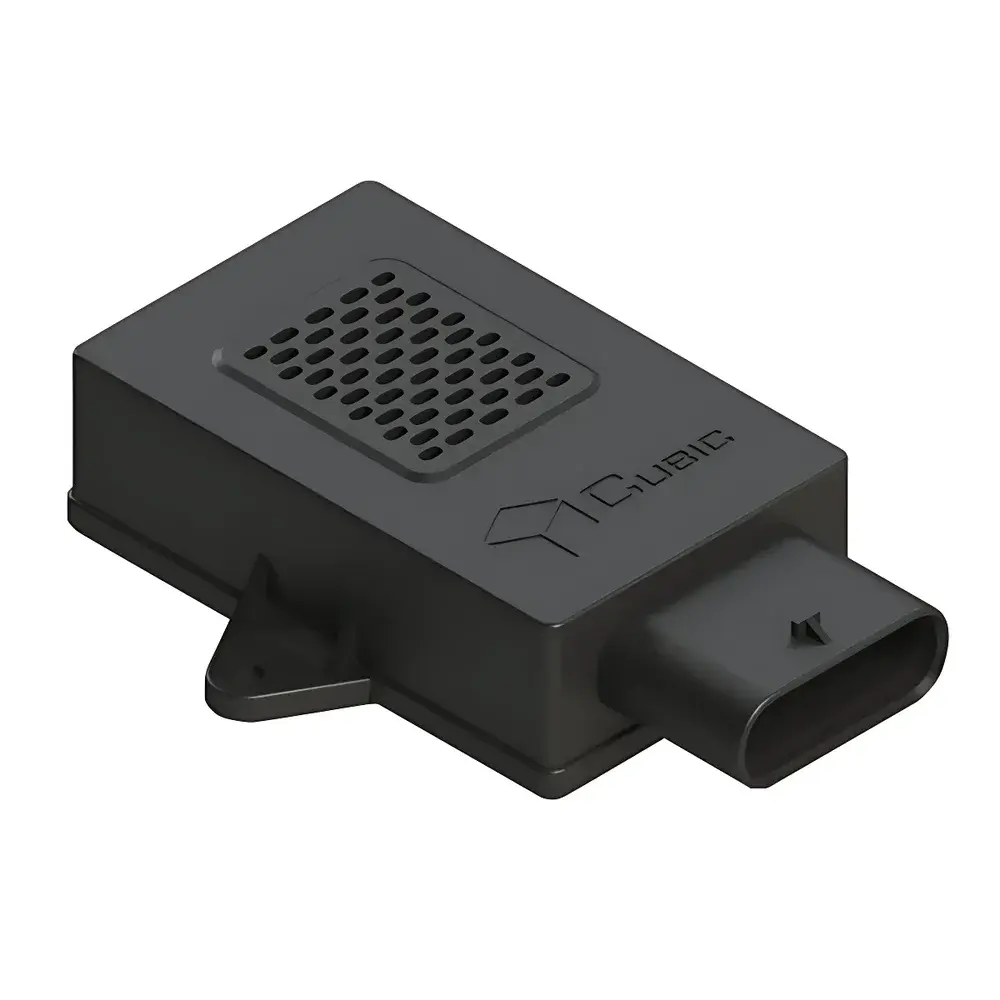
Cubic ATRS-1000 Battery Thermal Runaway Monitoring Sensor
| Brand | Cubic |
|---|---|
| Origin | Hubei, China |
| Model | ATRS-1000 |
| Detection Principles | CO₂ – Dual-Beam NDIR |
| Measured Gases | CO₂ (0–10,000 ppm), CO (1–1,000 ppm) |
| Pressure Range | 40–180 kPa |
| Temperature Range | −40 °C to +125 °C |
| Resolution | 1 ppm |
| CO₂ Accuracy | ±(50 ppm + 3% of reading) |
| CO Accuracy | ±40 ppm or ±30% of reading (whichever is greater) |
| Pressure Accuracy | ±1 kPa |
| Temperature Accuracy | ±2 °C |
| T₉₀ Response Time | <25 s |
| Data Refresh Rate | ≤1 s |
| Output Interfaces | CAN, LIN, UART, Analog Voltage |
| Operating Temp/Humidity | −40 °C to +85 °C / 0–99% RH (non-condensing) |
| Storage Conditions | −40 °C to +110 °C / 0–99% RH (non-condensing) |
| Supply Voltage | 9–16 VDC (nominal 12 VDC) |
| Avg. Current Draw | ≤100 mA @ 12 VDC |
| Sleep Current | <100 µA |
| IP Rating | IP65 |
| Particle Measurement | Optical Scattering (0–5 mg/m³, ±10% accuracy, response <8 s) |
Overview
The Cubic ATRS-1000 Battery Thermal Runaway Monitoring Sensor is an integrated, multi-parameter gas and environmental sensing module engineered for early-stage detection of lithium-ion battery thermal runaway events in electric vehicles (EVs), energy storage systems (ESS), and battery management systems (BMS). Unlike single-gas detectors, the ATRS-1000 employs a fused-sensor architecture combining dual-beam non-dispersive infrared (NDIR) spectroscopy for CO₂, MEMS-fabricated metal oxide semiconductor (MOX) technology for CO, piezoresistive transduction for ambient pressure, and high-stability NTC thermistors for temperature—enabling simultaneous, time-synchronized acquisition of chemically and physically correlated parameters. This multi-modal approach addresses the well-documented precursor signature of thermal runaway: the sequential release of CO₂ (from SEI layer decomposition), CO (from electrolyte oxidation), volatile organic compounds (VOCs), and particulate matter—often occurring minutes before catastrophic failure. The sensor’s design adheres to automotive functional safety principles (ISO 26262 ASIL-B readiness) and supports deterministic real-time data delivery via CAN bus, making it suitable for integration into ASIL-aware BMS architectures requiring validated fault detection latency and signal integrity.
Key Features
- Dual-Beam NDIR CO₂ Sensing: Utilizes reference and measurement channels to eliminate optical drift and humidity-induced baseline shift; achieves ±(50 ppm + 3% of reading) accuracy across 0–10,000 ppm range with T₉₀ < 25 s and zero cross-sensitivity to CO, CH₄, or H₂O vapor.
- MEMS-MOX CO Detection: Proprietary micro-hotplate architecture enables precise thermal modulation of sensing films, delivering superior selectivity against common interferents (e.g., H₂, ethanol, acetone); stable output under varying humidity (10–90% RH) and temperature gradients.
- Integrated Environmental Monitoring: Simultaneous pressure (40–180 kPa, ±1 kPa) and temperature (−40 °C to +125 °C, ±2 °C) measurements provide contextual compensation for gas concentration calculations and thermal state estimation.
- Optical Particulate Detection: Proprietary light-scattering module detects airborne particles up to 5 mg/m³ with <8 s response and ±10% measurement uncertainty—correlating with smoke onset during venting events.
- Automotive-Grade Hardware: PCB layout and component selection conform to AEC-Q200 stress test requirements; operating range −40 °C to +85 °C; IP65-rated enclosure ensures resistance to dust ingress and water jets.
- Low-Power System Architecture: Active current draw ≤100 mA at 12 VDC; ultra-low-power sleep mode (<100 µA) enables always-on monitoring without compromising vehicle battery standby life.
Sample Compatibility & Compliance
The ATRS-1000 is optimized for deployment within sealed or semi-ventilated battery enclosures where early off-gas detection is critical. It does not require sample conditioning, external pumps, or calibration gases—reducing system complexity and maintenance burden. Its sensing performance remains stable across the full operational humidity range (0–99% RH, non-condensing) and withstands mechanical shock per ISO 16750-3. While not certified as a standalone safety device, the sensor meets key requirements for integration into systems targeting compliance with UL 9540A (thermal runaway propagation evaluation), GB/T 34014 (EV battery system safety), and ISO 6469-1 (electrically propelled road vehicles — safety specifications). Raw sensor outputs are traceable to NIST-traceable reference standards via Cubic’s internal metrology lab, supporting GLP-aligned validation protocols.
Software & Data Management
The ATRS-1000 communicates via industry-standard CAN 2.0B (up to 500 kbps), with configurable message IDs and periodic frame transmission (≤1 s refresh). Optional LIN and UART interfaces support diagnostic access and firmware updates. All digital outputs include CRC-8 checksums for data integrity verification. Cubic provides a CAN DBC file and API documentation for seamless integration into MATLAB/Simulink, dSPACE SCALEXIO, or AUTOSAR-compliant BMS software stacks. The sensor supports configurable alert thresholds and hysteresis logic for local event triggering—minimizing bandwidth usage on the main CAN backbone. While the device itself does not store historical data, its deterministic timing and timestamp-ready output enable synchronized logging with vehicle-level ECUs, satisfying audit requirements under ISO/IEC 17025 and FDA 21 CFR Part 11 when deployed in validated quality systems.
Applications
- Real-time thermal runaway precursor detection in traction battery packs for BEVs and PHEVs
- Early-warning input for active thermal management strategies (e.g., forced cooling activation, contactor disengagement)
- Off-gas profiling during accelerated life testing and abuse testing (nail penetration, overcharge, thermal ramp)
- Multi-sensor fusion inputs for AI-driven BMS anomaly detection models (e.g., LSTM-based temporal pattern recognition)
- Environmental monitoring in stationary ESS racks, particularly in confined indoor installations with limited ventilation
- Reference-grade validation tool for laboratory-scale battery safety research under ASTM E2993 or UN 38.3 protocols
FAQ
Does the ATRS-1000 require periodic calibration in field use?
No. The dual-beam NDIR architecture and MEMS-MOX thermal stabilization eliminate the need for routine zero/span calibration. Field recalibration is only recommended after exposure to extreme contamination (e.g., silicone oil vapor) or mechanical damage.
Can the sensor detect hydrogen (H₂) or hydrogen fluoride (HF)?
Not natively. The current configuration targets CO₂, CO, pressure, temperature, and PM. H₂ and HF detection would require additional electrochemical or photoacoustic modules; Cubic offers custom OEM variants upon request.
Is CAN FD supported?
No. The standard ATRS-1000 implements classical CAN 2.0B. CAN FD capability is available in the ATRS-2000 series, scheduled for Q4 2024 release.
What is the expected service life under continuous operation?
Rated for ≥15 years in CO₂ channel (NDIR source lifetime); ≥8 years for CO channel (MOX film stability under automotive thermal cycling); full module MTBF exceeds 100,000 hours per MIL-HDBK-217F predictions.
How is humidity compensation implemented for CO measurement?
The onboard NTC and pressure sensors feed real-time environmental data into an embedded compensation algorithm, dynamically adjusting MOX baseline and sensitivity coefficients—validated across 10–90% RH at 25 °C and 60 °C.