
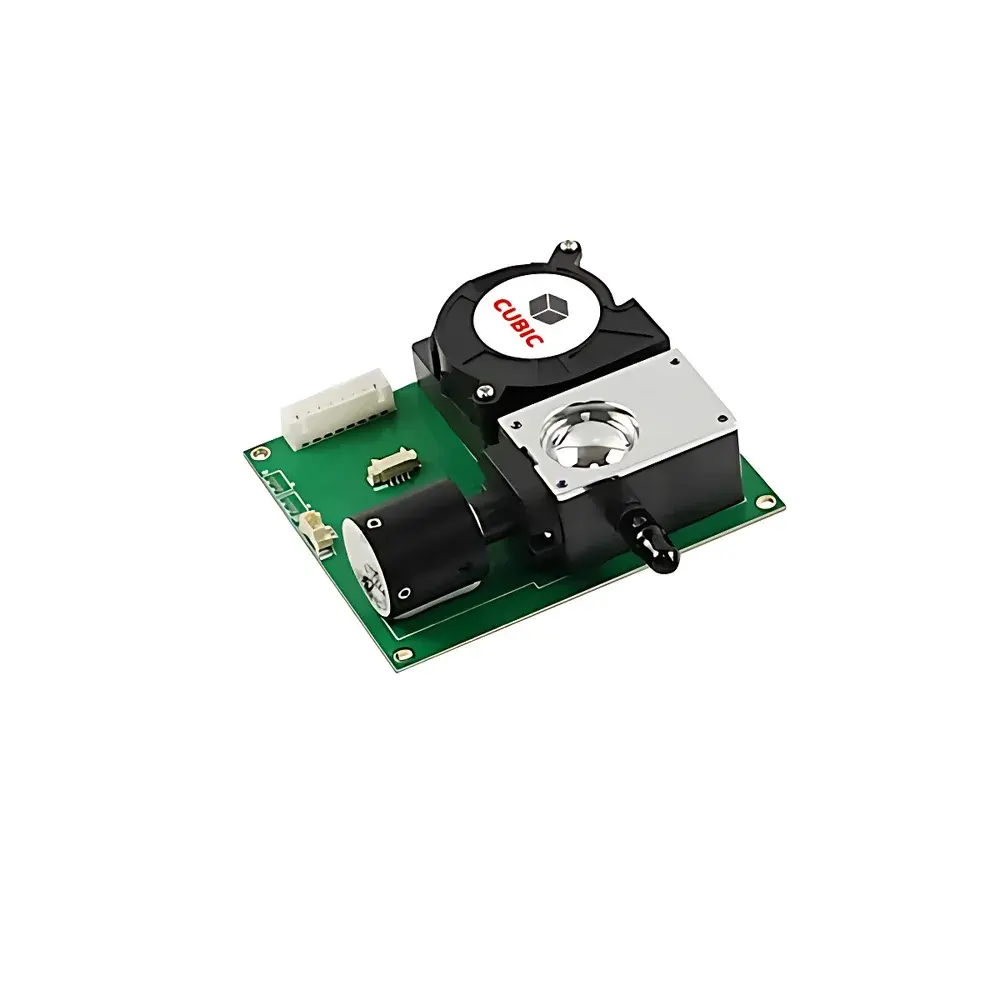
Cubic PM5000S Laser Particle Counting Sensor
| Brand | Cubic |
|---|---|
| Origin | Hubei, China |
| Manufacturer Type | Authorized Distributor |
| Country of Origin | China |
| Model | PM5000S |
| Operating Principle | Light Scattering (Laser Nephelometry) |
| Safety Rating | Non-Explosive Atmosphere Rated |
| Measurement Channels | 0.3, 0.5, 1.0, 2.5, 5.0, and 10.0 µm |
| Calibration Compliance | JJF 1190–2008 “Calibration Specification for Airborne Particle Counters” |
| Output Format | Particle concentration in pcs/L per channel |
| Sampling Flow Rate | 2.83 L/min (standard) |
| Detection Efficiency | ≥50% at 0.3 µm |
Overview
The Cubic PM5000S Laser Particle Counting Sensor is a compact, high-stability optical particle counter engineered for continuous airborne particulate monitoring in cleanroom environments, HVAC validation systems, pharmaceutical manufacturing facilities, and indoor air quality (IAQ) assessment platforms. It operates on the principle of single-particle laser light scattering (nephelometry), where aerosol-laden air is drawn through a precisely controlled laminar flow path intersecting a collimated 650 nm semiconductor laser beam. Each particle passing through the sensing volume scatters light proportionally to its size and refractive index; photodetectors capture these transient pulses, which are classified into six discrete size bins—0.3, 0.5, 1.0, 2.5, 5.0, and 10.0 µm—based on calibrated pulse-height thresholds. The sensor delivers real-time, volumetric particle concentration data in particles per liter (pcs/L), enabling quantitative compliance verification against ISO 14644-1, EU GMP Annex 1, and USP particulate matter requirements.
Key Features
- Simultaneous six-channel particle counting across standardized size thresholds (0.3–10.0 µm), supporting both cleanroom classification and PM2.5/PM10 trending.
- Constant-flow sampling architecture with integrated mass flow controller ensures stable 2.83 L/min aspiration rate—critical for reproducible counts under variable backpressure or filter loading conditions.
- Linear-output laser diode operating at constant power mode minimizes intensity drift over time, preserving counting accuracy across extended deployments (>12 months without recalibration).
- Fully compliant with JJF 1190–2008, China’s national metrological calibration specification for airborne particle counters, including requirements for counting efficiency, false count rate, coincidence loss correction, and size resolution verification.
- Robust mechanical design with IP54-rated enclosure enables integration into wall-mounted monitors, duct-mounted air handling units, and portable IAQ analyzers without external environmental shielding.
Sample Compatibility & Compliance
The PM5000S is optimized for ambient and conditioned air streams with temperature range of 10–40 °C and relative humidity ≤70% non-condensing. It is not intended for corrosive, oily, or high-concentration (>1×10⁶ pcs/m³) aerosol environments without upstream dilution or filtration. Its performance traceability aligns with international standards including ISO 21501–4 (Determination of particle size distribution—Single particle light interaction methods) and supports audit-ready documentation for GLP and GMP environments. While not intrinsically safe or explosion-proof, it meets CE marking requirements for electromagnetic compatibility (EN 61326–1) and low-voltage directive (EN 61000–6–3).
Software & Data Management
The sensor outputs digital RS-485 (Modbus RTU) and analog 4–20 mA signals for seamless integration into SCADA, BMS, and PLC-based monitoring networks. Optional USB-to-serial interface enables direct connection to Windows/Linux host PCs running Cubic’s OEM configuration utility, which supports firmware updates, threshold calibration verification, and raw pulse logging. All measurement data includes timestamped channel-specific counts, internal temperature/humidity readings (via onboard sensors), and diagnostic flags (e.g., flow alarm, laser health status). Audit trails and user-access logs can be implemented at the system level to satisfy FDA 21 CFR Part 11 requirements when deployed within validated computerized systems.
Applications
- Cleanroom environmental monitoring in semiconductor fabs and biopharmaceutical fill-finish suites.
- Real-time verification of HEPA/ULPA filter integrity during ISO 14644-3 certification tests.
- Continuous indoor air quality surveillance in hospitals, laboratories, and office buildings per ASHRAE Standard 62.1.
- OEM integration into portable particle monitors, smart ventilation controllers, and industrial dust suppression feedback loops.
- Research-grade particulate exposure assessment in occupational hygiene studies requiring multi-size-bin resolution.
FAQ
What is the minimum detectable particle size and counting efficiency at that size?
The PM5000S achieves ≥50% counting efficiency at 0.3 µm and ≥100% efficiency at 0.5 µm and above, as verified per JJF 1190–2008 and aligned with ISO 21501–4 reference methodologies.
Does the sensor require periodic recalibration, and what is the recommended interval?
Annual calibration against NIST-traceable polystyrene latex (PSL) standards is recommended for regulatory applications; field verification using check particles may be performed quarterly.
Can the PM5000S operate continuously in unattended mode?
Yes—it features thermal management and power-supply filtering designed for 24/7 operation with mean time between failures (MTBF) exceeding 20,000 hours.
Is the output compatible with Modbus TCP or only Modbus RTU?
The native interface is RS-485 Modbus RTU; Modbus TCP support requires an external protocol gateway or OEM-level firmware customization.
How is coincidence error corrected in high-concentration environments?
The firmware applies real-time coincidence loss correction based on measured count rate and empirically derived exponential decay models, maintaining accuracy up to 2×10⁵ pcs/m³ at 0.5 µm.







