
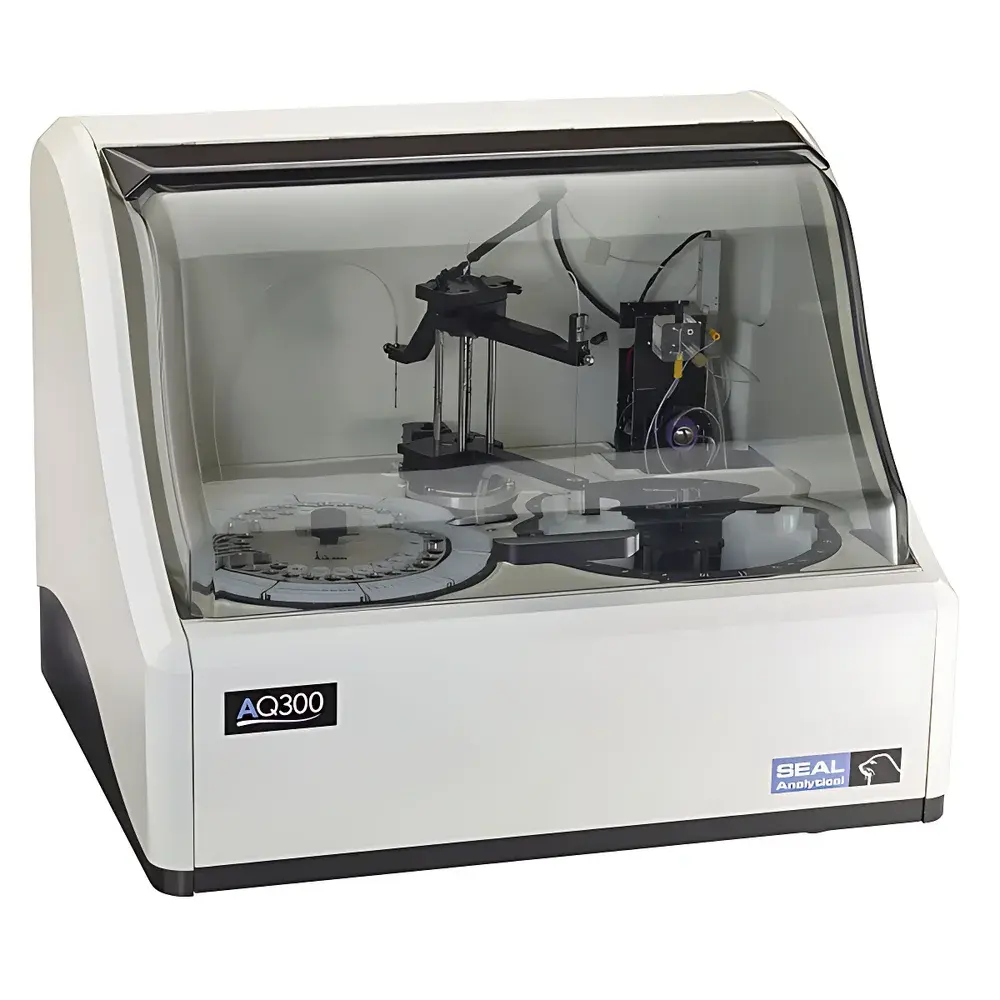
SEAL AQ300 Automated Discrete Analyzer
| Brand | SEAL |
|---|---|
| Origin | Germany |
| Model | AQ300 |
| Product Type | Discrete Flow Analyzer |
| Wavelength Range | 350–880 nm |
| Sample Positions | 57 or 97 (selectable) |
| Reagent Positions | 18 (with cooling capability) |
| Cuvette Path Length | 10 mm (quartz) |
| Light Source | Quartz-halogen lamp |
Overview
The SEAL AQ300 Automated Discrete Analyzer is a compact, high-precision benchtop instrument engineered for routine and regulatory-compliant wet-chemistry analysis in environmental, clinical, agricultural, and industrial laboratories. It operates on the discrete analysis principle—where individual sample and reagent aliquots are precisely metered into disposable reaction wells, incubated under controlled thermal conditions, and subsequently transferred to a fixed-position quartz cuvette for static photometric measurement. Unlike continuous-flow or segmented-flow systems, the AQ300 eliminates fluidic pulsation and dispersion-related variability by performing absorbance detection in a stationary optical path. This design ensures superior photometric reproducibility (<0.2% RSD for repeated standards), minimized carryover (<0.001%), and enhanced signal-to-noise ratio—critical for low-concentration analytes such as nitrate, orthophosphate, or phenolic compounds in complex matrices like wastewater or soil extracts.
Key Features
- Precision microdispensing system with stepper-motor-driven syringes enabling accurate delivery of 2–500 µL samples and 10–600 µL reagents in 0.5 µL increments
- Dedicated 10 mm Hellma quartz cuvette with fixed optical alignment—eliminates positional drift and surface-scatter artifacts associated with moving-cell designs
- Integrated thermostatic control for sample tray, reagent carousel, reaction wells, and detector compartment (30–45 °C, ±0.1 °C stability)
- Automated cadmium coil module for on-demand nitrate-to-nitrite reduction; fully regenerated in situ via software-controlled acid wash and conditioning cycles
- Reagent management with level sensors, expiration date tracking, and temperature-controlled storage (18 positions, dual-zone cooling)
- Static photometry using a quartz-halogen light source and 9-position filter wheel (350–880 nm), supporting ASTM, ISO, and EPA-approved colorimetric methods
- True walk-away operation: overnight runs, auto-dilution (up to 100×), multi-point calibration (up to 20 points), and dynamic range extension via post-analysis dilution
Sample Compatibility & Compliance
The AQ300 accommodates standard 1.2 mL and 2 mL polypropylene sample cups, compatible with unattended loading from 57- or 97-position trays. Its modular architecture supports method-specific configurations—including volatile phenol distillation modules (optional), heavy-metal chelation protocols, and enzymatic assays requiring precise incubation timing (up to 16 min per reaction). All hardware and firmware comply with CE, UL, and CSA safety directives. Data integrity features meet GLP/GMP expectations: full audit trail, electronic signatures (21 CFR Part 11–ready configuration available), and QCPro™ embedded quality control logic that flags outliers, triggers repeat analysis, and logs corrective actions. Method validation documentation aligns with ISO/IEC 17025 requirements for accredited testing laboratories.
Software & Data Management
AQ300 is operated via SEAL’s intuitive Windows-based AQ Software Suite, designed for multi-user environments with role-based access control. The interface supports drag-and-drop method creation, real-time monitoring of liquid handling status, and automatic generation of calibration curves with polynomial or linear regression options. Raw absorbance data, calculated concentrations, and QC metrics are stored in a relational database with timestamped metadata. Export formats include CSV, Excel, and XML for seamless LIMS integration. The software includes built-in tools for method transfer verification, instrument performance qualification (IPQ) reports, and trend analysis across batches. All data modifications are logged with user ID, timestamp, and reason code—ensuring traceability required under FDA and EU Annex 11 frameworks.
Applications
The AQ300 delivers validated performance for over 40 standardized colorimetric and enzymatic methods, including but not limited to: ammonia-N (salicylate and indophenol), nitrate/nitrite (cadmium reduction + diazotization), orthophosphate (ascorbic acid reduction), total phosphorus (persulfate digestion), sulfate (turbidimetric barium chloride), chloride (mercuric thiocyanate), cyanide (pyridine-barbituric acid), alkalinity (acid titration endpoint detection), silica (molybdate blue), and total Kjeldahl nitrogen (post-digestion distillation coupling). It is widely deployed in municipal water utilities (EPA Methods 353.2, 354.1, 365.2), environmental contract labs (ISO 15681-1, ISO 11908), and food safety testing facilities requiring AOAC-compliant nutrient profiling.
FAQ
What distinguishes discrete analysis from flow injection or segmented flow techniques?
Discrete analysis isolates each reaction in a dedicated vessel, eliminating cross-contamination risks and matrix interference common in continuous-flow manifolds. The AQ300’s static cuvette readout further enhances precision compared to flow-cell-based systems.
Can the AQ300 perform digestion or distillation steps?
The base unit does not include integrated digestion or distillation; however, it interfaces with external block digesters and steam distillation units via TTL-triggered synchronization and sample ID handshaking.
Is method validation support provided?
Yes—SEAL supplies application notes, certified reference material test reports, and IQ/OQ/PQ documentation templates aligned with ISO/IEC 17025 and USP .
How is carryover prevented between samples?
The system employs multi-stage cuvette cleaning (pressurized air purge, deionized water rinse, ethanol flush, and optical verification), coupled with probe-wash stations and programmable air-gap aspiration.
What maintenance is required for routine operation?
Daily: visual inspection of tubing, waste container level, and cuvette cleanliness. Weekly: syringe lubrication and filter replacement. Annually: photometer calibration verification and temperature sensor validation—no field-service engineer required for standard tasks.




