
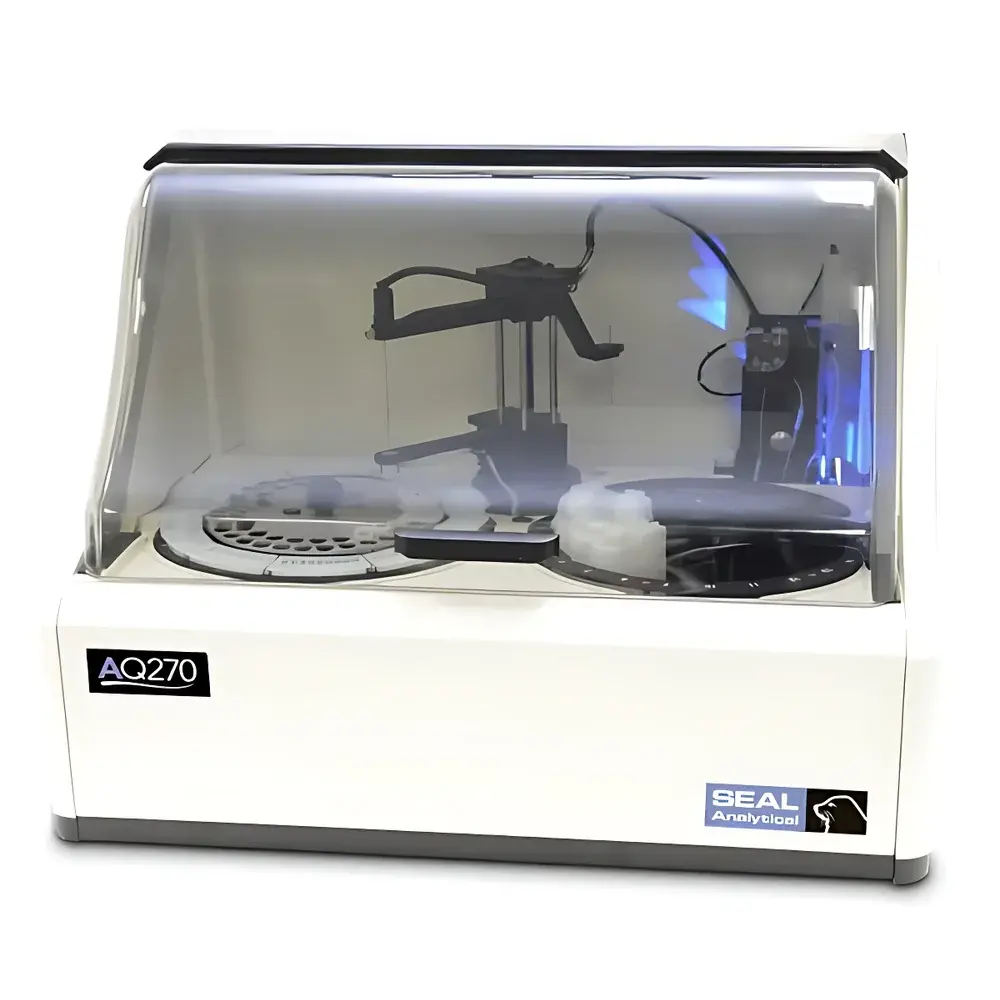
SEAL AQ270 Automated Discrete Analyzer
| Brand | SEAL |
|---|---|
| Origin | Germany |
| Model | AQ270 |
| Product Type | Discrete Analyzer |
| Wavelength Range | 350–880 nm |
| Sample Capacity | 57 positions |
| Reagent Positions | 18 |
| Cuvette Path Length | 10 mm |
| Light Source | Halogen Lamp |
| Compliance | EPA-approved methods, ISO 15681, ISO 11923, ISO 7827 |
Overview
The SEAL AQ270 Automated Discrete Analyzer is a compact, high-precision benchtop instrument engineered for routine and regulatory-compliant analysis of inorganic nutrients and common water quality parameters. Unlike continuous flow or flow injection systems, the AQ270 employs discrete (segmented) analysis methodology—where each sample and reagent are individually metered, mixed, reacted, and measured in isolated reaction zones. This architecture eliminates carryover, ensures full reaction completion under programmable incubation times (from seconds to >30 minutes), and delivers metrological traceability aligned with classical wet-chemistry principles. Designed for laboratories with limited footprint and moderate throughput requirements (up to ~120 samples per 8-hour shift), the AQ270 maintains full method equivalence to manual spectrophotometric protocols while automating sample handling, calibration, dilution, and data capture—enabling unattended overnight operation without compromise in analytical integrity.
Key Features
- Compact footprint with integrated 57-position sample carousel and 18-reagent rack—optimized for space-constrained QC and environmental labs.
- Fixed-pathlength (10 mm) quartz cuvette mounted on a stable optical platform, coupled with a temperature-stabilized halogen light source and high-resolution photodiode array detector (350–880 nm), ensuring consistent absorbance measurement and low signal drift.
- Programmable per-sample assay logic: up to seven independent parameters can be quantified from a single 2 mL sample aliquot within one run—maximizing sample economy and reducing preparation overhead.
- On-board standard curve generation and dynamic dilution capability: automatic serial dilution of standards and unknowns using precision syringe pumps, supporting wide linear ranges without manual intervention.
- Reaction-controlled kinetics: dwell time, mixing sequence, heating (optional Peltier module), and detection timing are fully configurable—enabling full compliance with EPA Methods 353.2, 350.1, 365.2, and ISO standards requiring endpoint or kinetic readout.
- Deep-cleaning protocol after every measurement cycle: three-stage wash (air–reagent–deionized water) with pressure-assisted aspiration ensures <0.001% carryover between samples—validated per ASTM D5173 and ISO 5667-3.
- Fully automated workflow: includes auto-sampling, reagent replenishment monitoring, error logging, and end-of-run notification—supporting 24/7 operation under GLP/GMP-aligned conditions.
Sample Compatibility & Compliance
The AQ270 is validated for liquid matrices including raw and treated drinking water, wastewater effluents, surface and groundwater, soil leachates, and digested biological samples. It supports direct analysis of turbid or particulate-laden samples via optional centrifugation or filtration integration. Method performance meets or exceeds requirements of U.S. EPA, ISO, and APHA standard methods—including but not limited to: Ammonia (EPA 350.1), Nitrate/Nitrite (EPA 353.2), Orthophosphate (EPA 365.2), Silicate (ISO 15681-1), Sulfate (ISO 7827), Cyanide (ISO 6703-1), Phenols (ISO 6439), and Total Kjeldahl Nitrogen (ISO 11923). Instrument design conforms to IEC 61000-6-3 (EMC) and IEC 61010-1 (safety); software audit trails comply with FDA 21 CFR Part 11 requirements when deployed with SEAL’s optional LIMS-ready control suite.
Software & Data Management
Controlled via SEAL Analyze™ v5.x—Windows-based application offering intuitive method editor, real-time status dashboard, and multi-level user access (operator, supervisor, administrator). All analytical sequences—including reagent consumption tracking, calibration history, QC flagging (e.g., Westgard rules), and raw absorbance/time-series export—are stored with immutable timestamps and electronic signatures. Data output formats include CSV, PDF reports (with embedded chromatograms and calibration curves), and XML for seamless integration into laboratory information management systems (LIMS) or ELN platforms. Full audit trail functionality records all parameter changes, sample re-runs, and manual overrides—ensuring full traceability for regulatory inspections.
Applications
The AQ270 serves as a primary analytical platform in municipal water utilities, environmental monitoring agencies, academic research labs, and contract testing facilities. Typical use cases include compliance monitoring under the U.S. Clean Water Act and EU Water Framework Directive; nutrient load assessment in watershed studies; QA/QC of industrial discharge permits; and method validation for ISO/IEC 17025-accredited testing. Its flexibility extends to non-regulatory applications such as fertilizer analysis, aquaculture water profiling, and fermentation broth monitoring—where robustness, repeatability (RSD <1.2% at mid-range), and minimal reagent consumption (<150 µL per test) deliver operational efficiency without sacrificing accuracy.
FAQ
What distinguishes discrete analysis from flow injection or segmented flow techniques?
Discrete analysis isolates each reaction in a dedicated vessel, enabling precise control over reaction time, temperature, and stoichiometry—unlike flow-based methods where dispersion and incomplete reaction kinetics limit sensitivity and reproducibility.
Can the AQ270 perform digestion steps onboard?
No—digestion (e.g., persulfate oxidation for total phosphorus) must be performed externally; however, the system seamlessly accepts pre-digested samples and integrates with third-party auto-digesters via TTL handshake.
Is method transfer from manual protocols straightforward?
Yes—SEAL provides validated method templates matching EPA and ISO reference procedures; most wet-chemistry methods require only minor optimization of reagent volumes and incubation times.
What maintenance is required for long-term reliability?
Daily: rinse probe and cuvette; weekly: inspect tubing integrity and clean syringe seals; quarterly: photometric verification with NIST-traceable filters and recalibration of fluidic subsystems.
Does the system support remote monitoring and troubleshooting?
Yes—via secure RDP or VNC connection; SEAL’s Technical Support Portal provides real-time diagnostics, firmware updates, and remote session initiation with customer consent.






