
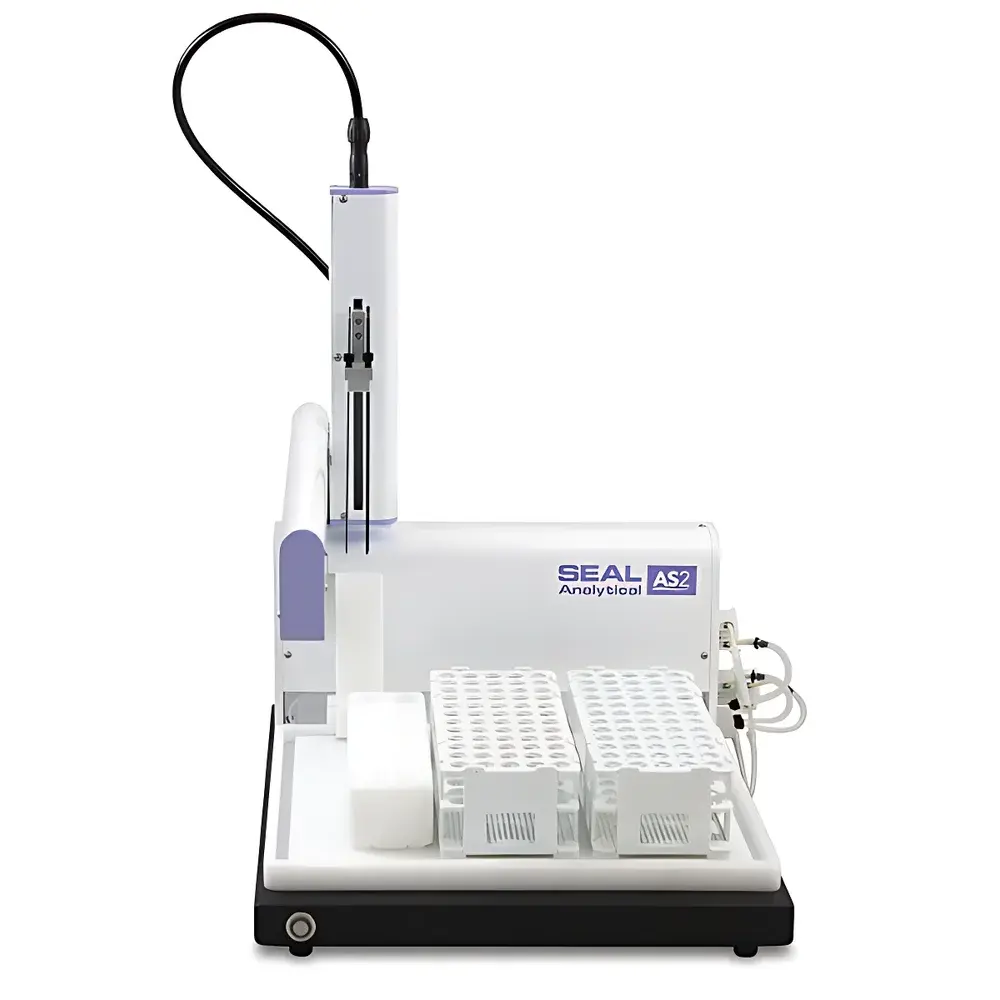
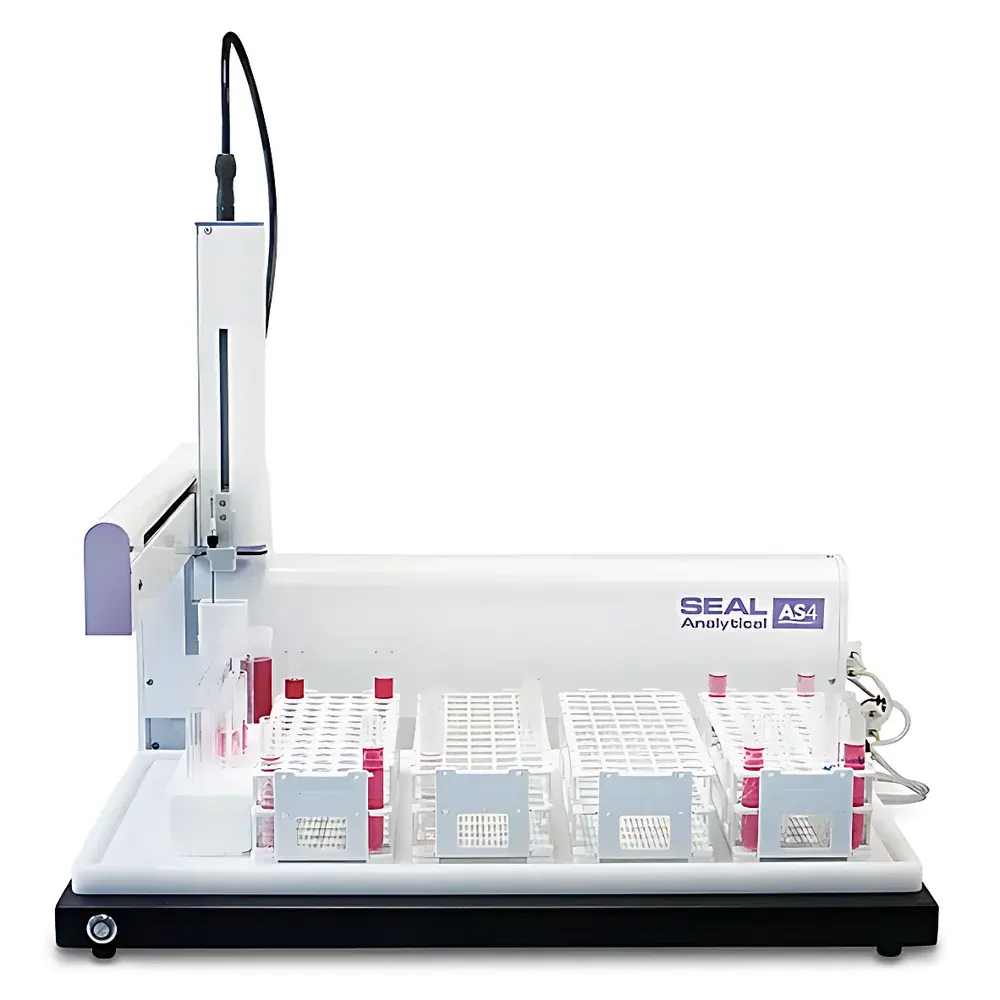
SEAL AS2 Autosampler for Flow Injection and Segmented Flow Analysis Systems
| Brand | SEAL |
|---|---|
| Origin | Netherlands |
| Model | AS2 |
| Sample Capacity | 180 × 0.5–2 mL vials or 120 × 4–10 mL vials |
| Compatible Platforms | SEAL AA500 Continuous Flow Analyzers, SEAL segmented flow analyzers, AACE software |
| Material | Stainless steel & PEEK probe |
Overview
The SEAL AS2 Autosampler is an industrial-grade, random-access liquid handling module engineered specifically for integration with SEAL continuous flow analysis (CFA) and segmented flow analysis (SFA) platforms—including the AA500 series and legacy SEAL instruments. It operates on the principle of precise, pneumatically assisted aspiration and dispensing within a controlled carrier stream, ensuring reproducible segment formation critical to photometric, colorimetric, and enzymatic assays in environmental, food, pharmaceutical, and clinical laboratories. Unlike fixed-sequence samplers, the AS2 employs a motorized carousel and servo-controlled probe arm to access any vial position on-demand—enabling dynamic re-injection, calibration bracketing, and adaptive QC insertion without interrupting assay runs. Its mechanical architecture prioritizes long-term stability: stainless steel structural components and chemically inert PEEK sample probes resist corrosion from acidic, alkaline, or organic matrices, supporting routine operation in EPA Method 300.0, ISO 15681-1, and AOAC-certified workflows.
Key Features
- Random-access sampling across 180 positions (for 0.5–2 mL vials) or 120 positions (for 4–10 mL vials), enabling non-sequential re-analysis and intelligent run reordering
- Consistent inter-sample air segmentation—maintained across all vial positions—to ensure uniform dispersion, mixing efficiency, and baseline stability in flow-through detection cells
- Dual-material probe assembly: 316 stainless steel shaft with PEEK tip for compatibility with aggressive reagents (e.g., HCl, HNO₃, perchloric acid) and high-salinity samples
- Independent 22-position auxiliary rack dedicated to calibration standards, QC materials, blanks, and reagent reservoirs—fully addressable within AACE method definitions
- Programmable aspiration velocity (adjustable per method step) to optimize dwell time, minimize carryover, and accommodate viscous or particulate-laden samples
- USB 2.0 interface for direct communication with AACE software; supports firmware updates, real-time status monitoring, and error logging with timestamped event records
Sample Compatibility & Compliance
The AS2 accommodates standard polypropylene, glass, and screw-cap vials ranging from 0.5 mL microtubes to 10 mL cylindrical containers. Custom racks—including deep-well plates and tapered tube holders—are available under SEAL’s OEM accessories program. All fluidic pathways comply with ISO 8573-1 Class 4 purity requirements for instrument air supply. When operated with AACE software v6.2+, the system supports 21 CFR Part 11 compliance through electronic signatures, role-based access control, and immutable audit trails—including probe wash cycles, vial position logs, and dilution event metadata. It meets GLP/GMP documentation standards for regulated environments performing analyses per US EPA Methods 300.0 (anions), 353.2 (nitrate/nitrite), and ASTM D5179 (phosphate in wastewater).
Software & Data Management
Controlled exclusively via SEAL’s AACE (Automated Analysis Control Environment) software, the AS2 integrates natively into method development, sequence scheduling, and data reduction pipelines. AACE provides full scripting capability for conditional logic (e.g., “re-analyze if CV >5%”, “inject QC after every 10 samples”), automatic dilution mapping when paired with the optional Injector Dilutor 3, and real-time visualization of probe trajectory and vial occupancy. Raw acquisition timestamps are embedded in .csv and .axd output files, preserving traceability from physical vial to final concentration value. Audit logs record operator ID, method name, start/stop times, and hardware fault codes—exportable in PDF or XML for internal QA review or regulatory submission.
Applications
The AS2 serves as the primary sample introduction interface for high-throughput nutrient, metal, and contaminant quantification in accredited laboratories. Typical use cases include: nitrate and nitrite determination in drinking water (EPA 353.2); orthophosphate analysis in surface waters (ISO 15681-1); cyanide speciation in industrial effluents (ISO 6703-1); sulfate measurement in soil extracts (ASTM D5179); and total phosphorus digestion-free assays in beverage QC. Its random-access capability is especially valuable in clinical labs performing batch-adapted hormone panels or in food safety testing where urgent samples must interrupt scheduled runs without compromising calibration integrity.
FAQ
Is the AS2 compatible with non-SEAL analyzers?
Yes—via analog TTL trigger signals and RS-232 command emulation, though full feature parity (e.g., dilutor synchronization, audit logging) requires native AACE integration.
What maintenance intervals are recommended for the PEEK probe?
Visual inspection every 2000 injections; replacement advised after 10,000 cycles or upon observed swelling, discoloration, or reduced seal integrity during aspiration.
Can the AS2 perform internal standard addition?
Not autonomously—but AACE software can coordinate timed injections from the auxiliary rack during sample aspiration, enabling post-dilution spiking protocols.
Does the AS2 support barcoded tube recognition?
No built-in scanner; however, third-party barcode readers may be interfaced via AACE’s external device API for sample ID validation prior to aspiration.
How is carryover mitigated between high-concentration and trace-level samples?
Through configurable multi-stage wash protocols: up to three independent rinse solutions (e.g., deionized water, 10% HNO₃, methanol) with adjustable dwell times and aspiration volumes—validated per CLSI EP26-A guidelines.





