
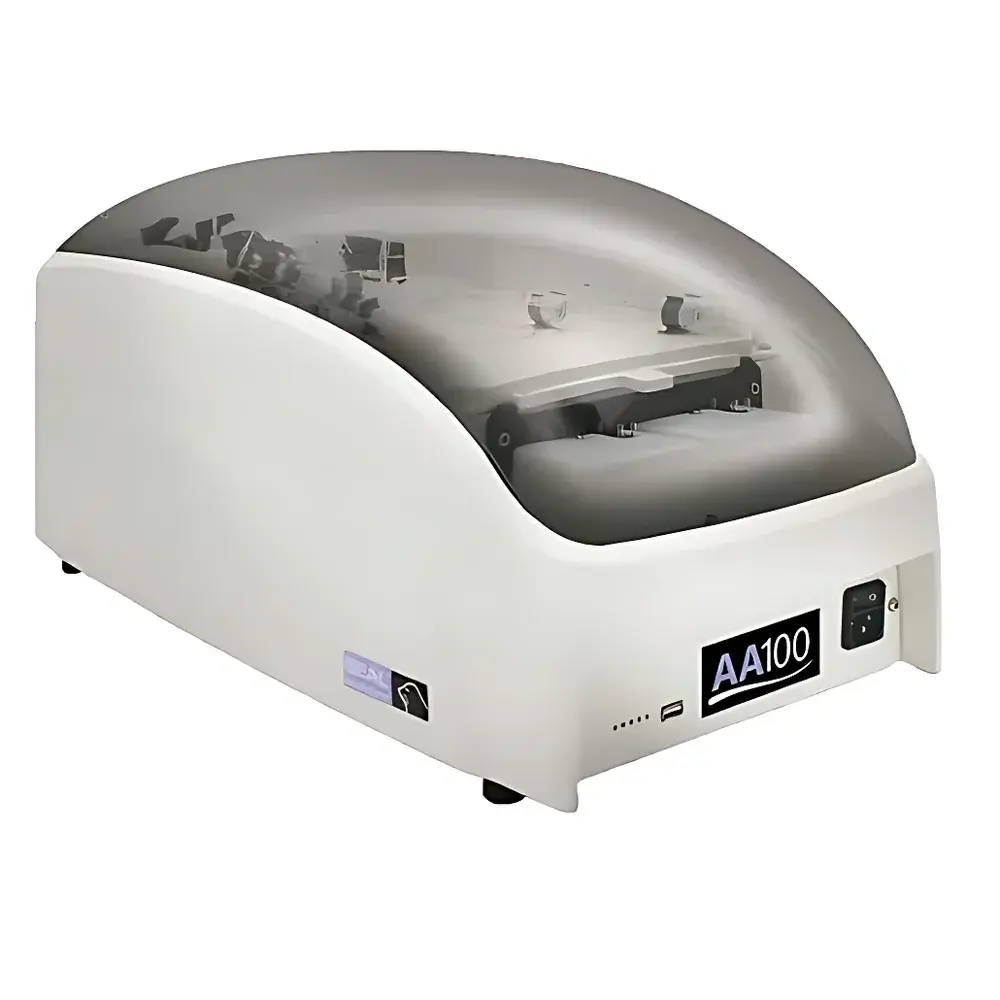
SEAL AA100 Continuous Flow Analyzer
| Brand | SEAL |
|---|---|
| Origin | Germany |
| Model | AA100 |
| Product Type | Continuous Flow Analyzer |
| Wavelength Range | 250–1000 nm |
| Sample Capacity | Configurable (via rotary autosampler) |
| Reagent Positions | Unlimited (modular reagent rack support) |
| Flow Cell Path Length | 10 mm |
| Light Source | High-Stability LED |
Overview
The SEAL AA100 Continuous Flow Analyzer is an engineered solution for high-throughput, reproducible wet-chemistry analysis in environmental, agricultural, and regulatory laboratories. Based on the classical continuous flow analysis (CFA) principle—where sample and reagent streams are continuously propelled by peristaltic pumping, segmented by precisely injected air bubbles, and mixed within chemically inert glass coils—the AA100 delivers robust, interference-resistant quantification of analytes via photometric detection. Unlike segmented flow or flow injection systems, CFA ensures consistent reaction time, complete mixing, and thermal equilibration across all segments, making it especially suitable for colorimetric and enzymatic assays requiring precise incubation control. The AA100 implements this methodology in a compact, integrated architecture where pump, chemistry manifold, detector, and temperature-controlled flow cell reside within a single chassis—minimizing dead volume, reducing carryover risk, and enhancing method transferability.
Key Features
- Integrated modular design: All core components—including multi-speed metal peristaltic pump, glass-based reaction manifold, thermally stabilized 10-mm-pathlength flow cell, and LED-driven digital photometer—are housed in a single, space-efficient unit (W × D × H: 580 × 530 × 420 mm).
- Dual-channel capability: Supports simultaneous analysis of two independent parameters (e.g., nitrate and phosphate) using fully isolated fluidic paths and dedicated optical channels—eliminating cross-talk and enabling parallel method execution.
- High-stability LED photometry: Narrow-band LEDs (250–1000 nm) provide long-term spectral consistency, low heat generation, and minimal drift—critical for compliance with ASTM D3869, ISO 15681-1, and EPA Method 353.2.
- Temperature-controlled reaction zone: Integrated Peltier-heated flow cell maintains ±0.2 °C stability over extended runs, ensuring kinetic consistency for enzyme-based or temperature-sensitive assays (e.g., total Kjeldahl nitrogen hydrolysis).
- Rotary autosampler with live loading: 60-position (expandable) carousel permits unattended operation; samples may be added mid-run without interrupting analysis—supporting GLP-compliant workflow continuity.
Sample Compatibility & Compliance
The AA100 accommodates aqueous liquid matrices including wastewater, surface water, soil extracts, plant digests, and drinking water—without modification to standard configurations. Its glass microfluidic path resists adsorption and corrosion from acidic, alkaline, or chelating reagents (e.g., molybdate for phosphate, sulfanilamide/NEDD for nitrite). The system meets essential regulatory requirements for routine environmental testing: it supports audit-trail-enabled data capture compliant with FDA 21 CFR Part 11 when used with validated AACE software configurations; its photometric performance aligns with ISO/IEC 17025 calibration traceability protocols; and method validation documentation adheres to EPA Contract Lab Program (CLP) reporting standards.
Software & Data Management
Instrument control, sequence definition, real-time monitoring, and quantitative data reduction are managed through AACE Lite—a Windows-based application built on Microsoft .NET Framework. AACE Lite provides role-based user access, electronic signature support, automatic peak integration using first-derivative smoothing, and export to CSV, PDF, or LIMS-compatible XML formats. Raw absorbance traces, calibration curves (linear, quadratic, or cubic), and QC flagging (e.g., blank drift >5%, R² <0.999) are stored with full metadata (operator ID, timestamp, method version, instrument serial number). Audit logs record all parameter changes, calibration events, and report generation actions—enabling full traceability during GMP or ISO 17025 assessments.
Applications
The AA100 is routinely deployed for regulatory-grade determination of nutrients and contaminants in environmental and food safety labs. Validated applications include: ammonium (indophenol blue, ASTM D1426), orthophosphate (molybdenum blue, ISO 6878), nitrate/nitrite (diazotization, EPA 353.2), total nitrogen (persulfate digestion + nitrate reduction), total phosphorus (acid persulfate oxidation), chloride (mercuric thiocyanate), silica (molybdenum yellow), and cyanide (pyridine-barbituric acid). Its dual-channel configuration allows concurrent monitoring of nutrient pairs (e.g., NO₃⁻ + PO₄³⁻ in eutrophication studies) or orthogonal quality indicators (e.g., COD + NH₄⁺ in WWTP influent screening).
FAQ
Does the AA100 require external cooling or compressed air?
No—temperature regulation is self-contained via Peltier elements; air segmentation is generated internally using a precision solenoid valve and regulated lab-grade air or nitrogen.
Can existing CFA methods be migrated to the AA100?
Yes—method parameters (pump speed, coil length, incubation temperature, reagent concentration) are fully configurable; SEAL provides method conversion support and validation templates aligned with ISO 8466-1.
Is the flow cell path length adjustable?
The standard path length is fixed at 10 mm for optimal sensitivity/speed balance; custom 5-mm or 20-mm cells are available as optional accessories for low- or high-absorbance applications.
How is carryover addressed during high-concentration sample analysis?
The system includes programmable post-injection rinse cycles with dual-solvent capability (e.g., deionized water followed by dilute acid), and flow cell flushing is triggered automatically after every 10th sample in high-dynamic-range sequences.
What maintenance intervals are recommended for routine operation?
Peristaltic pump tubing should be replaced every 3 months under continuous use; LED intensity and baseline stability are verified weekly using NIST-traceable neutral density filters; full photometer calibration is performed quarterly per ISO/IEC 17025 requirements.






