
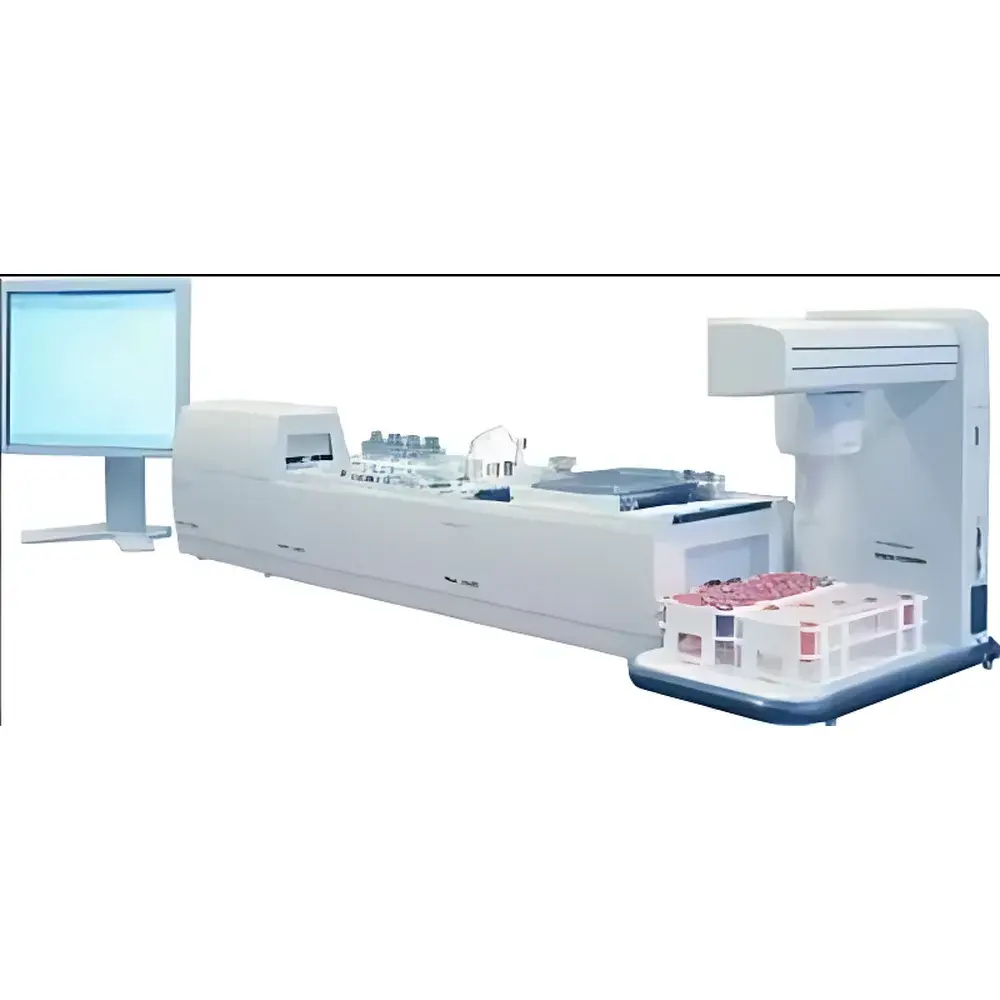
SEAL AA3 Continuous Flow Analyzer
| Brand | SEAL |
|---|---|
| Origin | Germany |
| Manufacturer Type | Authorized Distributor |
| Product Category | Imported |
| Model | AA3 |
| Product Type | Continuous Flow Analyzer |
Overview
The SEAL AA3 Continuous Flow Analyzer (CFA) is a fully automated, high-precision benchtop system engineered for standardized wet-chemical analysis of liquid and digested solid samples. Based on the classical continuous-flow analysis principle first commercialized in 1960 with the Technicon AutoAnalyzer I, the AA3 implements segmented flow methodology—using precisely spaced air bubbles to isolate discrete sample and reagent segments within transparent tubing. This segmentation minimizes axial dispersion, suppresses inter-sample carryover, and ensures uniform reaction residence time across all analytical channels. The system operates under strictly controlled temperature, flow rate, mixing intensity, and reaction dwell time—enabling reproducible photometric, fluorometric, or electrochemical detection with high inter-laboratory comparability. Designed for compliance-driven environments, the AA3 supports method validation per ISO 8466-1, ASTM D1253, USP , and EPA Methods 353.2, 365.2, and 4500-NH₃ F.
Key Features
- Modular architecture: Fully independent, hot-swappable modules—including autosampler (up to 216 positions), peristaltic pump with calibrated rollers, chemiluminescence/photometric detection units, and customizable chemistry manifolds—enable flexible configuration, rapid maintenance, and seamless scalability.
- Air-segmented flow technology: Programmable bubble injection ensures consistent segment length and optimal dispersion control, delivering low carryover (<0.005%) and high signal stability (RSD <0.8% for routine calibrants).
- Dual-range measurement capability: Integrated dual-injection manifold allows simultaneous high- and low-concentration analysis without manual hardware reconfiguration—eliminating dilution errors and extending dynamic range by up to 10⁴-fold.
- Comprehensive method library: Pre-validated, regulatory-compliant protocols for over 700 analytes—including nitrogen species (NO₃⁻, NO₂⁻, NH₄⁺, TN), phosphorus forms (PO₄³⁻, TP), metals (Fe, Mn, Ca, Mg), organic acids (citrate, sorbate), nutrients (vitamins B₁/B₂/B₃, ascorbic acid), and contaminants (cyanide, phenol, sulfide)—all traceable to AOAC, ISO, DIN, and EPA reference methods.
- Robust thermal management: Onboard thermostatic control (±0.1 °C) for digestion, distillation, solvent extraction, and ion exchange modules ensures complete reaction completion and matrix-specific interference suppression.
Sample Compatibility & Compliance
The AA3 accepts aqueous extracts, digests (microwave- or block-digested), filtrates, clarified supernatants, and diluted beverages without pre-treatment. It accommodates sample volumes from 20 µL to 2 mL and handles turbid, particulate-laden, or viscous matrices via integrated inline filtration and auto-dilution. All hardware and software comply with IEC 61000-6-3 (EMC), IEC 61010-1 (safety), and EU RoHS directives. Data integrity meets FDA 21 CFR Part 11 requirements through AACE software’s role-based access control, electronic signatures, full audit trail, and immutable raw data archiving. Method files include embedded calibration curves, QC flagging logic, and automatic recalibration triggers—supporting GLP/GMP laboratory accreditation audits.
Software & Data Management
The AACE (Automated Analytical Control Environment) software runs natively on Windows 10/11 (64-bit) and provides full instrument orchestration—from sequence definition and real-time flow monitoring to result calculation and report generation. Its intuitive workflow interface enables one-click method launch, multi-channel synchronization, and adaptive sampling (e.g., triggered dilution upon out-of-range absorbance). All analytical data—including raw voltage traces, peak integration parameters, baseline correction logs, and QC statistics—are stored in encrypted SQLite databases with configurable backup intervals. Export options include CSV, PDF, XML, and LIMS-ready ASTM E1384-compliant formats. Remote diagnostics and firmware updates are supported via secure TLS-encrypted connections.
Applications
The AA3 delivers validated performance across regulated and research laboratories: environmental labs quantify nitrate and phosphate in wastewater per ISO 11905-1; food safety labs determine sulfites in wine using AOAC 990.22; agricultural testing facilities measure total Kjeldahl nitrogen in soil extracts per ISO 14255; clinical nutrition labs quantify vitamin B₁₂ in fortified dairy using fluorescence detection; and pharmaceutical QC labs verify residual cyanide in active pharmaceutical ingredients per USP . Its modular design supports parallel analysis of multiple parameters (e.g., NH₄⁺ + NO₂⁻ + NO₃⁻ in a single run) while maintaining full traceability to certified reference materials (CRMs) such as NIST SRM 1643e and BAM CRM 129.
FAQ
What distinguishes continuous flow analysis (CFA) from flow injection analysis (FIA)?
CFA relies on air segmentation and fixed residence-time reactors for complete, equilibrium-controlled reactions—ideal for slow kinetics (e.g., colorimetric ammonia determination requiring 10+ min). FIA uses unsegmented flow and short, reproducible dispersion zones for rapid assays (e.g., glucose oxidase reactions), offering higher throughput but lower precision for complex matrices.
Can the AA3 perform online digestion or distillation?
Yes—the system integrates dedicated high-temperature digestion modules (up to 180 °C) and steam distillation manifolds compliant with ISO 5664-1 and AOAC 981.10, enabling direct TN and TKN determination without off-line sample preparation.
Is method validation documentation available for regulatory submissions?
SEAL provides full validation packages—including accuracy, precision, LOD/LOQ, linearity, robustness, and specificity data—for all listed EPA, ISO, and AOAC methods, along with IQ/OQ/PQ protocols and installation qualification checklists.
How does the dual-range module eliminate dilution-related errors?
By routing high- and low-concentration samples through separate, independently calibrated capillary paths—each with optimized flow rates and detector gain settings—the system avoids manual dilution steps, pipetting inaccuracies, and associated uncertainty propagation.
What level of technical support and service coverage is offered outside Germany?
SEAL-certified field service engineers provide on-site installation, preventive maintenance, and method transfer support globally, backed by a 24-month parts-and-labor warranty and optional extended service agreements with SLA-governed response times.
Related Products





