
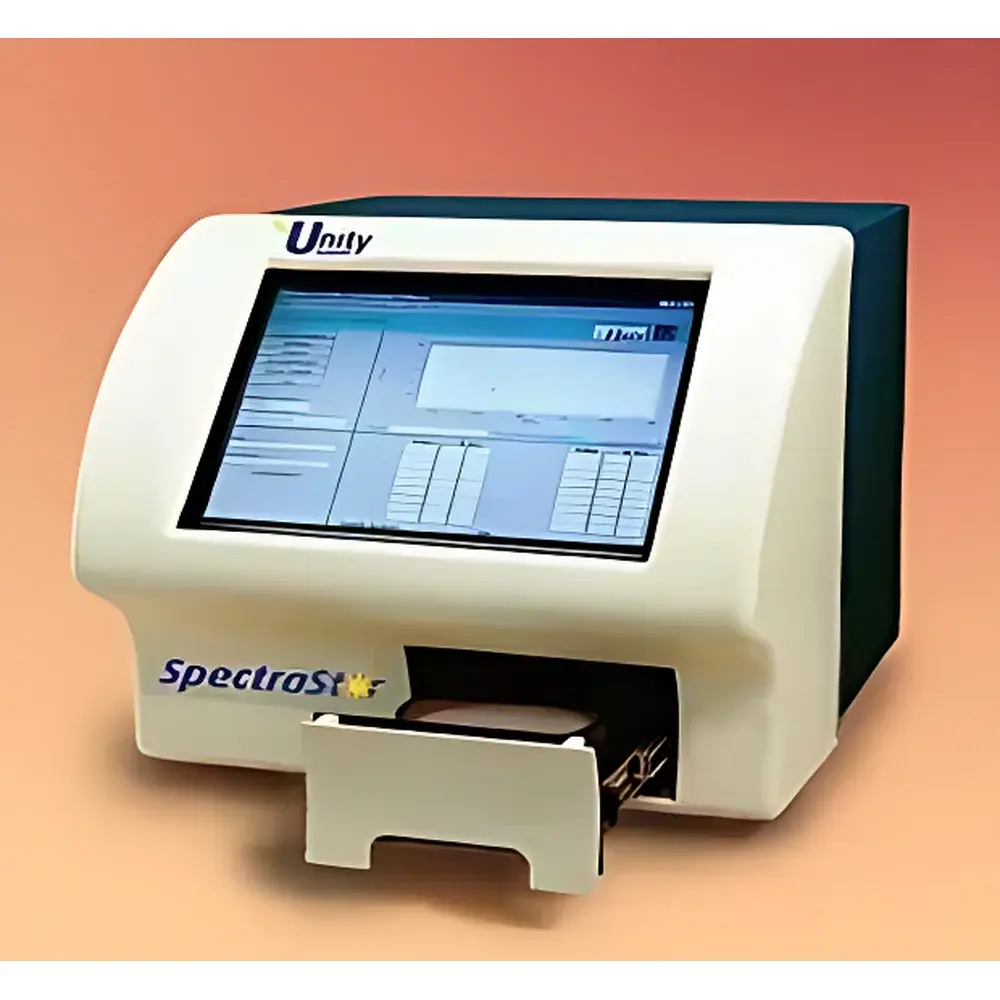
Unity SpectraStar 2400 Near Infrared Spectrometer
| Brand | Unity |
|---|---|
| Origin | USA |
| Model | SpectraStar 2400 |
| Instrument Principle | Grating-scanning NIR spectrometer |
| Wavelength Range | 1200–2400 nm |
| Detector | InGaAs (temperature-stabilized) |
| Scan Time | <8 s per scan |
| Data Interval | 1 nm |
| Photometric Range | 3.0 Abs |
| Photometric Noise | 20 µAU @ 1640 nm |
| Slit Bandwidth | Adjustable (typically 10 nm) |
| Sample Area | 225 mm² |
| Operating System | Windows 2000 |
| Display | 10" VGA touchscreen |
| Power | 100–240 VAC, 50/60 Hz, 75 VA |
| Dimensions (2400D) | 336 × 343 × 406 mm, 15.9 kg |
| Dimensions (2400W) | 330 × 368 × 381 mm, 13.6 kg |
Overview
The Unity SpectraStar 2400 Near Infrared Spectrometer is a high-performance, grating-scanning dispersive NIR instrument engineered for quantitative and qualitative analysis of organic materials across agricultural, food, pharmaceutical, and industrial sectors. It operates on the principle of diffuse reflectance and transmittance spectroscopy in the short-wave near-infrared region (1200–2400 nm), where overtones and combination bands of C–H, N–H, and O–H functional groups yield chemically specific spectral signatures. Unlike filter-based or Fourier-transform NIR systems, the SpectraStar 2400 employs a precision mechanical grating monochromator with real-time wavelength calibration, enabling high-resolution spectral acquisition at 1 nm data intervals. Its InGaAs photodiode array detector is intrinsically temperature-insensitive—eliminating the need for active thermoelectric cooling—and delivers superior signal stability, low drift (10,000:1) compared to legacy PbS-based instruments. The system’s optical architecture is optimized for robustness under variable ambient conditions, supporting routine use in QC laboratories, pilot plants, and production floors without recalibration between shifts.
Key Features
- Grating-scanning optical design with automated wavelength calibration and adjustable slit bandwidth (standard 10 nm), ensuring reproducible spectral resolution across the full 1200–2400 nm range
- InGaAs detector with zero thermal drift and <20 µAU photometric noise at 1640 nm—enabling high-precision quantitation of low-concentration analytes
- Scan time ≤8 seconds per spectrum; total analysis time 10–60 seconds depending on averaging and model complexity
- Integrated industrial-grade PC with Windows 2000 OS, 10-inch VGA resistive touchscreen, dual USB ports, and RJ-45 Ethernet interface
- Two ergonomic sample interfaces: 2400D rotary drawer (for heterogeneous bulk solids such as whole grains, pellets, or blended powders) and 2400W top-access window (for vials, Petri dishes, pouches, or small-volume liquid cells)
- Modular hardware compatibility: accepts standard sample cups from Foss, Bran+Luebbe, and PerkinElmer NIRSystems, facilitating method transfer and cross-platform validation
- Low-maintenance architecture: halogen-tungsten light source rated for 10,000 hours MTBF; sealed optical path minimizes dust ingress and alignment sensitivity
Sample Compatibility & Compliance
The SpectraStar 2400 accommodates a broad spectrum of physical sample forms without chemical reagents or destructive preparation—fully aligning with green analytical chemistry principles (ISO 14001, ASTM E2601). Solid samples include intact seeds, milled cereals, tobacco leaves, tablet granules, polymer pellets, and powdered APIs. Liquids and semi-solids (e.g., syrups, emulsions, slurries) are compatible with the 2400W configuration using quartz cuvettes or disposable plastic containers. All configurations support GLP-compliant operation: audit trails, user access levels, electronic signatures, and data integrity safeguards are implemented via InfoStar software in accordance with FDA 21 CFR Part 11 requirements. Method validation documentation—including linearity (R² ≥0.995), repeatability (RSD <1.5% for major constituents), and intermediate precision—meets ISO 11095 and USP guidelines for NIR calibrations.
Software & Data Management
InfoStar is the embedded, validated application suite for instrument control, spectral acquisition, multivariate modeling (MLR, PLS), and result reporting. It supports full lifecycle management of calibration models—including outlier detection, residual analysis, and bias correction—with built-in tools for spectral preprocessing (Savitzky-Golay smoothing, SNV, derivatives). TranStar utility enables seamless migration of existing NIR calibrations from FOSS, Bran+Luebbe, NIRSystems, Bruker, Buchi, and Nicolet platforms by applying wavelength-matching algorithms and coefficient transformation matrices. All raw spectra and processed results are stored in vendor-neutral .csv and .jdx formats. Remote diagnostics, firmware updates, and performance monitoring are supported via secure TCP/IP connections—enabling proactive service interventions without onsite visits. Data export complies with LIMS integration standards (ASTM E1482, ANSI/NIST ITL 2007).
Applications
The SpectraStar 2400 is routinely deployed in regulated and non-regulated environments for: moisture, protein, fat, starch, and fiber quantification in cereal grains and oilseeds; active pharmaceutical ingredient (API) assay and blend uniformity testing per USP ; real-time monitoring of tablet coating thickness and dissolution profile prediction; compositional analysis of dairy powders, infant formula, and meat products; and rapid identification of adulterants in botanicals and spices. Its accuracy—validated against reference wet-chemistry methods per AOAC 992.15 and ISO 21542—meets or exceeds regulatory thresholds for release testing in GMP manufacturing. Process analytical technology (PAT) implementations leverage its Ethernet connectivity for SPC charting and automated batch release decisions.
FAQ
Does the SpectraStar 2400 require daily wavelength calibration?
No. The instrument performs automatic internal wavelength verification before each scan using a stable reference source, eliminating manual calibration routines.
Can existing PLS models from other NIR instruments be imported directly?
Yes—TranStar software converts coefficients and applies spectral alignment corrections to ensure predictive equivalence without rebuilding models from scratch.
Is the InGaAs detector sensitive to ambient temperature fluctuations?
No. The detector is passively stabilized and exhibits no measurable thermal drift across 15–35°C operating range.
What sample throughput can be expected in a high-volume QC lab?
With automated drawer loading (2400D) and batch scripting in InfoStar, up to 120 samples per hour can be analyzed with full spectral acquisition and model inference.
Does the system support 21 CFR Part 11 compliance out-of-the-box?
Yes—InfoStar includes role-based access control, electronic signatures, audit trail logging, and data encryption features fully documented in the system validation package.
Related Products





