
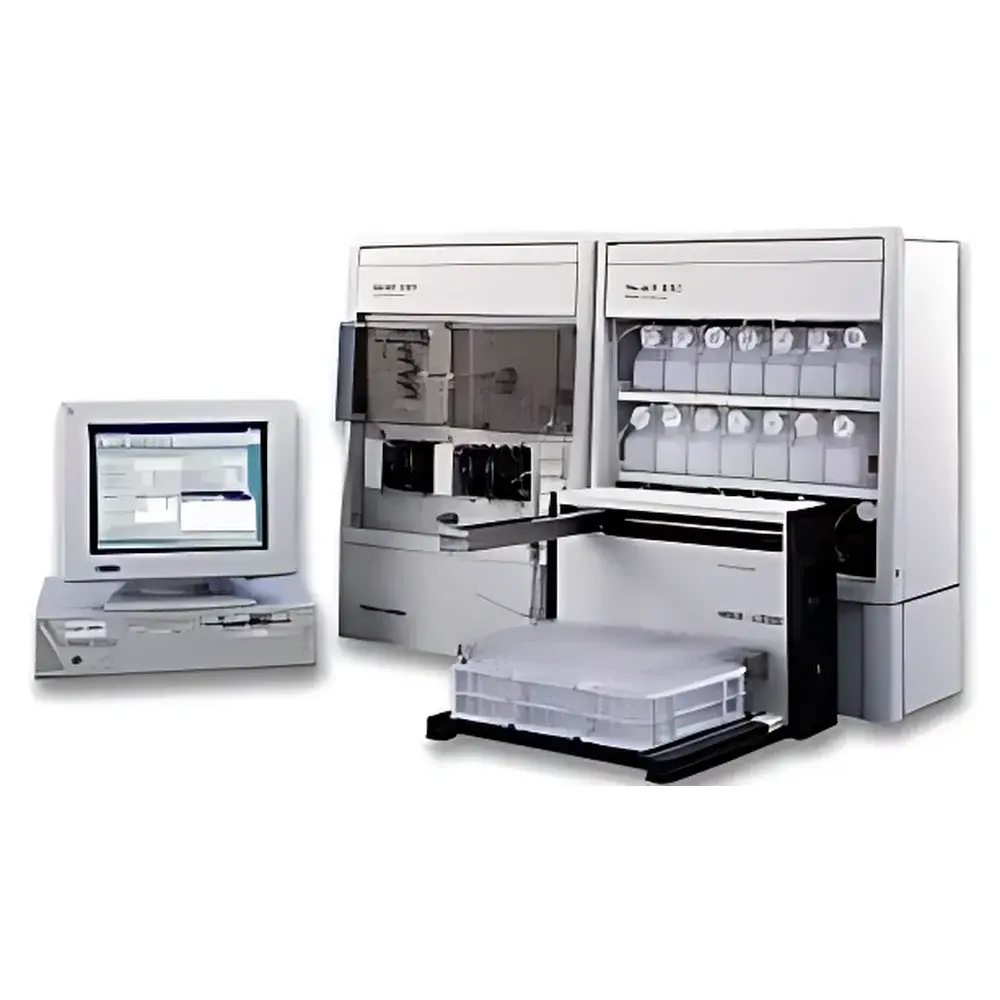
Traccs 2000 Continuous Flow Analyzer
| Origin | Germany |
|---|---|
| Manufacturer Type | Authorized Distributor |
| Origin Category | Imported Instrument |
| Model | Traccs 2000 |
| Pricing | Upon Request |
| Product Type | Continuous Flow Analyzer |
Overview
The Traccs 2000 Continuous Flow Analyzer is a fully automated, benchtop chemical analysis system engineered for high-throughput, reproducible quantification of inorganic and organic analytes in liquid matrices using standardized continuous flow analysis (CFA) methodology. Based on the classical segmented flow principle—where discrete sample zones are separated by air bubbles and propelled through chemically inert PTFE tubing at precisely controlled flow rates—the instrument enables robust colorimetric detection across a broad dynamic range. Unlike discrete or batch analyzers, the Traccs 2000 maintains a steady-state hydrodynamic environment throughout analysis, minimizing carryover and ensuring exceptional inter-run precision. Its compact vertical architecture reduces footprint by over 40% compared to legacy CFA platforms such as the SEAL AA3, while maintaining full method compatibility with internationally validated protocols endorsed by AOAC, EPA, ISO, and ASTM.
Key Features
- Vertical modular design optimized for space-constrained laboratory environments—occupies less than 0.5 m² of benchtop area.
- Micro-bore fluidic pathway (1.0 mm ID PTFE tubing) reduces reagent consumption by up to 60% versus conventional CFA systems without compromising analytical sensitivity or linearity.
- High-speed peristaltic pumping system enabling up to 120 samples per hour per channel, scalable to 16 simultaneous parameters via multi-stream manifold configuration.
- Integrated thermostatic reaction coil heating (37–100 °C, ±0.3 °C stability) and precise optical pathlength control (10–50 mm selectable) ensure method transferability across diverse colorimetric chemistries.
- Automated calibration, blank correction, and drift compensation routines compliant with GLP documentation requirements.
Sample Compatibility & Compliance
The Traccs 2000 accepts aqueous liquid samples—including environmental waters (surface, wastewater, seawater), clinical sera/plasma, food extracts, and agricultural leachates—without requiring pre-filtration for particles <5 µm. It supports direct injection of acidified or buffered matrices within pH 1.5–12.0, with optional inline filtration or dialysis modules available for turbid or particulate-laden samples. All hardware components contacting fluids are chemically resistant (PTFE, PEEK, borosilicate glass), meeting USP Class VI biocompatibility standards. The system is designed to support audit-ready compliance with ISO/IEC 17025:2017, EPA Methods 300.0–350.1, ISO 15681-1/2 (phosphate, nitrate), and AOAC Official Methods of Analysis™, with built-in traceability for reagent lot numbers, operator IDs, and environmental monitoring logs.
Software & Data Management
Controlled via TRAACS Control Suite v4.x—a Windows-based application supporting IEC 62443-aligned user role management (administrator, analyst, reviewer). The software provides real-time flow visualization, automatic peak integration using derivative-based baseline correction, and export of raw absorbance/time data in CSV and ASTM E1382-compliant formats. Audit trail functionality complies with FDA 21 CFR Part 11 requirements, including electronic signatures, immutable event logging, and version-controlled method storage. Data can be integrated into LIMS environments via OPC UA or HL7 interfaces, and QC metrics (e.g., %RSD, recovery spikes, calibration curve R²) are auto-generated per batch in accordance with ISO 8466-1 validation guidelines.
Applications
The Traccs 2000 delivers validated performance in environmental monitoring (NO₃⁻, NO₂⁻, NH₄⁺, PO₄³⁻, SiO₂, Cl⁻, SO₄²⁻, Fe²⁺/Fe³⁺), clinical chemistry (glucose, urea, creatinine, uric acid, total protein), food & beverage quality control (nitrite in cured meats, sulfite in wine, phosphate in dairy), and regulatory testing laboratories performing EPA-certified wastewater compliance reporting. Its ability to run >200 standardized methods—including those published by the International Organization for Vine and Wine (OIV), European Committee for Standardization (CEN), and German DIN standards—ensures method equivalence across global laboratories.
FAQ
Is the Traccs 2000 compatible with existing CFA methods developed for the SEAL AA3?
Yes—hardware geometry, flow dynamics, and detector specifications have been harmonized to enable seamless method porting; minor optimization of pump speed or reaction coil temperature may be required.
What maintenance intervals are recommended for routine operation?
Peristaltic pump tubing should be replaced every 3–6 months depending on usage intensity; optical cells require cleaning after every 500 analyses; annual calibration verification against NIST-traceable standards is advised.
Can the system be configured for unattended overnight operation?
Yes—the instrument supports scheduled start/stop sequences, automatic waste level monitoring, and emergency shutdown triggered by pressure deviation or photometric saturation.
Does the software support multi-user environments with electronic signature capability?
Yes—TRAACS Control Suite implements role-based access control, digital signature capture, and full 21 CFR Part 11 audit trail generation for regulated laboratories.
Are application-specific method packages available for purchase?
Yes—pre-validated method bundles are offered for environmental, clinical, and food sectors, each including SOPs, calibration standards, and QC checklists aligned with ISO/IEC 17025 internal audit criteria.





