
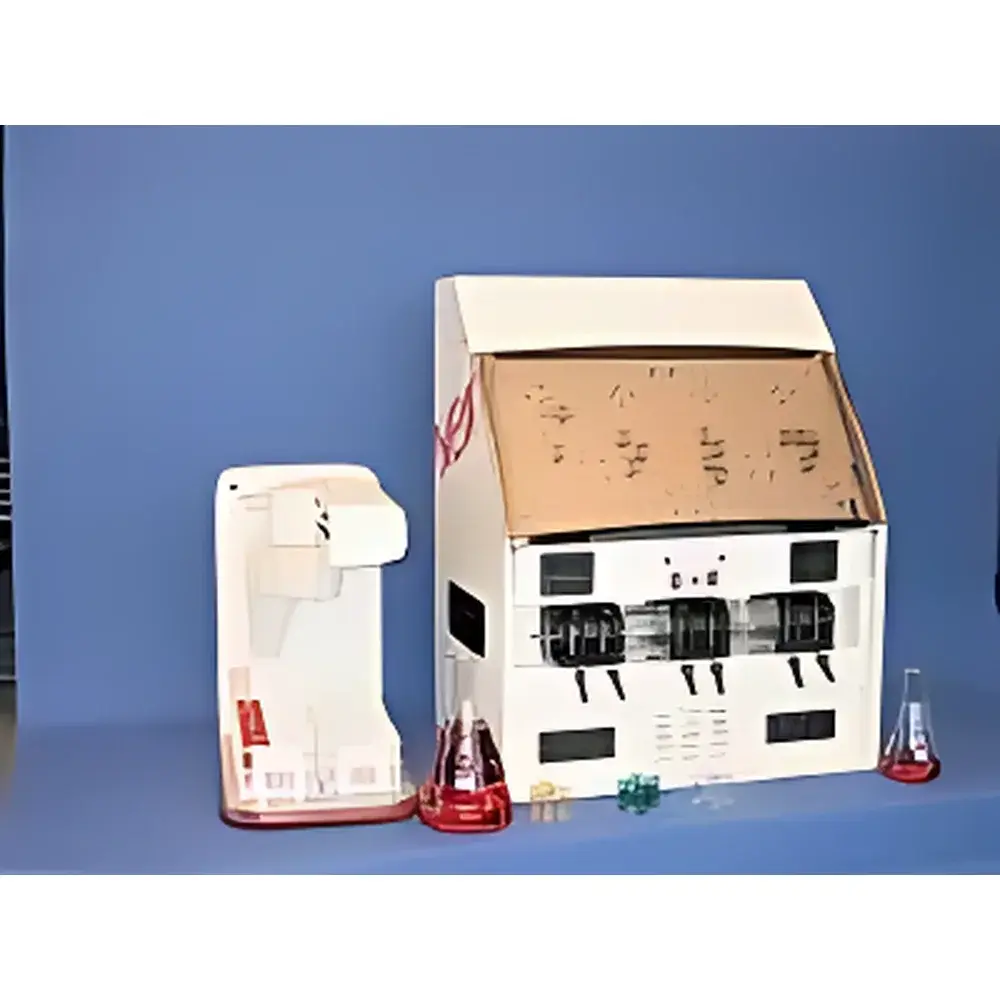
SEAL QuAAtro Continuous Flow Analyzer
| Brand | SEAL |
|---|---|
| Origin | Germany |
| Model | QuAAtro |
| Instrument Type | Laboratory Continuous Flow Analyzer (CFA) |
| Flow Cell ID | 1 mm |
| Temperature Control | Air-Circulating Thermostatic System (37 °C) |
| Max. Sample Throughput | 120 samples/hour |
| Optical Detection | LED-based Photometer with 24-bit ADC |
| Software | AACE v5.x (Automated Analysis Control Environment) |
| Channel Capacity | Up to 4 independent analytical channels per bench |
| Compliance | ISO 15682, EPA Methods 300.0, 353.2, 365.2, ASTM D5179, D5504 |
| Pumping System | Precision Micro-bore Peristaltic Pump with CrMoV Steel Rollers (±8 µm tolerance), Kel-F® fluidic tubing |
Overview
The SEAL QuAAtro Continuous Flow Analyzer is an advanced laboratory-grade automated wet-chemistry platform engineered for high-precision, multi-parameter water quality analysis. Based on the segmented flow analysis (SFA) principle—a robust variant of continuous flow analysis—the QuAAtro introduces microfluidic precision through a 1 mm internal diameter glass coil manifold and digitally controlled air segmentation. This architecture enables reproducible sample–reagent mixing, precise reaction timing, and optimized residence time control across diverse chemical methodologies. Designed in Germany and manufactured to stringent EU quality standards, the system operates under a fully enclosed, thermostatically stabilized environment maintained at 37 °C via a recirculating air system—ensuring thermal homogeneity across all reaction coils, dialysis membranes, heating zones, and the photometric detection cell. Its modular benchtop footprint (56 cm wide) supports up to four parallel analytical channels, allowing simultaneous determination of nutrients (e.g., nitrate, phosphate, silicate), metals (via chelation), and organic parameters (e.g., COD, phenol) without cross-channel interference.
Key Features
- Microbore Flow Architecture: 1 mm ID glass reaction coils paired with Kel-F® fluidic tubing minimize reagent consumption by up to 70% versus conventional CFA systems while maintaining laminar flow integrity and segment stability.
- Intelligent Air Segmentation: Programmable bubble frequency and volume allow method-specific optimization—high-frequency micro-bubbles for rapid colorimetric assays; low-frequency macro-bubbles for extended reaction kinetics (e.g., distillation, high-temperature digestion).
- Thermal Uniformity Engine: A closed-loop air circulation system maintains ±0.2 °C stability across all modules—including photometer, reaction manifold, and detector—critical for assays sensitive to thermal drift (e.g., enzymatic or equilibrium-based methods).
- Multi-Wavelength Flexibility: The LED-based photometer supports user-defined wavelength selection (including dual-wavelength ratioing) without mechanical filter wheels, enabling seamless switching between EPA-compliant methods on a single instrument.
- High-Integrity Peristaltic Drive: Precision-machined CrMoV steel rollers (tolerance ±8 µm), surface-hardened and mounted on micro-needle bearings, deliver exceptional volumetric repeatability (10,000 hours of operation.
- Modular Expandability: One control unit can manage two independent benches (8 total channels); optional auto-dilution valves, leak detection sensors, and fail-safe shutdown protocols enhance unattended operation compliance.
Sample Compatibility & Compliance
The QuAAtro accommodates liquid matrices including freshwater, seawater, wastewater effluents, digested sludge extracts, and acidified metal leachates. Its flow path design meets ISO 15682 requirements for segmented flow instrumentation and is validated against multiple U.S. EPA methods—including Method 300.0 (anions), 353.2 (nitrate/nitrite), 365.2 (phosphate), and ASTM standards D5179 (COD) and D5504 (sulfur compounds). All chemistry modules are constructed from inert materials (borosilicate glass, Kel-F®, PTFE) to prevent analyte adsorption or catalytic degradation. The system supports GLP/GMP workflows through full audit trail logging in AACE software, including user authentication, method versioning, calibration history, and electronic signatures compliant with FDA 21 CFR Part 11 when configured with appropriate IT infrastructure.
Software & Data Management
AACE (Automated Analysis Control Environment) v5.x serves as the integrated control, acquisition, and reporting platform. Its intuitive interface allows method launch with a single “Start” command, eliminating manual sequence programming. Real-time monitoring includes pressure diagnostics, flow rate validation, baseline drift compensation, and automatic blank correction. Data output conforms to LIMS-ready formats (CSV, XML, PDF reports with embedded metadata). Raw absorbance traces, peak integration parameters, and QC flagging (e.g., out-of-range calibrants, carryover alerts) are stored with timestamped, immutable records. Optional database connectivity (ODBC/JDBC) enables direct integration with enterprise laboratory information management systems.
Applications
The QuAAtro is routinely deployed in environmental testing laboratories accredited to ISO/IEC 17025 for regulatory compliance testing. Key applications include nutrient monitoring in watershed studies (NO₃⁻, NO₂⁻, NH₄⁺, PO₄³⁻, SiO₂), trace metal speciation (Fe²⁺/Fe³⁺, Mn²⁺), disinfection by-product precursors (e.g., total organic carbon via persulfate oxidation), and industrial effluent screening (cyanide, phenol, formaldehyde). Its stability and low detection limits support long-term trend analysis required by EU Water Framework Directive (WFD) monitoring programs and U.S. Clean Water Act reporting. Marine research vessels utilize its LED photometer configuration for underway nutrient profiling due to its vibration resistance and low power draw.
FAQ
What sample volume is required per analysis?
Typical injection volumes range from 50–200 µL depending on method dilution factors and sensitivity requirements.
Can the QuAAtro perform distillation or high-temperature digestion onboard?
Yes—dedicated high-temperature reaction modules (up to 120 °C) and integrated steam distillation units are available as factory-installed options.
How often does maintenance require pump tube replacement?
Under standard 8-hour daily operation, pump tubing is rated for ≥90 days before scheduled replacement; extended-life tubing kits are available for high-throughput labs.
Is remote monitoring supported?
AACE software supports secure remote access via TLS-encrypted VNC or web-based dashboard (optional add-on), enabling real-time status review and alarm notification via email/SMS.
Does the system support method validation per ISO 8466-1?
Yes—built-in linearity assessment tools, spike recovery calculation modules, and LOD/LOQ estimation routines align with ISO 8466-1 and EURACHEM guidelines.
Related Products







